H.R. 9499 explained · 119th Congress · Pending in Congress
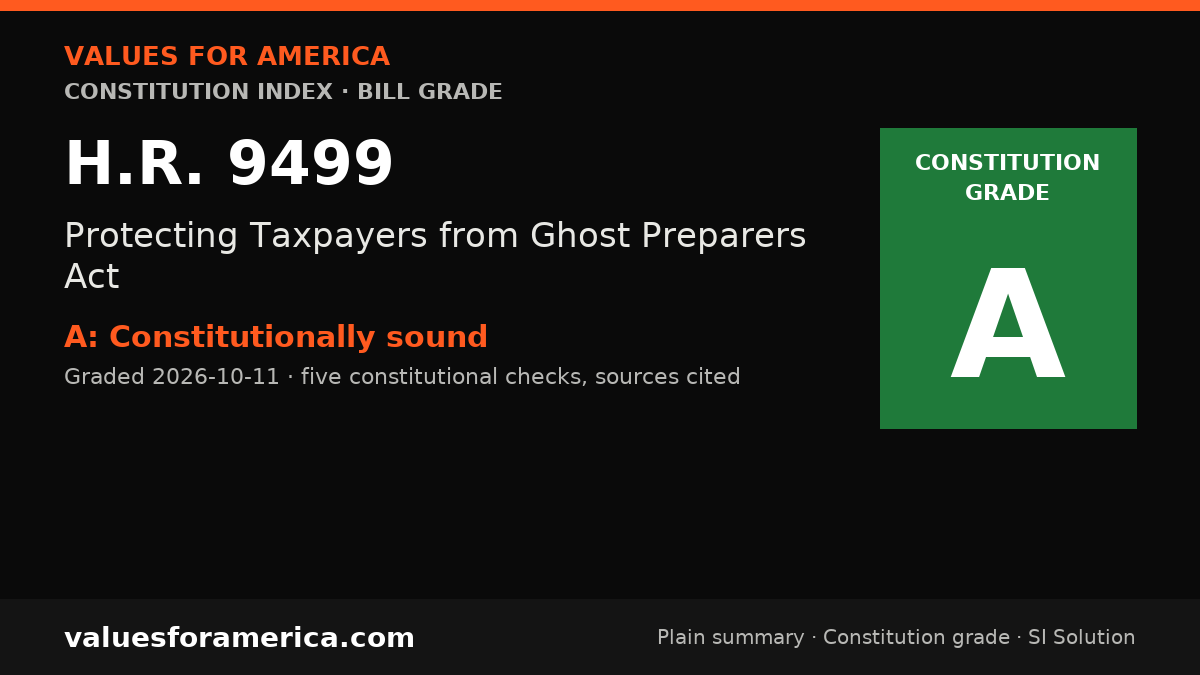
Protecting Taxpayers from Ghost Preparers Act
Cosponsors: none · per Congress.gov, 2026-10-14
Introduced: 2026-06-29
Latest action (2026-09-16): Received in the Senate and Read twice and referred to the Committee on Finance.
What H.R. 9499 does, in plain terms
Protecting Taxpayers from Ghost Preparers Act This bill limits the amount of time the Internal Revenue Service (IRS) has to assess taxes related to fraudulent or false federal tax returns where there is no intent by the taxpayer to evade taxes. As background, the IRS generally has three years from the date that a tax return is filed (statute of limitations) to assess taxes owed by the taxpayer for the tax year. However, if a false or fraudulent tax return is filed with the intent to evade tax (fraud exception), then the IRS may assess taxes at any time. In Murrin v. Commissioner the U.S. Tax Court held (and the U.S. Court of Appeals for the Third Circuit affirmed) that the fraud exception applies when a tax return preparer places false or fraudulent entries on a tax return without the taxpayer’s knowledge. In contrast, the U.S. Court of Federal Claims held in BASR Partnership v. Commissioner that the fraud exception only applies if the taxpayer intends to evade taxes. The bill limits the fraud exception to cases in which the taxpayer intends to evade taxes.
Official summary by the Congressional Research Service, via Congress.gov.
Constitution Index
“VFA Constitution grade”
Constitutionally sound
Graded 2026-10-11
SI-generated grade · five published checks · not individually reviewed by a person · methodology
This bill is fully constitutional. It clarifies the fraud exception to the tax assessment statute of limitations, limiting it to cases where the taxpayer personally intended to evade taxes. This is a proper exercise of Congress's enumerated power to lay and collect taxes, and it protects taxpayers from being penalized for the misconduct of third-party preparers without proof of their own intent. No rights are infringed, individual sovereignty is enhanced, and the action does not consolidate power upward.
-
✓ Passes · Enumerated powers
Congress has explicit constitutional authority under Article I, Section 8, Clause 1 to 'lay and collect Taxes, Duties, Imposts and Excises.' This bill directly regulates the procedural rules for tax assessment, which falls squarely within that enumerated power. The bill does not exceed federal authority; it merely clarifies the scope of an existing tax enforcement mechanism. -
✓ Passes · Bill of Rights
The bill does not infringe any provision of the Bill of Rights. It does not restrict speech, religion, assembly, press, petition (First Amendment), the right to keep and bear arms (Second Amendment), or any other protected right. It does not authorize unreasonable searches or seizures (Fourth Amendment), compel self-incrimination (Fifth Amendment), or impose cruel or unusual punishment (Eighth Ame… -
✓ Passes · Individual sovereignty
The bill enhances individual sovereignty by ensuring that a taxpayer is not penalized for fraudulent conduct they did not intend. It places the burden of proof on the government to show the taxpayer's own intent to evade taxes before the unlimited assessment period applies. This protects individuals from being held responsible for the actions of third-party preparers without their knowledge or con… -
✓ Passes · Decentralization
This bill passes all four questions of the decentralization test. (1) An individual or family cannot handle federal tax assessment rules on their own; this is a matter of federal law. (2) A local community cannot set the statute of limitations for federal taxes. (3) A state cannot set the statute of limitations for federal taxes. (4) The bill does not consolidate decision-making upward; it merely … -
✓ Passes · Due process and takings
The bill strengthens due process by requiring proof of the taxpayer's own intent to evade taxes before the unlimited assessment period applies. This provides fair notice and a clear standard, preventing arbitrary government action. It does not take property without just compensation; it merely limits the time the IRS has to assess taxes, which is a procedural rule, not a taking. The Fifth Amendmen…
Sources: Congress.gov: HR 9499 summary
Report an error in this grade
What should pass
“VFA SI Solution”
No solution yet
A sourced SI draft appears here once it passes automated checks (Constitution citation, source verification, independent SI critic). How publication works.
Related on VFA

For journalists and bloggers
“Embed this grade”
Free to use with the link back. The badge and card update when the grade changes. Embed terms →
