H.R. 9496 explained · 119th Congress · Pending in Congress
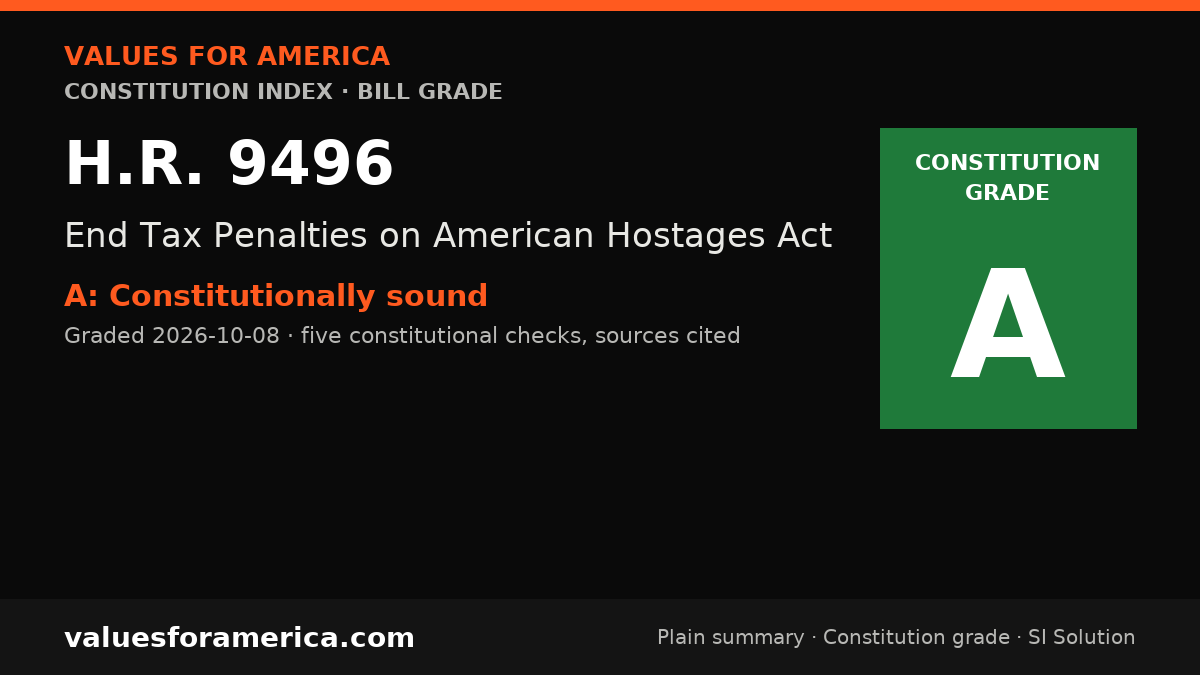
End Tax Penalties on American Hostages Act
Cosponsors: 2 (2 D, 0 R) · per Congress.gov, 2026-10-14
Introduced: 2026-06-29
Latest action (2026-10-14): Message on Senate action sent to the House.
What H.R. 9496 does, in plain terms
End Tax Penalties on American Hostages Act This bill extends certain federal tax deadlines for U.S. nationals who are unlawfully or wrongfully detained abroad or held hostage abroad and their spouses. The bill also allows for an abatement and refund of additional taxes, interest, and penalties assessed to such individuals for failing to meet a federal tax deadline during a period of detention. Specifically, under the bill, the time period during which a U.S. national is unlawfully or wrongfully detained abroad or held hostage abroad is disregarded in determining certain federal tax deadlines, including deadlines for filing a return for and paying federal income, estate, gift, employment, or excise taxes; a tax credit or refund claim; and the determination, assessment, and collection of additional taxes, interest, or penalties. The bill requires the Department of State and the Department of Justice to annually provide the Internal Revenue Service (IRS) with lists to identify U.S. nationals who qualify for an extension. The bill also requires the IRS to (1) abate and refund additional taxes, interest, and penalties assessed for any tax year ending during a period of detention for which an extension of a federal tax deadline is permitted; and (2) establish a program allowing U.S. nationals unlawfully or wrongfully detained abroad or taken hostage abroad (or their spouse or dependent) to claim a refund of additional taxes, interest, and penalties assessed for any tax year ending during a period of detention from 2021 to the bill’s enactment date.
Official summary by the Congressional Research Service, via Congress.gov.
Constitution Index
“VFA Constitution grade”
Constitutionally sound
Graded 2026-10-08
SI-generated grade · five published checks · not individually reviewed by a person · methodology
Constitutional relief measure within Congress's tax power that pauses federal tax deadlines during wrongful detention abroad and refunds penalties, with no rights infringement, no power overreach, and no upward consolidation of authority.
-
✓ Passes · Enumerated powers
Congress has express authority to lay and collect taxes and to set related filing, payment, assessment, and collection rules under Article I, Section 8, Clause 1, as supplemented by the Sixteenth Amendment for income taxes. Tolling deadlines and abating interest and penalties for detained nationals is a direct exercise of that tax power, plus the Necessary and Proper Clause in Article I, Section 8… -
✓ Passes · Bill of Rights
Creates no restriction on speech, religion, press, assembly, arms, search, self-incrimination, trial rights, jury, punishment, or unenumerated rights. It relieves a penalty burden on a defined class under the Sixteenth Amendment tax power and Article I, Section 8, Clause 1, expanding liberty rather than contracting First through Tenth Amendment protections. -
✓ Passes · Individual sovereignty
Removes rather than imposes a burden on person, property, and labor by pausing federal tax deadlines during wrongful detention and refunding penalties assessed while the person could not comply. No speech, belief, movement, or property use is restricted, so no compelling justification is even required beyond the tax authority cited. -
✓ Passes · Decentralization
Federal income, estate, gift, employment, and excise deadlines are exclusively federal under Article I, Section 8, Clause 1 and the Sixteenth Amendment. No individual, county, or state can toll federal statutory deadlines or order IRS abatement. The bill keeps decision-making at the existing federal level and does not move new subject matter upward, so it satisfies the minimum-level test. -
✓ Passes · Due process and takings
Strengthens procedural due process under the Fifth Amendment by disregarding detention periods, requiring State and Justice lists to identify eligible persons, and mandating abatement and refund of interest and penalties that accrued without fair opportunity to file or pay. No property is taken; prior erroneous assessments are returned with a claims program, satisfying just-compensation and non-ar…
Sources: Congress.gov: HR 9496 summary
Report an error in this grade
The Framers
“Founders’ Verdict”
Confidence 1.00
SI-generated · automated checksSI-generated · passed automated checks (Constitution citation, source verification, independent SI critic) · not individually reviewed by a person · Report an error: hello@valuesforamerica.com
Synthesis
Article I, Section 8, Clause 1 governs this proposal because Congress holds express power to lay and collect taxes and to prescribe the time, manner, and remission of that duty. As of the latest action on 2026-10-14, a Message on Senate action was sent to the House, so the bill is pending bicameral action and not enacted law. If enacted, the bill would disregard periods during which a U.S. national is unlawfully or wrongfully detained abroad or held hostage abroad in determining certain federal tax deadlines, including filing, payment, credit or refund claims, and assessment and collection, and would require abatement and refund of additional taxes, interest, and penalties for tax years ending during detention. Qualifying persons would be identified through annual lists from the Department of State and the Department of Justice, with refunds administered by the IRS as the official summary states, including a proposed program for periods from 2021 to enactment. Under Article I, Section 8, Clause 18, Congress may choose means plainly adapted to just execution of its revenue power, including equitable relief and direction to executive officers to execute legislative standards. This would temper rather than enlarge federal power, restoring a captive citizen to the position held absent detention while leaving the general tax power undiminished and preserving uniformity, consistent with due process. The strongest objection is that executive identification of qualifying detention could become arbitrary or unequal. The answer is regularity by general rule: duration bounded by actual detention as certified, administration uniform among taxpayers, executive officers executing rather than making law. Conservatives gain fiscal legitimacy through limited, rule-bound mercy that restrains arbitrary exaction; progressives gain protection for individual liberty and equal relief for citizens deprived of freedom through SI-assisted review of uniform administration.
Congress holds plenary power to lay and collect taxes and to prescribe the time, manner, and remission thereof under Article I, Section 8, Clause 1. The measure suspends deadlines and abates interest and penalties for citizens incapacitated by unlawful detention abroad, an exercise of equitable discretion inherent in revenue administration. Under Article I, Section 8, Clause 18, Congress may enact all laws necessary and proper to execute its fiscal powers, including directing executive departments to identify qualifying persons and directing the Treasury to administer refunds. As explained in …
Congress holds express power to lay and collect taxes and to establish uniform rules respecting their administration, including power to fix, extend, and remit deadlines, interest and penalties as necessary and proper to that power. To exact penalties from a citizen held captive abroad and thus rendered unable to file or pay is contrary to due process and to first principles of just government, which presumes liberty and punishes only willful neglect. This measure relieves such compulsion and restores the citizen to the position he would have held absent unlawful detention, leaving the general…
Madison holds this measure constitutional. The power to lay and collect taxes includes power to prescribe time, manner, and relief for payment, and the Necessary and Proper Clause permits means plainly adapted to just execution of that power. Disregarding periods of wrongful detention abroad and abating interest and penalties does not enlarge federal authority but tempers its exercise with equity toward citizens deprived of liberty. Extended republican government must control faction and protect individual rights while preserving energy in administration; annual lists from the Department of St…
The power to lay and collect taxes is expressly granted to the Congress, and with it is granted the power to prescribe the time, manner, and means of assessment and collection. To postpone a deadline during captivity, and to abate interest and penalties growing from such captivity, is not to relinquish the tax but to regulate its fair exaction. Under McCulloch v. Maryland, where the end is legitimate and within the scope of the Constitution, all means which are appropriate, which are plainly adapted to that end, and which are not prohibited, are constitutional. That a citizen wrongfully detain…
Report an error in this Founders' Verdict
What should pass
“VFA SI Solution”
No solution yet
A sourced SI draft appears here once it passes automated checks (Constitution citation, source verification, independent SI critic). How publication works.
Related on VFA

For journalists and bloggers
“Embed this grade”
Free to use with the link back. The badge and card update when the grade changes. Embed terms →
