H.R. 936 explained · 119th Congress · Pending in Congress
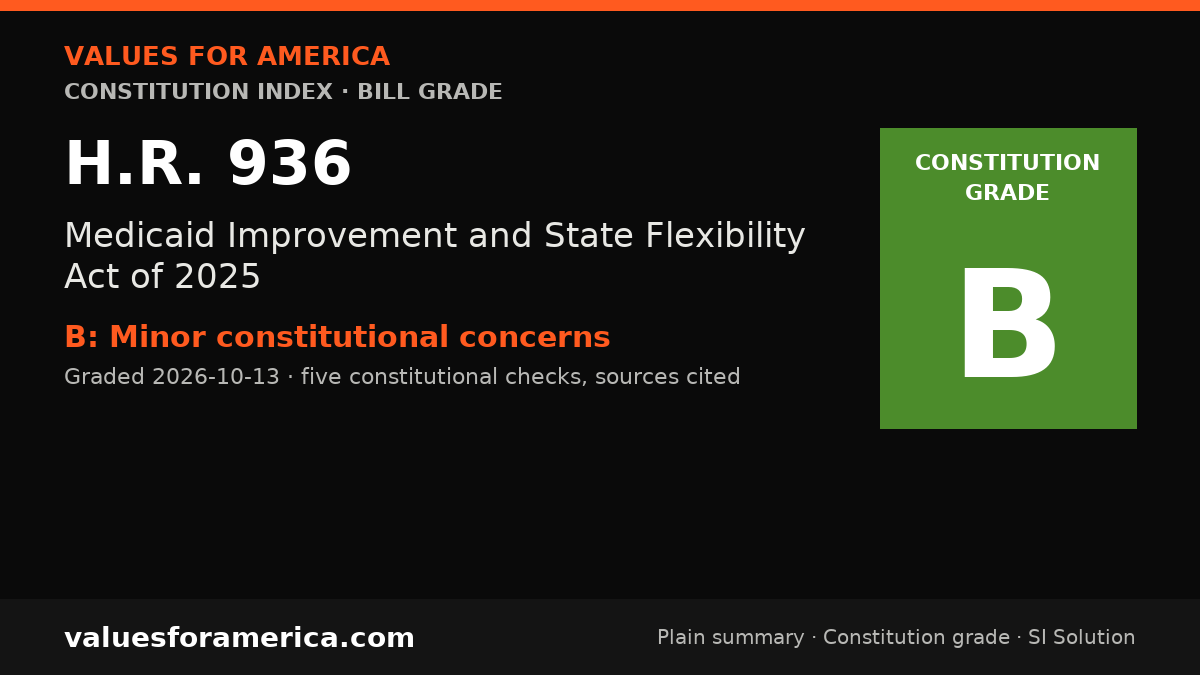
Medicaid Improvement and State Flexibility Act of 2025
Cosponsors: 1 (0 D, 1 R) · per Congress.gov, 2026-10-12
Introduced: 2025-02-04
Latest action (2025-02-04): Referred to the House Committee on Energy and Commerce.
What H.R. 936 does, in plain terms
Medicaid Improvement and State Flexibility Act of 2025 This bill authorizes states to approve their own experimental, pilot, or demonstration project under Medicaid if the project provides certain benefits involving electronic benefits transfer (EBT) cards. (Currently, the Centers for Medicare & Medicaid Services approves Medicaid demonstration projects; such projects are also known as Section 1115 Demonstrations.) Specifically, the project must provide enrollees who elect to participate with an EBT card to purchase primary care services; enrollees must receive any remaining balance at the end of the year in the form of a cash payment and must also obtain catastrophic health insurance.
Official summary by the Congressional Research Service, via Congress.gov.
Constitution Index
“VFA Constitution grade”
Minor constitutional concerns
Graded 2026-10-13
SI-generated grade · five published checks · not individually reviewed by a person · methodology
The bill is mostly sound constitutionally, with minor tensions regarding federalism and the delegation of Medicaid demonstration authority. It does not infringe on individual rights, but it raises questions about the appropriate level of government for approving Medicaid waivers and the potential for state-level consolidation of healthcare decision-making.
-
✓ Passes · Enumerated powers
The bill operates within the federal government's spending power under Article I, Section 8, Clause 1, which authorizes Congress to provide for the general welfare through programs like Medicaid. The bill modifies the administration of Medicaid, a cooperative federal-state program, and does not exceed federal authority. States are given flexibility within the existing Medicaid framework, which is … -
✓ Passes · Bill of Rights
The bill does not infringe on any of the first ten amendments. It does not restrict speech, religion, assembly, press, petition, arms, quartering, search and seizure, self-incrimination, due process, takings, fair trial, jury, cruel and unusual punishment, or unenumerated rights. The EBT card program is voluntary for enrollees, and no rights are abridged. -
✓ Passes · Individual sovereignty
The bill enhances individual choice by allowing enrollees to elect to participate in the EBT card program and to receive a cash balance at year-end. It does not restrict personal autonomy; rather, it provides additional options for healthcare spending. The requirement to obtain catastrophic insurance is a reasonable condition for participation and does not unduly burden individual sovereignty. -
✗ Concern · Decentralization
The bill fails the decentralization test because it consolidates decision-making at the state level rather than allowing individuals or local communities to handle the matter. While states are closer to the people than the federal government, the bill still centralizes authority over Medicaid demonstration projects at the state level, which is higher than the individual or local level. However, it… -
✓ Passes · Due process and takings
The bill does not bypass due process or take property without just compensation. It establishes a voluntary program with clear terms, and enrollees who choose to participate receive benefits. There is no deprivation of life, liberty, or property without due process, and no taking of private property for public use without compensation.
Sources: Congress.gov: HR 936 summary
Report an error in this grade
What should pass
“VFA SI Solution”
No solution yet
A sourced SI draft appears here once it passes automated checks (Constitution citation, source verification, independent SI critic). How publication works.
Related on VFA

For journalists and bloggers
“Embed this grade”
Free to use with the link back. The badge and card update when the grade changes. Embed terms →
