H.R. 9340 explained · 119th Congress · Pending in Congress
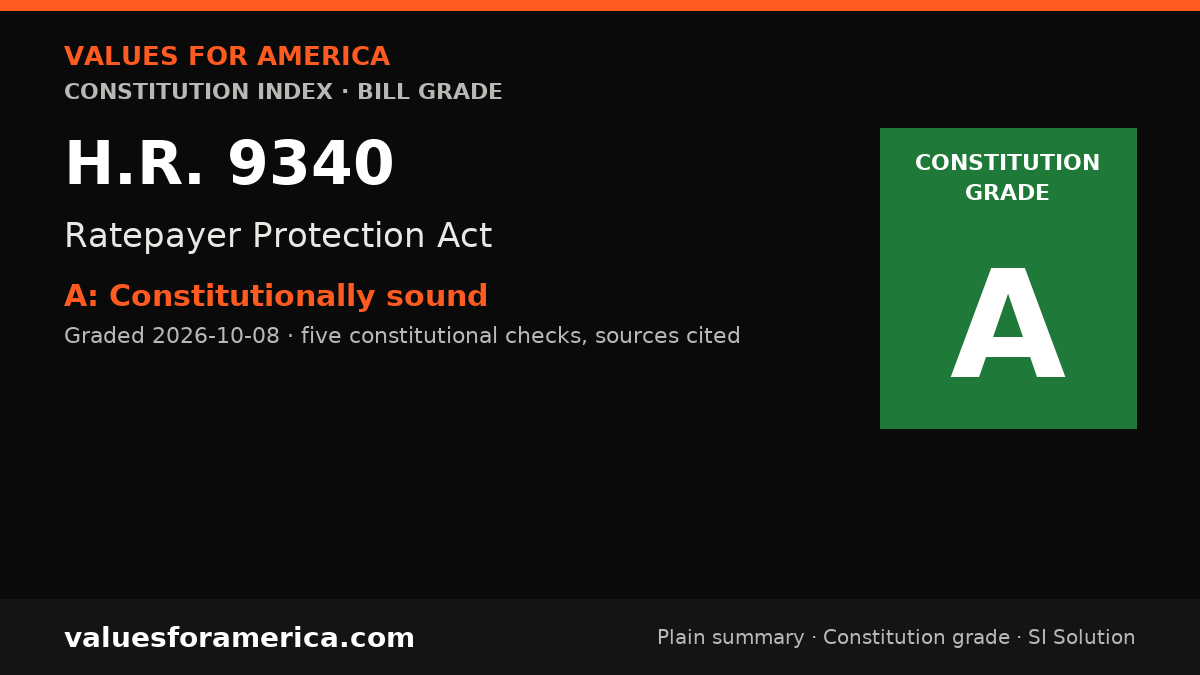
Ratepayer Protection Act
Cosponsors: 42 (7 D, 35 R) · per Congress.gov, 2026-10-14
Introduced: 2026-06-18
Latest action (2026-09-30): Motion to proceed to consideration of measure withdrawn in Senate. (CR S5199)
What H.R. 9340 does, in plain terms
Ratepayer Protection Act The bill requires state utility regulators and nonregulated utilities to consider implementing a standard to hold certain large-load customers responsible for the costs associated with any generation, transmission, or distribution upgrade of electric service necessary to serve such customers. A large-load customer means a non-residential electric consumer that enters, or requests to enter, an agreement concerning the sale of electric energy primarily to operate information technology infrastructure and related systems pertaining to data storage and computational applications and services (e.g., data centers) that have a peak electric demand of 100 megawatts or more at a single site or campus. Specifically, the bill requires states to consider implementing a federal standard for large-load customers. The standard must require rates charged by electric utilities for providing electric service to a large-load customer to be designed to recover from the large-load customer the full, incremental cost of any generation, transmission, or distribution upgrade necessary to serve such customer. This rate must include the costs that would be incurred if the large-load customer terminates an agreement with the electric utility pertaining to the sale of electric energy or otherwise ceases the purchase of energy from the electric utility. Under the standard, an electric utility must require the large-load customer to provide to the utility financial assurances or contributions to cover the cost of any generation, transmission, or distribution upgrade that is necessary to serve the load of a large-load customer before the utility makes any generation, transmission, or distribution upgrade.
Official summary by the Congressional Research Service, via Congress.gov.
Constitution Index
“VFA Constitution grade”
Constitutionally sound
Graded 2026-10-08
SI-generated grade · five published checks · not individually reviewed by a person · methodology
The Ratepayer Protection Act is constitutional. It rests on the Commerce Clause, infringes no Bill of Rights protection, preserves state decision-making by requiring only consideration of a cost-causer-pays standard, and provides no shortcut around due process or takings protections.
-
✓ Passes · Enumerated powers
Congress has explicit authority over interstate electricity markets and sales under Article I, Section 8, Clause 3 (Commerce Clause) and authority to make laws necessary and proper under Article I, Section 8, Clause 18. Data-center loads over 100 megawatts materially affect interstate transmission, generation adequacy, and wholesale rates. The bill uses the established approach of requiring state … -
✓ Passes · Bill of Rights
No First through Tenth Amendment right is infringed. The bill does not restrict speech, religion, press, assembly under the First Amendment, does not implicate arms under the Second Amendment, does not authorize searches or seizures under the Fourth Amendment, and imposes no criminal penalty, compelled testimony, or taking under the Fifth Amendment. It regulates utility cost-allocation procedures … -
✓ Passes · Individual sovereignty
No person is restricted in use of person, property, speech, labor, or belief. The bill imposes consideration of a cost-causer-pays utility rate principle on utilities and large commercial data-center customers; it does not compel any individual to buy, sell, speak, worship, or work, and any burden falls on sophisticated commercial load customers with full ability to negotiate interconnection agree… -
✓ Passes · Decentralization
Individuals and localities cannot handle interstate large-load grid cost-shifting alone, but states can and do retain decision authority here. The bill only requires state regulators to consider a federal cost-allocation standard, not to adopt it, so it does not consolidate decision-making upward beyond the minimum necessary and respects the Tenth Amendment. -
✓ Passes · Due process and takings
No deprivation of life, liberty, or property without due process under the Fifth Amendment and Fourteenth Amendment, Section 1. The bill creates no fine, forfeiture, or physical appropriation, and any future rate or financial-assurance requirement would be set through state regulatory proceedings with notice and hearing. Requiring full incremental-cost recovery from the cost-causing customer preve…
Sources: Congress.gov: HR 9340 summary
Report an error in this grade
What should pass
“VFA SI Solution”
No solution yet
A sourced SI draft appears here once it passes automated checks (Constitution citation, source verification, independent SI critic). How publication works.
Related on VFA

For journalists and bloggers
“Embed this grade”
Free to use with the link back. The badge and card update when the grade changes. Embed terms →
