H.R. 9339 explained · 119th Congress · Pending in Congress
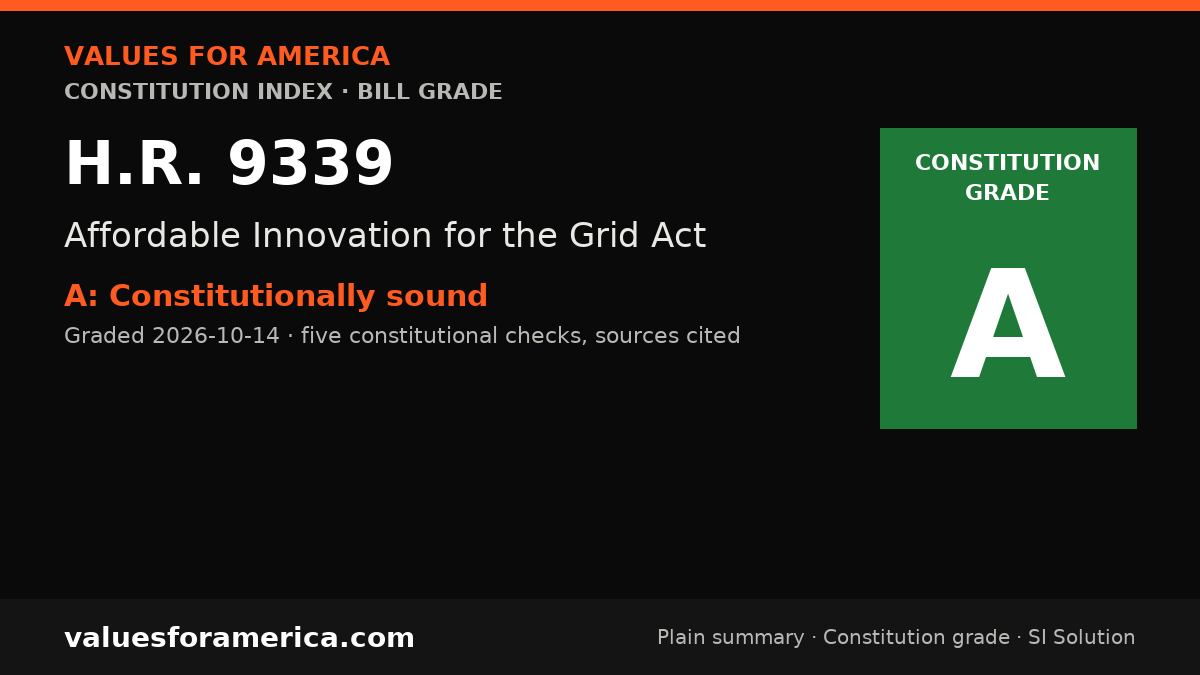
Affordable Innovation for the Grid Act
Cosponsors: 6 (3 D, 3 R) · per Congress.gov, 2026-10-14
Introduced: 2026-06-18
Latest action (2026-09-16): Received in the Senate and Read twice and referred to the Committee on Energy and Natural Resources.
What H.R. 9339 does, in plain terms
Affordable Innovation for the Grid Act This bill directs the Department of Energy to assess and report on the use of artificial intelligence and high-performance computing technologies to enhance the capacity, reliable operation, and operational efficiency of the bulk-power system.
Official summary by the Congressional Research Service, via Congress.gov.
Constitution Index
“VFA Constitution grade”
Constitutionally sound
Graded 2026-10-14
SI-generated grade · five published checks · not individually reviewed by a person · methodology
The bill merely directs the Department of Energy to study and report on the use of certain technologies for the bulk-power system. It does not authorize any enforcement, regulation, or spending beyond what is necessary for a study. The action falls within the federal government's enumerated power over interstate commerce and national defense, does not infringe any constitutional right, and does not centralize decision-making beyond what is necessary for a federal study. The bill is fully consistent with the Constitution.
-
✓ Passes · Enumerated powers
The federal government has authority over the bulk-power system under the Commerce Clause (Article I, Section 8, Clause 3) and the power to provide for the common defense and general welfare (Article I, Section 8, Clause 1). Directing a study and report is a legitimate exercise of these powers, as it is incidental to regulating interstate electricity transmission and ensuring grid reliability. -
✓ Passes · Bill of Rights
The bill imposes no restrictions on speech, religion, press, assembly, petition, arms, quartering, search and seizure, self-incrimination, due process, takings, trial rights, or cruel and unusual punishment. It is a purely informational directive and does not touch any protected activity. -
✓ Passes · Individual sovereignty
The bill does not restrict any individual's use of their person, property, speech, labor, or belief. It merely requires a federal agency to produce a report. No individual is compelled to act or refrain from acting, and no property is taken or regulated. -
✓ Passes · Decentralization
The study concerns the bulk-power system, which is inherently interstate and national in scope. Individual families, local communities, and even states cannot effectively assess the entire national grid. Federal involvement is the minimum necessary to produce a comprehensive report. The bill does not consolidate decision-making upward; it only gathers information. -
✓ Passes · Due process and takings
The bill does not deprive anyone of life, liberty, or property, nor does it take any property. It does not create any adjudicative process or impose any penalty. There is no due process or takings concern.
Sources: Congress.gov: HR 9339 summary
Report an error in this grade
What should pass
“VFA SI Solution”
No solution yet
A sourced SI draft appears here once it passes automated checks (Constitution citation, source verification, independent SI critic). How publication works.
Related on VFA

For journalists and bloggers
“Embed this grade”
Free to use with the link back. The badge and card update when the grade changes. Embed terms →
