H.R. 9331 explained · 119th Congress · Pending in Congress
STOP Payments Fraud Act of 2026
Cosponsors: 3 (2 D, 1 R) · per Congress.gov, 2026-10-14
Introduced: 2026-06-18
Latest action (2026-09-01): Placed on the Union Calendar, Calendar No. 692.
What H.R. 9331 does, in plain terms
Strengthening Transaction Oversight and Preventing Payments Fraud Act of 2026 or the STOP Payments Fraud Act of 2026 This bill establishes additional grounds for banks to pause the processing of deposited checks and wire transfers. Under current law, banks are generally required to make deposited funds available in one to two business days, depending on the type of deposit and with limited exceptions. Under the bill, receiving banks are allowed to delay the processing of checks or wire transfers that they reasonably suspect are fraudulent. The bill allows for an initial hold that is not to exceed 10 days and an extended hold that is not to exceed 45 days. If an account is overdrawn due to a hold on a wire transfer and the depositor did not receive written notice, no overdraft fees may be applied. The bill allows the Federal Reserve Board and the Consumer Financial Protection Bureau (CFPB) to determine when to apply safeguards to accounts determined to be at greater risk of fraud. Such safeguards must not apply for more than 60 days for each occurrence. These changes take effect 60 days after the issuance of implementing rules, which must be issued within one year of the bill's enactment. The bill also requires (1) the board and CFPB to determine whether to remove Treasury checks and cashier’s checks from expedited classification due to material losses from fraud, and (2) the Government Accountability Office to report on issues relating to the availability of funds and fraud protection.
Official summary by the Congressional Research Service, via Congress.gov.
Constitution Index
“VFA Constitution grade”
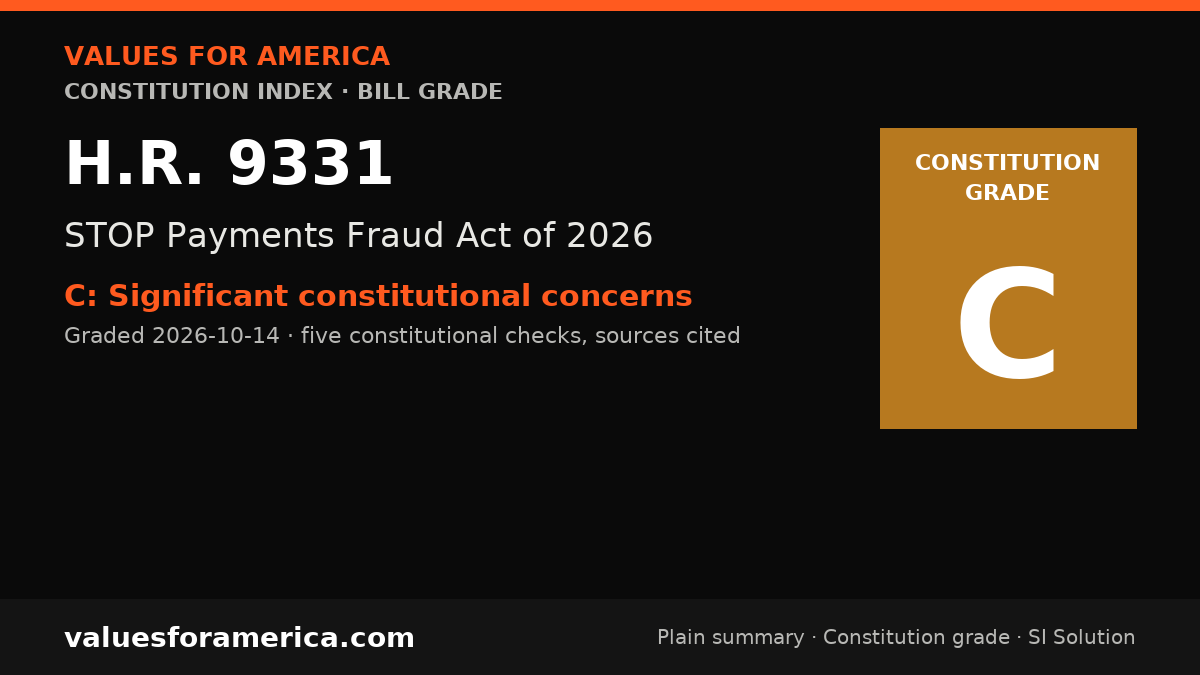
Significant constitutional concerns
Graded 2026-10-14
SI-generated grade · five published checks · not individually reviewed by a person · methodology
The STOP Payments Fraud Act of 2026 raises significant constitutional concerns by authorizing federal agencies to impose discretionary holds on deposited funds, potentially infringing on property rights and due process, while also expanding federal authority over banking practices beyond clear enumerated powers. The bill's delegation of rulemaking authority to the Federal Reserve and CFPB, without clear standards, further compounds these issues. Although the bill aims to combat fraud, its mechanisms lack sufficient constitutional safeguards.
-
✗ Concern · Enumerated powers
The federal government's authority over banking and commerce derives from Article I, Section 8, Clause 3 (the Commerce Clause) and the Necessary and Proper Clause (Article I, Section 8, Clause 18). However, this bill goes beyond regulating interstate commerce by allowing federal agencies to impose discretionary holds on individual bank deposits, which touches on property rights traditionally reser… -
✗ Concern · Bill of Rights
The bill's provisions allowing banks to hold deposited funds for up to 45 days without a judicial determination implicate the Fifth Amendment's Due Process Clause, which protects against arbitrary deprivation of property. While the bill provides for notice in some cases, it does not guarantee a prompt hearing or an opportunity to contest the hold, potentially violating procedural due process. Addi… -
✗ Concern · Individual sovereignty
The bill restricts individuals' control over their own property—specifically, their deposited funds—by allowing banks to freeze access for extended periods based on suspicion of fraud. This is a significant restriction on individual sovereignty, as it limits the ability to use one's own money without a compelling justification. The government has a legitimate interest in preventing fraud, but the … -
✗ Concern · Decentralization
The bill consolidates decision-making at the federal level by granting the Federal Reserve and CFPB authority to determine when and how to apply safeguards, rather than allowing states or local communities to address fraud prevention. While banking regulation is often a federal matter, the bill's specific provisions could be handled at the state level, as states already regulate banking and consum… -
✗ Concern · Due process and takings
The bill's allowance for holds on deposited funds without a prompt judicial or administrative hearing raises serious due process concerns under the Fifth Amendment. The Supreme Court has held that the government must provide notice and an opportunity to be heard before depriving an individual of property (e.g., Fuentes v. Shevin, 1972). The bill's provisions for written notice in some cases are in…
Sources: Congress.gov: HR 9331 summary
Report an error in this grade
What should pass
“VFA SI Solution”
No solution yet
A sourced SI draft appears here once it passes automated checks (Constitution citation, source verification, independent SI critic). How publication works.
Related on VFA

For journalists and bloggers
“Embed this grade”
Free to use with the link back. The badge and card update when the grade changes. Embed terms →
