H.R. 9330 explained · 119th Congress · Pending in Congress
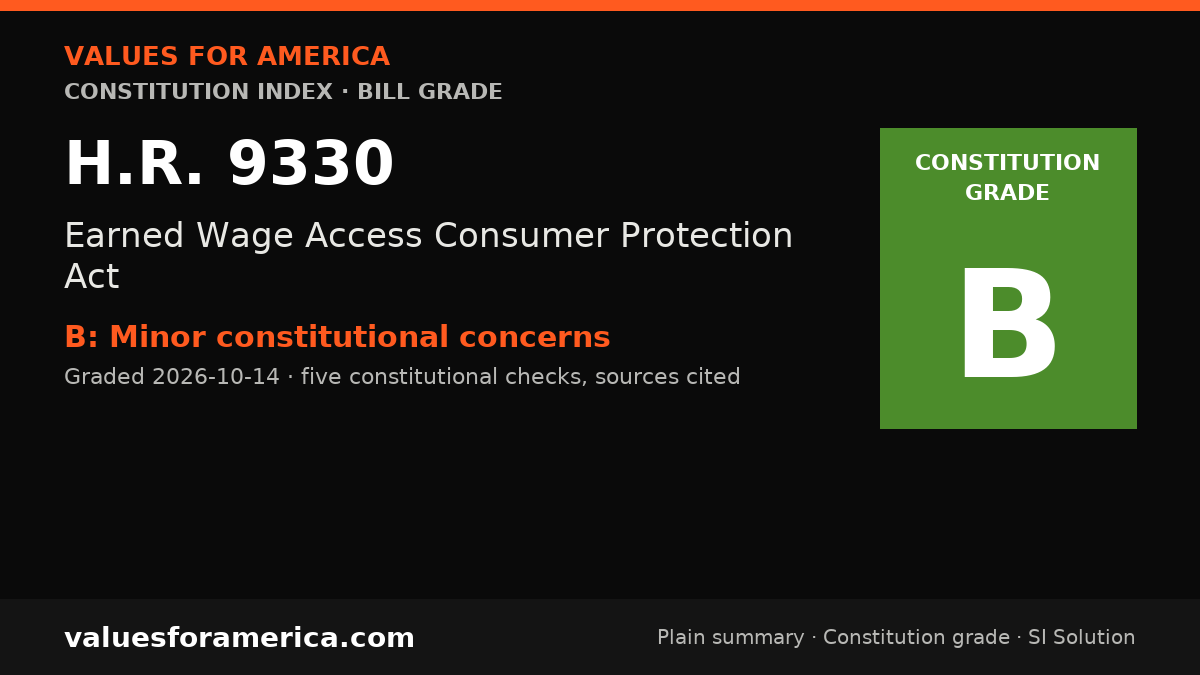
Earned Wage Access Consumer Protection Act
Cosponsors: none · per Congress.gov, 2026-10-14
Introduced: 2026-06-18
Latest action (2026-09-01): Placed on the Union Calendar, Calendar No. 690.
What H.R. 9330 does, in plain terms
Earned Wage Access Consumer Protection Act This bill addresses the regulation of earned wage access products. Earned wage access products provide consumers with access to their earned wages before their scheduled pay day. The bill specifies that earned wage access products are not subject to regulation under the Truth in Lending Act (TILA). TILA requires consumer credit products to disclose borrowing costs, finance charges, and the total cost of the loan. Under the bill, providers of earned wage access products must provide an alternative no-cost option for receiving earned wages if the provider offers an option to receive earned wages for a fee; are prohibited from bringing civil suits or from pursuing collection to compel repayment, except in cases of fraud; and must reimburse the consumer for overdraft fees or penalties imposed on a consumer by their depository institution if incurred because of an error by the provider. Providers must inform consumers of their rights under an agreement for an earned wage access product and disclose all associated fees before the consumer enters into an agreement. Providers must also inform consumers how to obtain earned wages without paying a fee or tip in a clear and conspicuous manner. Providers are prohibited from sharing fees or tips with the consumer’s employer. The bill also limits the form of payment providers may accept from consumers and limits certain additional fees for failure to pay. A provider may not set a default tip at an amount greater than $0 for such services.
Official summary by the Congressional Research Service, via Congress.gov.
Constitution Index
“VFA Constitution grade”
Minor constitutional concerns
Graded 2026-10-14
SI-generated grade · five published checks · not individually reviewed by a person · methodology
The Earned Wage Access Consumer Protection Act is mostly sound but has minor constitutional tensions. It operates within Congress's enumerated commerce power, does not directly infringe the Bill of Rights, and preserves individual sovereignty by requiring a no-cost option. However, it preempts state consumer protection laws (like state TILA equivalents) without clear necessity, raising minor federalism concerns under the Tenth Amendment. The bill also imposes disclosure and fee restrictions that, while reasonable, could be seen as a modest consolidation of regulatory authority at the federal level.
-
✓ Passes · Enumerated powers
Congress has authority under Article I, Section 8, Clause 3 (Commerce Clause) to regulate earned wage access products because these products involve interstate financial transactions and affect the national credit market. The bill's provisions—disclosure requirements, fee limits, and prohibitions on collection—are rationally related to regulating interstate commerce in financial services. -
✓ Passes · Bill of Rights
The bill does not infringe any of the first ten amendments. It imposes no restrictions on speech, religion, assembly, press, petition, arms, quartering, search and seizure, self-incrimination, due process, takings, trial rights, or cruel and unusual punishment. The disclosure requirements are commercial speech regulations that are permissible under the First Amendment because they are content-neut… -
✓ Passes · Individual sovereignty
The bill enhances individual sovereignty by requiring providers to offer a no-cost option for accessing earned wages, ensuring that consumers are not forced to pay fees or tips. The prohibition on default tips greater than $0 protects consumers from coercive defaults. The ban on civil suits for repayment (except fraud) prevents wage garnishment and preserves the individual's control over their own… -
✗ Concern · Decentralization
The bill fails two of the four decentralization questions. While an individual could not handle this alone (requires provider regulation), and a local community could not effectively regulate a national market, states could handle this through their own consumer protection laws. The bill preempts state TILA-like regulation, consolidating authority at the federal level without a compelling intersta… -
✓ Passes · Due process and takings
The bill does not bypass due process or take property without just compensation. It requires clear disclosure of fees and rights before agreement, ensuring procedural due process. The prohibition on civil suits for repayment (except fraud) does not deprive providers of property without due process—it merely limits the remedy, which is a legitimate exercise of consumer protection. No property is ta…
Sources: Congress.gov: HR 9330 summary
Report an error in this grade
What should pass
“VFA SI Solution”
No solution yet
A sourced SI draft appears here once it passes automated checks (Constitution citation, source verification, independent SI critic). How publication works.
Related on VFA

For journalists and bloggers
“Embed this grade”
Free to use with the link back. The badge and card update when the grade changes. Embed terms →
