H.R. 9310 explained · 119th Congress · Pending in Congress
Department of Homeland Security Appropriations Act, 2027
Cosponsors: none · per Congress.gov, 2026-10-14
Introduced: 2026-06-12
Latest action (2026-06-12): Placed on the Union Calendar, Calendar No. 605.
What H.R. 9310 does, in plain terms
Department of Homeland Security Appropriations Act, 2027 This bill provides FY2027 appropriations for the Department of Homeland Security (DHS). Specifically, the bill provides appropriations to DHS for Departmental Management, Intelligence, Situational Awareness, and Oversight, including the Office of the Secretary and Executive Management; the Management Directorate; Intelligence, Analysis, and Situational Awareness; and the Office of Inspector General. In addition, the bill provides appropriations for Security, Enforcement, and Investigations, including U.S. Customs and Border Protection, U.S. Immigration and Customs Enforcement, the Transportation Security Administration, the U.S. Coast Guard, and the U.S. Secret Service. The bill provides appropriations for Protection, Preparedness, Response, and Recovery, including the Cybersecurity and Infrastructure Security Agency, and the Federal Emergency Management Agency (FEMA). The bill provides appropriations for Research, Development, Training, and Services, including U.S. Citizenship and Immigration Services, the Federal Law Enforcement Training Centers, and the Science and Technology Directorate. The bill also sets forth requirements and restrictions for using funds provided by this and other appropriations acts.
Official summary by the Congressional Research Service, via Congress.gov.
Constitution Index
“VFA Constitution grade”
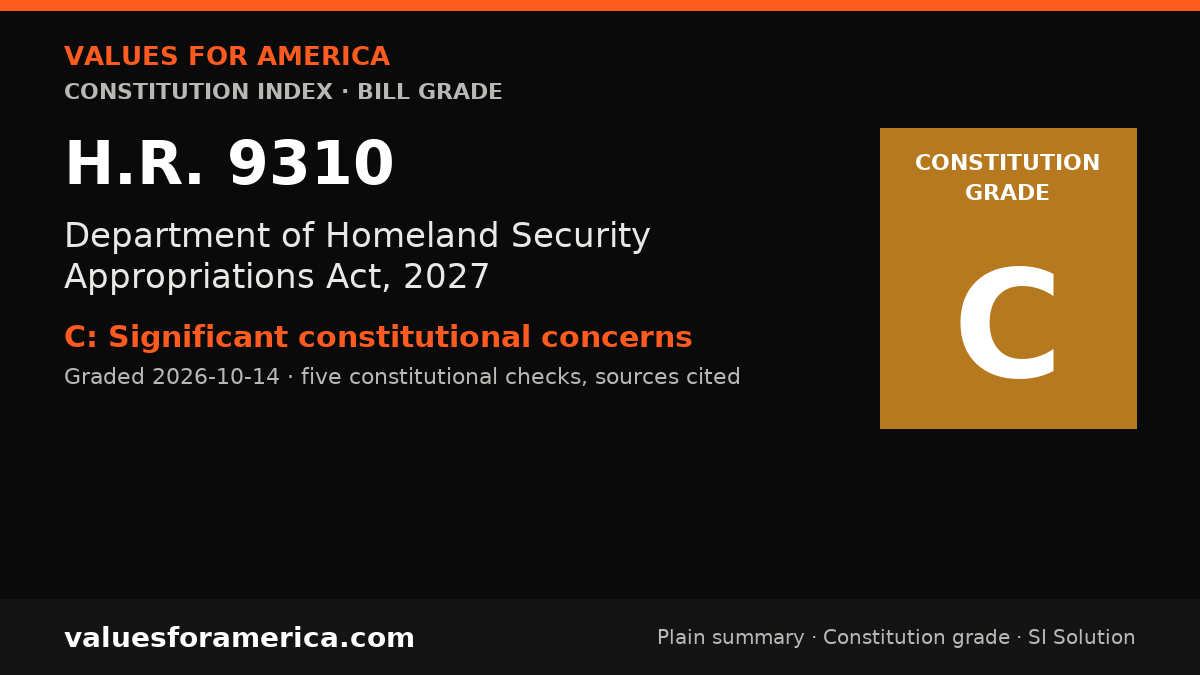
Significant constitutional concerns
Graded 2026-10-14
SI-generated grade · five published checks · not individually reviewed by a person · methodology
The bill is a routine appropriations measure that funds the Department of Homeland Security, an executive department established by Congress under its Article I spending powers. However, the bill's broad funding for intelligence, surveillance, and enforcement activities raises significant constitutional concerns, particularly regarding the Fourth Amendment and the principle of decentralization. The bill does not itself authorize specific surveillance or enforcement actions, but it provides the financial means for activities that could infringe on individual rights if not carefully constrained. The grade reflects the need for structural safeguards to ensure that funded activities comply with constitutional limits.
-
✓ Passes · Enumerated powers
Congress has the power to appropriate funds under Article I, Section 8, Clause 1 (the Spending Clause), which grants Congress the power to lay and collect taxes to provide for the common defense and general welfare. The Department of Homeland Security was created by Congress under its Article I powers, and appropriating funds for its operations is a legitimate exercise of the spending power. The b… -
✗ Concern · Bill of Rights
The bill funds the Intelligence, Analysis, and Situational Awareness office and other DHS components that conduct surveillance and data collection. While the bill itself does not authorize specific searches or seizures, it provides the financial resources for activities that could violate the Fourth Amendment's protection against unreasonable searches and seizures if not conducted with proper warr… -
✗ Concern · Individual sovereignty
The bill funds enforcement and intelligence activities that could restrict individual liberty, such as immigration enforcement, surveillance, and cybersecurity monitoring. While the government has a compelling interest in national security, the bill does not include provisions to ensure that these activities respect individual sovereignty, such as requiring probable cause for surveillance or limit… -
✗ Concern · Decentralization
The bill consolidates significant decision-making and funding at the federal level for functions that could be handled by states or local communities. For example, immigration enforcement and border security are areas where states have historically played a role, and the federal government's dominance in these areas may not be the minimum necessary. The bill fails the decentralization test because… -
✓ Passes · Due process and takings
The bill is an appropriations measure and does not itself take property or deprive individuals of due process. However, the funded activities, such as immigration enforcement and intelligence gathering, could lead to due process violations if individuals are detained or deprived of rights without fair procedures. The bill does not include provisions that would bypass due process, but it also does …
Sources: Congress.gov: HR 9310 summary
Report an error in this grade
The Framers
“Founders’ Verdict”
Confidence 0.75
Archived SI output (machine-generated)No editorial review recorded. This historical SI verdict was machine-generated by software and predates the review desk; check it against the official bill text.
Synthesis
The bill is constitutional only if its appropriations are strictly limited to purposes enumerated in the Constitution, such as common defense, regulation of commerce with foreign nations, naturalization, and suppressing insurrections, and do not fund activities reserved to the states under the Tenth Amendment or infringe upon individual rights.
This bill appropriates funds for the Department of Homeland Security, which is a proper exercise of the power of Congress under Article I, Section 8, Clause 1 to provide for the common defense and general welfare. However, the Constitution requires that all appropriations be made by law and that the funds be drawn from the Treasury only in consequence of such appropriations (Article I, Section 9, Clause 7). The expediency and necessity of such an appropriation is a question of legislative judgment, not constitutional law, provided the object falls within the enumerated powers. I must condition…
The Constitution vests in Congress the power to provide for the common defense and to appropriate funds for the general welfare, but only for purposes enumerated in Article I, Section 8. A Department of Homeland Security, if it exercises powers not delegated to the United States, would encroach upon the reserved powers of the states and the people under the Tenth Amendment. The bill is constitutional only if its appropriations are strictly limited to the enumerated powers—such as regulating commerce with foreign nations, establishing uniform rules of naturalization, and suppressing insurrectio…
The proposed appropriations for the Department of Homeland Security must be examined under the constitutional principle that all federal expenditures be for purposes enumerated in the Constitution. The power of the purse is vested in Congress (Article I, Section 9, Clause 7), but the objects of spending are limited to those powers delegated to the federal government. If the appropriations are strictly for the common defense and general welfare as defined by enumerated powers—such as regulating commerce with foreign nations and providing for the common defense (Article I, Section 8, Clauses 1, …
This bill, being an appropriations measure for the Department of Homeland Security, falls within the clear authority of Congress under Article I, Section 8, Clause 1 to lay and collect Taxes, Duties, Imposts and Excises, to pay the Debts and provide for the common Defence and general Welfare of the United States. Moreover, Congress possesses the power under the Necessary and Proper Clause (Article I, Section 8, Clause 18) to enact laws that are appropriate and plainly adapted to the execution of any power vested in the Government, including the appropriations power. In McCulloch v. Maryland (1…
Report an error in this Founders' Verdict
What should pass
“VFA SI Solution”
Archived SI output (machine-generated) · No editorial review recorded
This historical draft has no editorial review time on record. Check its claims against the original bill and current law.
Department of Homeland Security Appropriations Act, 2027 – Constitutional and Fiscal Responsibility Version
Generated by VFA SI Solutions
To provide funding for the Department of Homeland Security for fiscal year 2027, enabling it to carry out its statutory missions including border security, immigration enforcement, cybersecurity, disaster response, and counterterrorism.
Bipartisan rationale: Honors Democratic priorities by maintaining funding for disaster response, cybersecurity, and immigration enforcement with robust oversight and due process protections. Honors Republican priorities by capping spending growth, requiring sunset of new programs, and ensuring fiscal accountability through audits and withholding of funds.
Article I, Section 8, Clause 1 Article I, Section 8, Clause 18 Amendment X
Report an error in this Solution
Citizen Consensus
“Do you support this VFA SI Solution?”
One vote per verified account; you can change it any time. Only verified accounts count, results publish once 30 verified people have voted, and state and district results count only people who attested a home ZIP code. How this works.
Email verification is not switched on yet, so no vote counts toward results yet. Votes cast now are saved and count once the voter verifies their email address.
Sign in or create a free account to vote.
Add a short reason (optional)
/280 · no links or contact details · reasons are reviewed before anyone sees them, and many never are shown.
Your vote is saved but held out of published results by an automated integrity check (for example, several accounts voting from one browser).
Your vote is saved. It will count once you verify your email address. Verify on your account page.
Your vote counts nationally. Add your home ZIP code to count in your state and district too.
Your vote counts nationally and in .
Reason saved privately; it is shown only if it passes review.
Verified participants nationwide · n =
Self-selected participants, not a random sample; ± is the 95% sampling margin.
Not enough verified votes yet. Results publish at verified votes.
A sudden surge of votes on this item was flagged and is under review; votes from new accounts in that surge are held out until it is resolved.
Related on VFA

For journalists and bloggers
“Embed this grade”
Free to use with the link back. The badge and card update when the grade changes. Embed terms →
