H.R. 9238 explained · 119th Congress · Pending in Congress
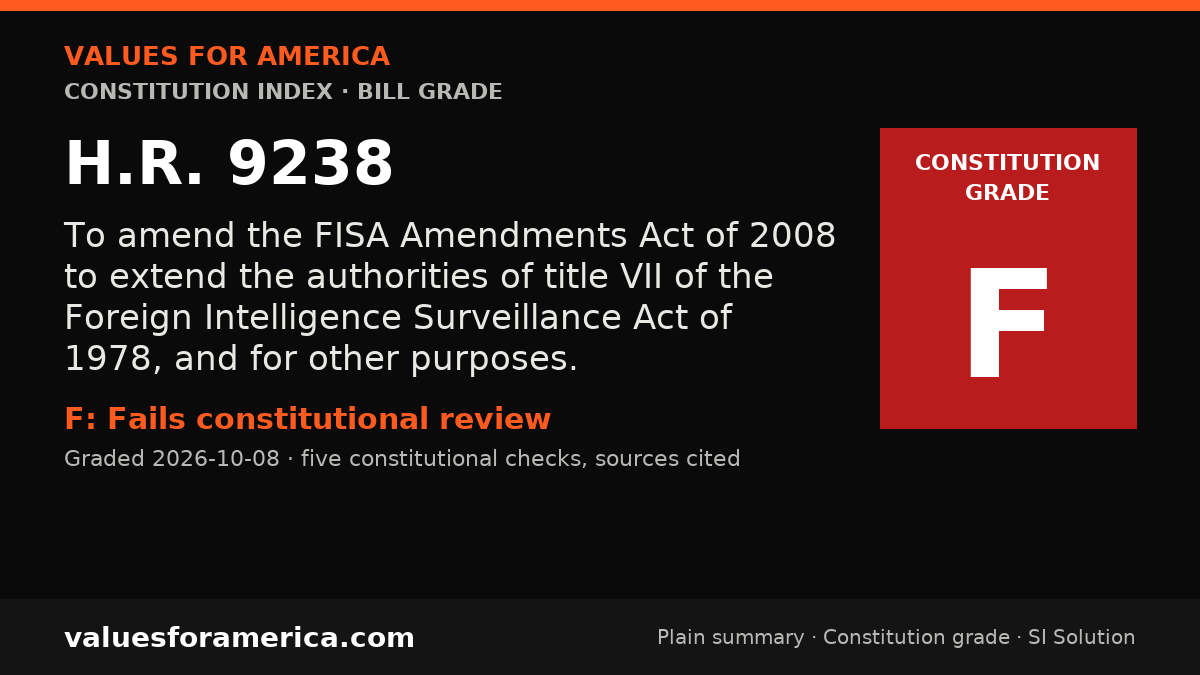
To amend the FISA Amendments Act of 2008 to extend the authorities of title VII of the Foreign Intelligence Surveillance Act of 1978, and for other purposes.
Cosponsors: none · per Congress.gov, 2026-10-08
Introduced: 2026-06-10
Latest action (2026-06-11): On motion to suspend the rules and pass the bill Failed by the Yeas and Nays: (2/3 required): 198 - 218 (Roll no. 221).
What H.R. 9238 does, in plain terms
This bill extends the authorities of Title VII of the Foreign Intelligence Surveillance Act (FISA) until July 2, 2026. Title VII of FISA generally addresses electronic surveillance and other methods of acquiring foreign intelligence information that are directed at targets outside the United States. Title VII includes surveillance under Section 702, which concerns acquiring communications of non-U.S. persons believed to be outside the United States to obtain foreign intelligence information. Information about U.S. persons may incidentally be acquired by this type of surveillance and subsequently queried (searched) under certain circumstances. For additional information, see CRS In Focus, IF11451 Foreign Intelligence Surveillance Act (FISA); and CRS Report, R48592 FISA Section 702 and the 2024 Reforming Intelligence and Securing America Act.
Official summary by the Congressional Research Service, via Congress.gov.
Constitution Index
“VFA Constitution grade”
Fails constitutional review
Graded 2026-10-08
SI-generated grade · five published checks · not individually reviewed by a person · methodology
Extension of FISA Title VII Section 702 authority continues warrantless collection that incidentally sweeps in U.S. person communications and permits later searching without probable-cause warrants, in direct tension with the Fourth Amendment and with First Amendment speech protections and Fifth Amendment due process. Federal authority for foreign intelligence exists, but the method violates rights and individual sovereignty.
-
✓ Passes · Enumerated powers
Congress has authority over foreign surveillance under Article I, Section 8, Clauses 11 through 14 concerning war, armed forces, and related national defense powers, combined with Article I, Section 8, Clause 18 to make laws necessary and proper for executing those powers. Extending Title VII to target non-U.S. persons believed to be outside the United States falls within that grant. Authority to … -
✗ Concern · Bill of Rights
Section 702 authorizes acquisition of communications where U.S. persons communications are incidentally collected and later queried without a warrant based on probable cause. This implicates the Fourth Amendment requirement that searches be reasonable and supported by warrant upon probable cause, and the First Amendment where speech and association are chilled by warrantless collection and queryin… -
✗ Concern · Individual sovereignty
The program restricts individual sovereignty over private speech, belief, association, and papers by permitting interception, retention, and later searching of private communications without the individual's consent and without a prior warrant. The burden is on the government to justify such restriction with a compelling constitutional basis and narrow tailoring. A blanket extension until July 2, … -
✗ Concern · Decentralization
Foreign-intelligence surveillance directed at targets outside the United States is not suitable for individual, local, or state handling. Those three questions are answered false because national defense requires federal action. However the bill consolidates decision-making upward by extending broad federal collection and querying authority with limited particularized judicial approval, rather tha… -
✗ Concern · Due process and takings
Under the Fifth Amendment Due Process Clause, government searches and deprivations of liberty and privacy must follow fair procedures and non-arbitrary standards. Bulk collection with later warrantless queries of U.S. person communications bypasses prior judicial finding of probable cause, notice, and individualized hearing. While no physical property is taken requiring just compensation under the…
Sources: Congress.gov: HR 9238 summary
Report an error in this grade
The Framers
“Founders’ Verdict”
Confidence 0.75
Archived SI output (machine-generated)No editorial review recorded. This historical SI verdict was machine-generated by software and predates the review desk; check it against the official bill text.
Synthesis
The extension of Title VII of FISA, including Section 702, is constitutionally permissible only if the bill is amended to include explicit safeguards against unreasonable searches and seizures of U.S. persons' communications. Specifically, the statute must require a warrant based on probable cause for any query of incidentally collected U.S. person information, or at minimum provide robust procedural protections (e.g., judicial oversight) to prevent general warrants and protect Fourth Amendment rights. Absent such protections, the bill violates the Fourth Amendment.
The extension of Title VII of FISA, including Section 702, is constitutionally permissible only if it strictly adheres to the Fourth Amendment's protection against unreasonable searches and seizures. The incidental collection of U.S. persons' communications without a warrant based on probable cause raises serious concerns under the Fourth Amendment. Congress may authorize such surveillance for foreign intelligence purposes under its Article I, Section 8 powers to provide for the common defense and to make all laws necessary and proper for executing those powers, but it must ensure that queries…
This bill extends surveillance powers that permit the incidental collection of communications of U.S. persons without a warrant based on probable cause, which violates the Fourth Amendment's protection against unreasonable searches and seizures. The Constitution requires that any search of a person's papers or effects be supported by a warrant particularly describing the place to be searched and the persons or things to be seized. The incidental collection and subsequent querying of U.S. persons' communications under Section 702 lacks such particularized judicial oversight and effectively allo…
The extension of Title VII of FISA, particularly Section 702, raises grave concerns under the Fourth Amendment's protection against unreasonable searches and seizures, as well as the principle of separation of powers. The incidental collection of U.S. persons' communications without a warrant based on probable cause appears to violate the Fourth Amendment's requirement that 'no Warrants shall issue, but upon probable cause.' Moreover, the authority to query databases containing such incidentally collected information without individualized judicial oversight may constitute a general warrant, w…
This Court must consider the legislation in light of the Constitution's explicit grant to Congress of power to provide for the common defense and to regulate the means of gathering foreign intelligence, which is an inherent attribute of national sovereignty. The extension of Title VII of FISA, including Section 702, falls within Congress's authority under Article I, Section 8, Clause 18—the Necessary and Proper Clause—as it is a means reasonably adapted to the ends of protecting the nation from foreign threats. However, the Fourth Amendment, which guards against unreasonable searches and seizu…
Report an error in this Founders' Verdict
What should pass
“VFA SI Solution”
No solution yet
A sourced SI draft appears here once it passes automated checks (Constitution citation, source verification, independent SI critic). How publication works.
Related on VFA

For journalists and bloggers
“Embed this grade”
Free to use with the link back. The badge and card update when the grade changes. Embed terms →
