H.R. 9203 explained · 119th Congress · Pending in Congress
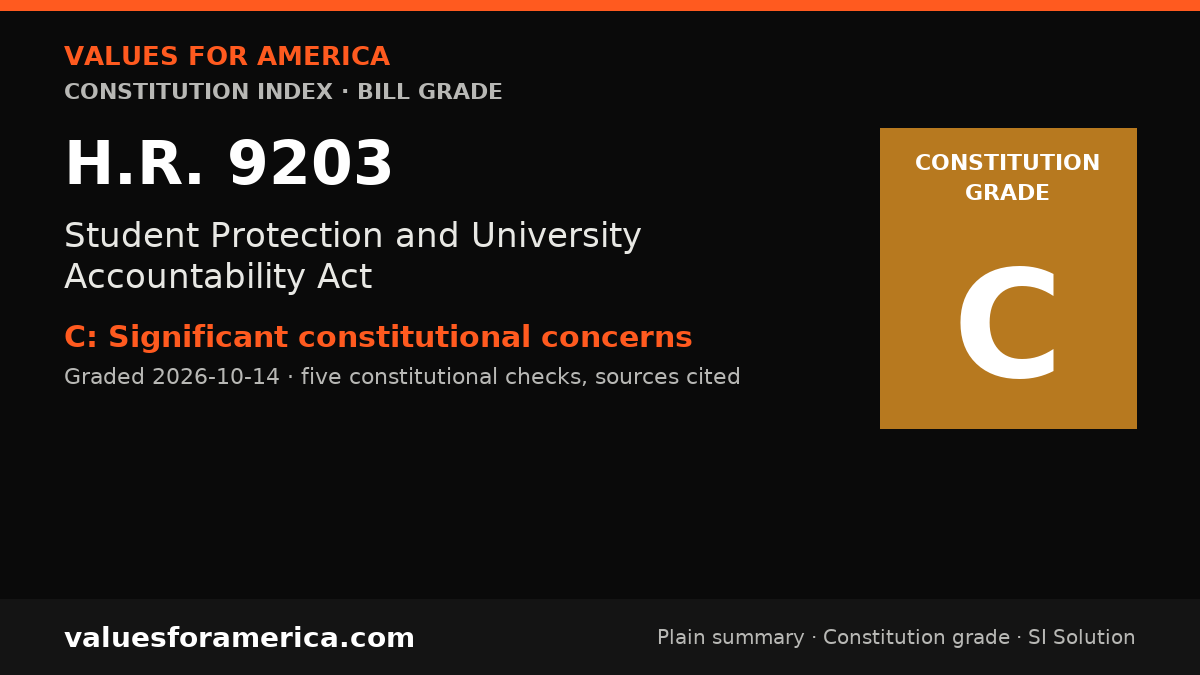
Student Protection and University Accountability Act
Cosponsors: 2 (2 D, 0 R) · per Congress.gov, 2026-10-14
Introduced: 2026-06-08
Latest action (2026-09-08): Placed on the Union Calendar, Calendar No. 700.
What H.R. 9203 does, in plain terms
Student Protection and University Accountability Act This bill requires institutions of higher education (IHEs) participating in federal student aid programs and the Department of Education (ED) to take certain actions to investigate alleged violations of civil rights under Title VI of the Civil Rights Act of 1964. (Title VI of the Civil Rights Act of 1964 prohibits discrimination based on race, color, or national origin in federally funded programs or activities.) Specifically, the bill requires an IHE to develop specific procedures for investigating Title VI complaints and widely distribute those procedures to students and their families. Among these procedures, an IHE must designate at least one Title VI coordinator and have a system for maintaining records of complaints. The bill makes an IHE that fails to meet the bill's requirements for two consecutive award years ineligible to participate in federal student aid programs for at least two subsequent award years. However, the IHE may regain eligibility if it demonstrates compliance with the bill's requirements. ED's Office for Civil Rights (OCR) must give bimonthly congressional briefings on (1) the number of complaints filed with OCR, (2) how OCR plans to address those complaints and the investigations being carried out in response to those complaints, and (3) data about the length of those investigations. The bill revises the process through which OCR investigates Title VI complaints, including by prohibiting OCR from closing a complaint due to the filing of another complaint involving the same allegations against the same IHE under certain circumstances.
Official summary by the Congressional Research Service, via Congress.gov.
Constitution Index
“VFA Constitution grade”
Significant constitutional concerns
Graded 2026-10-14
SI-generated grade · five published checks · not individually reviewed by a person · methodology
The bill imposes procedural requirements on institutions of higher education as a condition of participating in federal student aid programs, which falls within Congress's spending power. However, it raises significant concerns by mandating specific administrative structures and processes, potentially infringing on institutional autonomy and state control over education, and by creating a compliance regime that may burden individual rights and due process.
-
✓ Passes · Enumerated powers
Congress has the power to attach conditions to federal spending under Article I, Section 8, Clause 1 (the Spending Clause). Requiring institutions that voluntarily participate in federal student aid programs to comply with certain procedures is a valid exercise of this power, as long as the conditions are related to the federal interest in the program. The bill's requirements are tied to ensuring … -
✗ Concern · Bill of Rights
The bill does not directly infringe on the First, Second, Third, Fourth, Fifth, Sixth, Seventh, Eighth, or Ninth Amendments. However, by imposing detailed procedural mandates on institutions, it may indirectly affect academic freedom and freedom of association, which are protected under the First Amendment. The requirement to designate a Title VI coordinator and maintain records could be seen as a… -
✗ Concern · Individual sovereignty
The bill restricts the autonomy of institutions of higher education by dictating specific administrative procedures and record-keeping requirements. While institutions are not individuals, they are composed of individuals whose academic freedom and institutional self-governance are affected. The government has a compelling interest in preventing discrimination, but the means must be narrowly tailo… -
✗ Concern · Decentralization
The bill consolidates decision-making at the federal level by imposing uniform procedural requirements on all institutions of higher education, regardless of state or local variations. While the federal government has a role in enforcing civil rights in federally funded programs, the specific procedural mandates could be left to states and institutions to develop, as long as they meet federal anti… -
✗ Concern · Due process and takings
The bill's provision that an institution may be deemed ineligible for federal student aid programs for two years if it fails to meet requirements for two consecutive award years raises due process concerns. The bill does not specify a hearing or opportunity to contest the determination before the penalty is imposed. Additionally, the prohibition on OCR closing a complaint due to the filing of anot…
Sources: Congress.gov: HR 9203 summary
Report an error in this grade
What should pass
“VFA SI Solution”
No solution yet
A sourced SI draft appears here once it passes automated checks (Constitution citation, source verification, independent SI critic). How publication works.
Related on VFA

For journalists and bloggers
“Embed this grade”
Free to use with the link back. The badge and card update when the grade changes. Embed terms →
