H.R. 9171 explained · 119th Congress · Pending in Congress
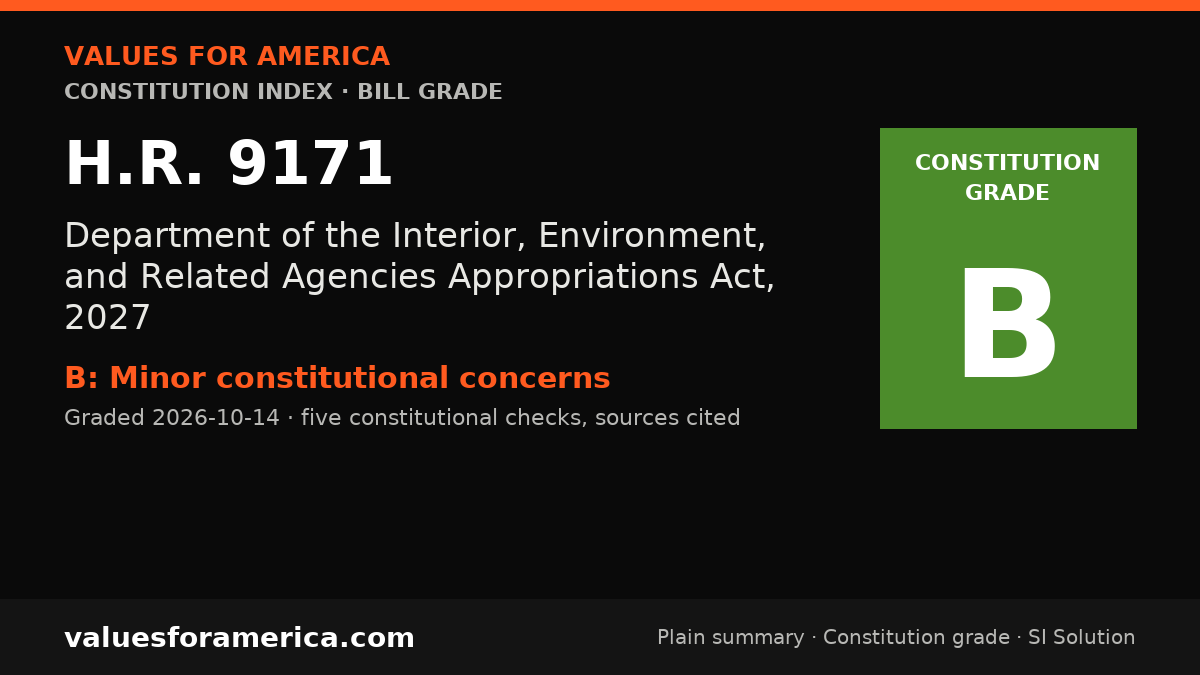
Department of the Interior, Environment, and Related Agencies Appropriations Act, 2027
Cosponsors: none · per Congress.gov, 2026-10-14
Introduced: 2026-06-05
Latest action (2026-06-05): Placed on the Union Calendar, Calendar No. 599.
What H.R. 9171 does, in plain terms
Department of the Interior, Environment, and Related Agencies Appropriations Act, 2027 This bill provides FY2027 appropriations for the Department of the Interior, the Environmental Protection Agency (EPA), and several related agencies. The bill provides appropriations to Interior for the Bureau of Land Management, the U.S. Fish and Wildlife Service, the National Park Service, the U.S. Geological Survey, the Bureau of Ocean Energy Management, the Bureau of Safety and Environmental Enforcement, the Office of Surface Mining Reclamation and Enforcement, the Bureau of Indian Affairs, the Bureau of Indian Education, the Bureau of Trust Funds Administration, the U.S. Wildland Fire Service, Departmental Offices, and Department-Wide Programs. The bill also provides appropriations to the EPA and the Forest Service. Within the Department of Health and Human Services, the bill provides appropriations for the Indian Health Service, the National Institute of Environmental Health Sciences, and the Agency for Toxic Substances and Disease Registry. The bill provides appropriations to several related agencies, including the Council on Environmental Quality and Office of Environmental Quality, the Chemical Safety and Hazard Investigation Board, the Institute of American Indian and Alaska Native Culture and Arts Development, the Smithsonian Institution, the National Gallery of Art, the John F. Kennedy Center for the Performing Arts, the Woodrow Wilson International Center for Scholars, the National Endowment for the Arts, the National Endowment for the Humanities, the Commission of Fine Arts, the Advisory Council on Historic Preservation. the National Capital Planning Commission, the U.S. Holocaust Memorial Museum, and the U.S. Semiquincentennial Commission. Additionally, the bill sets forth requirements and restrictions for using funds provided by this and other appropriations acts.
Official summary by the Congressional Research Service, via Congress.gov.
Constitution Index
“VFA Constitution grade”
Minor constitutional concerns
Graded 2026-10-14
SI-generated grade · five published checks · not individually reviewed by a person · methodology
This bill is mostly constitutional. It funds federal agencies within Congress's enumerated power to appropriate money (Article I, Section 9, Clause 7). However, several funded entities—such as the National Endowment for the Arts, the National Endowment for the Humanities, and the Smithsonian Institution—operate in areas not explicitly enumerated in Article I, Section 8, creating minor tension with the principle of limited federal power. No Bill of Rights violations, individual sovereignty infringements, due process issues, or takings problems are present. The bill fails the decentralization test because many funded activities could be handled by states or private entities, but this is a structural concern rather than a direct constitutional violation.
-
✗ Concern · Enumerated powers
Congress has the power to appropriate funds under Article I, Section 9, Clause 7 (the Appropriations Clause). However, the Constitution limits federal spending to powers enumerated in Article I, Section 8. While funding the Department of the Interior, EPA, and related agencies for land management, environmental protection, and tribal affairs can be tied to the Property Clause (Article IV, Section … -
✓ Passes · Bill of Rights
The bill merely appropriates funds and sets conditions on their use. It does not restrict speech, religion, assembly, press, petition (First Amendment), bear arms (Second Amendment), quarter soldiers (Third Amendment), authorize unreasonable searches (Fourth Amendment), compel self-incrimination or deny due process (Fifth Amendment), impair fair trial rights (Sixth Amendment), deny jury trial (Sev… -
✓ Passes · Individual sovereignty
The bill does not restrict any individual's person, property, speech, labor, or belief. It allocates government funds to agencies and programs. Individuals are not compelled to participate in or fund these programs beyond general taxation, which is a settled constitutional matter (see Article I, Section 8, Clause 1). No restriction on individual sovereignty is imposed. -
✗ Concern · Decentralization
Applying the four-question test: (1) Individuals or families cannot handle national land management, environmental regulation, or tribal affairs—these require collective action. (2) Local communities cannot manage national parks, interstate environmental issues, or nationwide tribal programs. (3) States could handle many of these functions, such as environmental protection, arts funding, and histo… -
✓ Passes · Due process and takings
The bill does not deprive any person of life, liberty, or property without due process of law (Fifth Amendment). It does not take private property for public use without just compensation (Fifth Amendment Takings Clause). It imposes no penalties, fines, or forfeitures. No due process or takings issues are present.
Sources: Congress.gov: HR 9171 summary
Report an error in this grade
The Framers
“Founders’ Verdict”
Confidence 0.75
Archived SI output (machine-generated)No editorial review recorded. This historical SI verdict was machine-generated by software and predates the review desk; check it against the official bill text.
Synthesis
The bill is constitutional only if each of its specific provisions falls within Congress's enumerated powers, respects federalism limits (especially Tenth Amendment and state police powers), and avoids unconstitutional conditions, improper delegation without intelligible principles, or infringement on individual rights such as property rights under the Fifth Amendment. A provision-by-provision analysis is required to ensure constitutionality.
This bill, as an appropriations measure for the Department of the Interior and Environment, concerns the power of the purse, which is constitutionally vested in Congress under Article I, Section 9, Clause 7: 'No Money shall be drawn from the Treasury, but in Consequence of Appropriations made by Law.' Congress may condition spending on specific policy objectives, provided such conditions are not arbitrary or unrelated to the general welfare (Article I, Section 8, Clause 1). However, should any provision within the bill attempt to delegate legislative power to executive agencies without intelli…
This appropriations bill is constitutional only insofar as it funds activities strictly within the enumerated powers of the federal government, such as the management of federal lands under Article IV, Section 3, Clause 2, and the provision for the general welfare under Article I, Section 8, Clause 1. However, if it extends to matters reserved to the states—such as intrastate environmental regulation or land use not on federal property—it would exceed the limited authority delegated by the Constitution. The Tenth Amendment reserves all powers not delegated to the United States to the states or…
This bill appropriates funds for the Department of the Interior and related agencies. While Congress holds the power of the purse under Article I, Section 9, Clause 7, the Constitution limits federal jurisdiction to enumerated powers. The management of lands and environment not falling under federal property (Article IV, Section 3, Clause 2) or necessary and proper execution of enumerated powers should remain with the states or the people. Federalist No. 45 warns that the powers delegated to the federal government are few and defined, while those reserved to the states are numerous and indefin…
The power of the purse is a fundamental attribute of Congress under Article I, Section 9, Clause 7, which provides that 'No Money shall be drawn from the Treasury, but in Consequence of Appropriations made by Law.' This bill, as an appropriations act, is generally a proper exercise of that power. However, the constitutionality of any specific provision within the bill must be assessed against the enumerated powers of Congress and the limitations imposed by the Constitution. If the bill contains riders or conditions that exceed the legislative authority granted to Congress under Article I, Sect…
Report an error in this Founders' Verdict
What should pass
“VFA SI Solution”
Archived SI output (machine-generated) · No editorial review recorded
This historical draft has no editorial review time on record. Check its claims against the original bill and current law.
Constitutional Interior and Environment Appropriations Act of 2027
Generated by VFA SI Solutions
To fund the Department of the Interior, the Environmental Protection Agency, and related agencies for fiscal year 2027, supporting environmental protection, public lands management, and cultural programs.
Bipartisan rationale: Honors Democratic priorities: robust funding for environmental protection and public lands, with clear federal role. Honors Republican priorities: respect for state sovereignty (Tenth Amendment), protection of property rights (Fifth Amendment), limits on agency discretion (nondelegation), and sunset to ensure accountability.
Article I, Section 8, Clause 1 Article I, Section 8, Clause 3 Article IV, Section 3, Clause 2 Amendment V Amendment X Article I, Section 1
Report an error in this Solution
Citizen Consensus
“Do you support this VFA SI Solution?”
One vote per verified account; you can change it any time. Only verified accounts count, results publish once 30 verified people have voted, and state and district results count only people who attested a home ZIP code. How this works.
Email verification is not switched on yet, so no vote counts toward results yet. Votes cast now are saved and count once the voter verifies their email address.
Sign in or create a free account to vote.
Add a short reason (optional)
/280 · no links or contact details · reasons are reviewed before anyone sees them, and many never are shown.
Your vote is saved but held out of published results by an automated integrity check (for example, several accounts voting from one browser).
Your vote is saved. It will count once you verify your email address. Verify on your account page.
Your vote counts nationally. Add your home ZIP code to count in your state and district too.
Your vote counts nationally and in .
Reason saved privately; it is shown only if it passes review.
Verified participants nationwide · n =
Self-selected participants, not a random sample; ± is the 95% sampling margin.
Not enough verified votes yet. Results publish at verified votes.
A sudden surge of votes on this item was flagged and is under review; votes from new accounts in that surge are held out until it is resolved.
Related on VFA

For journalists and bloggers
“Embed this grade”
Free to use with the link back. The badge and card update when the grade changes. Embed terms →
