H.R. 9170 explained · 119th Congress · Pending in Congress
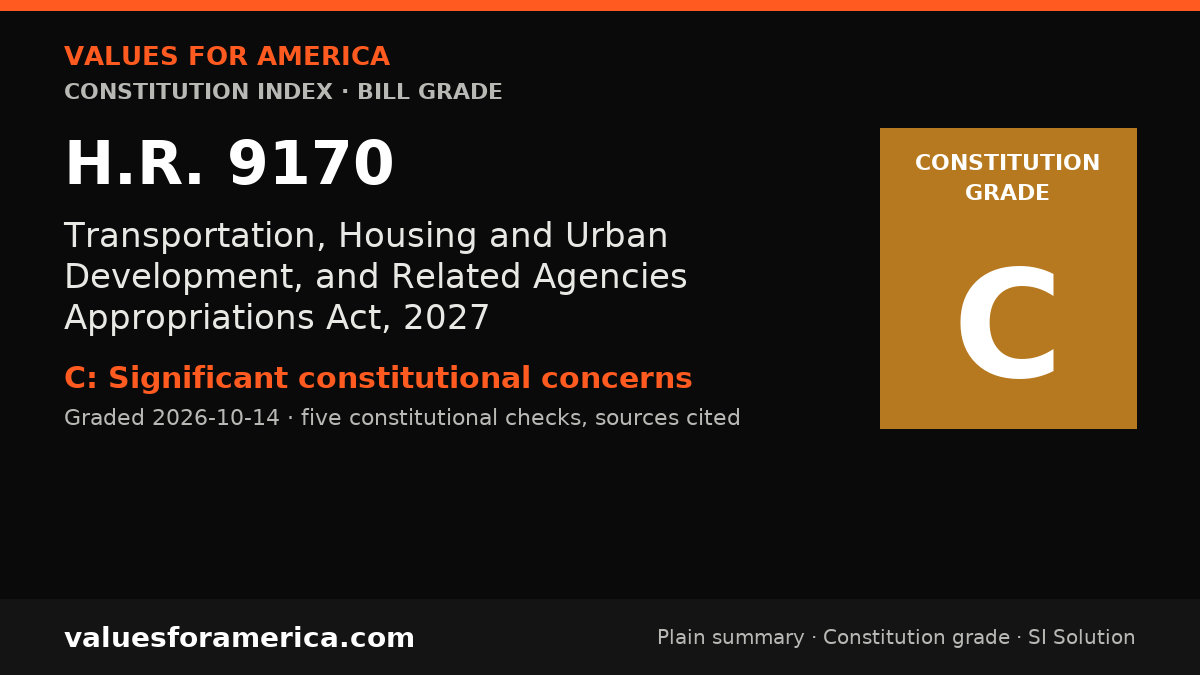
Transportation, Housing and Urban Development, and Related Agencies Appropriations Act, 2027
Cosponsors: none · per Congress.gov, 2026-10-14
Introduced: 2026-06-05
Latest action (2026-06-05): Placed on the Union Calendar, Calendar No. 598.
What H.R. 9170 does, in plain terms
Transportation, Housing and Urban Development, and Related Agencies Appropriations Act, 2027 This bill provides FY2027 appropriations to the Department of Transportation (DOT), the Department of Housing and Urban Development (HUD), and several related agencies. The bill provides appropriations to DOT for the Office of the Secretary, the Federal Aviation Administration, the Federal Highway Administration, the Federal Motor Carrier Safety Administration, the National Highway Traffic Safety Administration, the Federal Railroad Administration, the Federal Transit Administration, the Great Lakes St. Lawrence Seaway Development Corporation, the Maritime Administration, the Pipeline and Hazardous Materials Safety Administration, and the Office of Inspector General. The bill provides appropriations to HUD for Management and Administration, Public and Indian Housing, Community Planning and Development, Housing Programs, the Federal Housing Administration, the Government National Mortgage Association (Ginnie Mae), Policy Development and Research, Fair Housing and Equal Opportunity, the Office of Lead Hazard Control and Healthy Homes, and the Office of Inspector General. The bill also provides appropriations to several related agencies, including the Access Board, the Federal Maritime Commission, the National Railroad Passenger Corporation (Amtrak) Office of Inspector General, the National Transportation Safety Board, the Neighborhood Reinvestment Corporation, the Surface Transportation Board, and the U.S. Interagency Council on Homelessness. Additionally, the bill sets forth requirements and restrictions for using funds provided by this and other appropriations acts.
Official summary by the Congressional Research Service, via Congress.gov.
Constitution Index
“VFA Constitution grade”
Significant constitutional concerns
Graded 2026-10-14
SI-generated grade · five published checks · not individually reviewed by a person · methodology
The bill is a routine appropriations measure that largely falls within Congress's enumerated power to spend for the general welfare, but it contains provisions that raise significant constitutional concerns. Specifically, the bill's funding for housing and urban development programs, while arguably within the spending power, may exceed the scope of enumerated powers by effectively regulating local land use and housing markets. Additionally, the bill imposes numerous conditions and restrictions on the use of funds that could infringe on individual sovereignty and state autonomy, and it consolidates decision-making at the federal level in areas traditionally handled by states and localities. The bill also raises due process concerns by conditioning funding on compliance with federal mandates that may not provide adequate procedural safeguards.
-
✗ Concern · Enumerated powers
The bill's appropriations for transportation and related agencies are clearly within Congress's enumerated powers under Article I, Section 8, Clause 3 (the Commerce Clause) and Article I, Section 8, Clause 1 (the Spending Power). However, the bill's extensive funding for HUD programs, including public housing, community planning, and housing programs, goes beyond the traditional scope of enumerate… -
✗ Concern · Bill of Rights
The bill does not directly infringe on the First, Second, Third, Fourth, Fifth, Sixth, Seventh, Eighth, or Ninth Amendments. However, the bill's funding for 'Fair Housing and Equal Opportunity' and other HUD programs may impose conditions that restrict property rights and freedom of contract, which are protected under the Fifth Amendment's Due Process Clause and the Ninth Amendment's protection of… -
✗ Concern · Individual sovereignty
The bill's extensive federal funding for housing and community development programs imposes conditions that restrict individual property owners' and local communities' ability to make decisions about land use and housing. The burden is on the government to justify these restrictions, and the bill does not provide a compelling constitutional justification for overriding local control. The Tenth Ame… -
✗ Concern · Decentralization
The bill fails the decentralization test. (1) Individuals and families can handle housing and transportation needs without federal involvement, as these are traditionally local matters. (2) Local communities and counties can handle housing and transportation without state involvement, as they have the closest knowledge of local needs. (3) States can handle these matters without federal involvement… -
✗ Concern · Due process and takings
The bill's conditions on funding may constitute a taking of property without just compensation, as they require states and localities to comply with federal mandates that could restrict property use. Additionally, the bill's requirements and restrictions may not provide adequate procedural due process, as they are imposed through the appropriations process without a fair hearing or notice to affec…
Sources: Congress.gov: HR 9170 summary
Report an error in this grade
The Framers
“Founders’ Verdict”
Confidence 0.75
Archived SI output (machine-generated)No editorial review recorded. This historical SI verdict was machine-generated by software and predates the review desk; check it against the official bill text.
Synthesis
The bill is constitutional only if appropriations are strictly tied to enumerated federal powers (e.g., interstate commerce, post roads, federal property) and do not intrude on state sovereignty or coerce states into adopting federal policies. Two founders (Madison, Jefferson) explicitly condition constitutionality on this limitation; Hamilton and Marshall broadly support the bill but acknowledge implicit limits. Thus, the conditional position commands a majority.
This bill is an ordinary exercise of Congress's power of the purse under Article I, Section 9, Clause 7, which mandates that 'No Money shall be drawn from the Treasury, but in Consequence of Appropriations made by Law.' The legislation provides for the funding of transportation, housing, and urban development—objects that plainly fall within the general welfare and the necessary and proper execution of enumerated powers, such as the power to regulate interstate commerce (Article I, Section 8, Clause 3) and to establish post roads (Article I, Section 8, Clause 7). Nothing in the text of the Con…
This bill appropriates funds for transportation, housing, and urban development. The Constitution grants Congress the power to tax and spend for the general welfare (Article I, Section 8, Clause 1), but this power is limited by the Tenth Amendment, which reserves to the states or the people all powers not delegated to the United States. The federal government may only exercise enumerated powers; internal improvements, housing, and urban development are not among them. If this bill funds projects that are truly national in scope and necessary for the execution of enumerated powers (e.g., post r…
This bill purports to exercise the spending power under Article I, Section 8, Clause 1 for general welfare, but the Constitution vests Congress only with enumerated powers. The Tenth Amendment reserves all non-delegated powers to the States or the people. Federal appropriations for transportation and housing must be limited to objects truly national in scope, not matters of local police power. Federalist No. 10 warns against factions using public funds for partial interests; Federalist No. 45 reminds that the powers of the federal government are few and defined. Therefore, the bill is constitu…
The Constitution vests in Congress the power to appropriate funds for the general welfare and to provide for the common defense. Article I, Section 8, Clause 1 grants Congress the authority to lay and collect taxes, duties, imposts, and excises, to pay the debts and provide for the common defense and general welfare of the United States. The appropriation of funds for transportation, housing, and urban development falls squarely within the scope of promoting the general welfare. Furthermore, the Necessary and Proper Clause (Article I, Section 8, Clause 18) empowers Congress to make all laws wh…
Report an error in this Founders' Verdict
What should pass
“VFA SI Solution”
Archived SI output (machine-generated) · No editorial review recorded
This historical draft has no editorial review time on record. Check its claims against the original bill and current law.
Enumerated Infrastructure and Housing Assistance Act of 2027
Generated by VFA SI Solutions
To fund transportation, housing, and urban development programs for fiscal year 2027, addressing infrastructure needs and housing affordability.
Bipartisan rationale: Honors Democratic priorities by funding infrastructure and housing assistance for vulnerable populations (federal employees, tribes). Honors Republican priorities by strictly limiting federal power to enumerated powers, avoiding state coercion, and including a sunset and oversight mechanism.
Article I, Section 8, Clause 3 Article I, Section 8, Clause 7 Article IV, Section 3, Clause 2 Amendment X Amendment V
Report an error in this Solution
Citizen Consensus
“Do you support this VFA SI Solution?”
One vote per verified account; you can change it any time. Only verified accounts count, results publish once 30 verified people have voted, and state and district results count only people who attested a home ZIP code. How this works.
Email verification is not switched on yet, so no vote counts toward results yet. Votes cast now are saved and count once the voter verifies their email address.
Sign in or create a free account to vote.
Add a short reason (optional)
/280 · no links or contact details · reasons are reviewed before anyone sees them, and many never are shown.
Your vote is saved but held out of published results by an automated integrity check (for example, several accounts voting from one browser).
Your vote is saved. It will count once you verify your email address. Verify on your account page.
Your vote counts nationally. Add your home ZIP code to count in your state and district too.
Your vote counts nationally and in .
Reason saved privately; it is shown only if it passes review.
Verified participants nationwide · n =
Self-selected participants, not a random sample; ± is the 95% sampling margin.
Not enough verified votes yet. Results publish at verified votes.
A sudden surge of votes on this item was flagged and is under review; votes from new accounts in that surge are held out until it is resolved.
Related on VFA

For journalists and bloggers
“Embed this grade”
Free to use with the link back. The badge and card update when the grade changes. Embed terms →
