H.R. 915 explained · 119th Congress · Pending in Congress
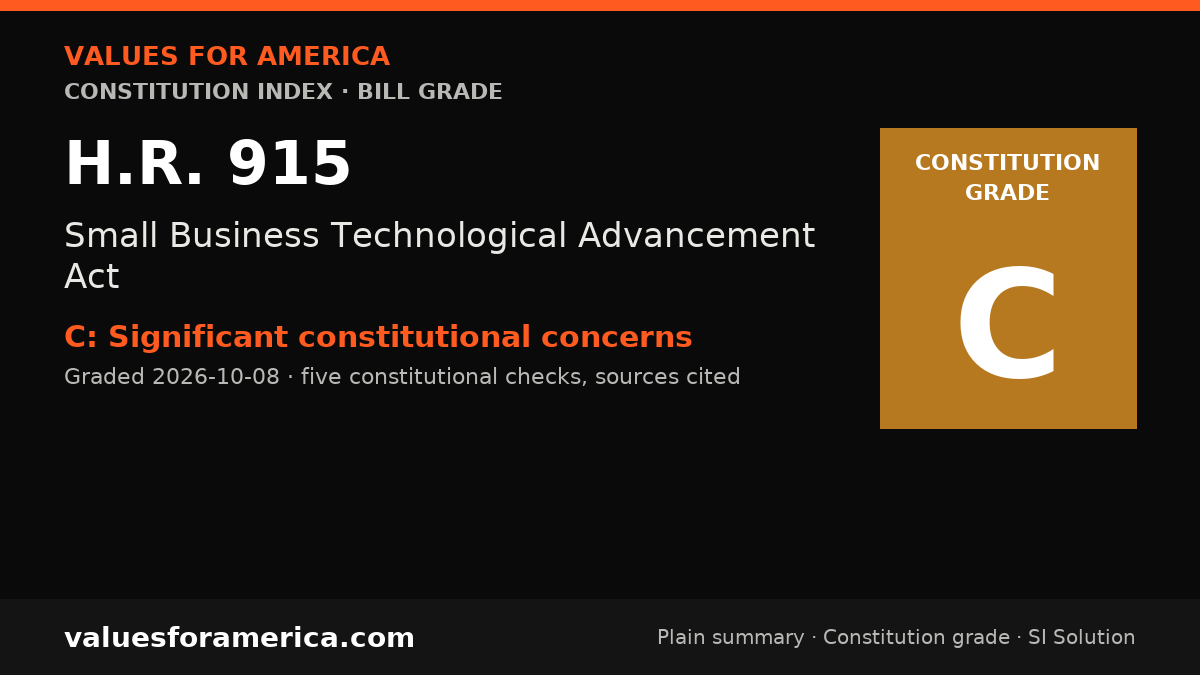
Small Business Technological Advancement Act
Cosponsors: 3 (3 D, 0 R) · per Congress.gov, 2026-10-08
Introduced: 2025-02-04
Latest action (2026-07-13): Received in the Senate and Read twice and referred to the Committee on Small Business and Entrepreneurship.
What H.R. 915 does, in plain terms
Small Business Technological Act of 2025 This bill authorizes the Small Business Administration (SBA) to finance under the 7(a) loan program business software or cloud computing services that facilitate business operations, product or service delivery, payroll processing, human resources functions, sales and billing functions, or accounting or tracking of inventory. Such software or services include business tools that utilize artificial intelligence. The 7(a) loan program is the SBA's primary business loan program that provides loan guaranties for participating lenders to provide financing to small businesses that are otherwise unable obtain reasonable credit terms.
Official summary by the Congressional Research Service, via Congress.gov.
Constitution Index
“VFA Constitution grade”
Significant constitutional concerns
Graded 2026-10-08
SI-generated grade · five published checks · not individually reviewed by a person · methodology
Voluntary federal loan-guarantee expansion with no Bill of Rights violation, but it lacks a clear enumerated power and centralizes routine business financing at the federal level in tension with the Tenth Amendment.
-
✗ Concern · Enumerated powers
No enumerated power in Article I, Section 8 authorizes the federal government to guarantee private loans for general business software and cloud services. The Commerce Clause, Article I, Section 8, Clause 3, permits regulation of interstate commerce, not federal financing of ordinary business inputs. The Spending Clause, Article I, Section 8, Clause 1, permits spending for the general welfare but … -
✓ Passes · Bill of Rights
The bill does not restrict speech, religion, press, assembly under the First Amendment, does not implicate the Second, Third, Fourth, Fifth self-incrimination, Sixth, Seventh, or Eighth Amendments. It authorizes loan guarantees for business software including tools using artificial intelligence; it compels no speech and imposes no search, seizure, or punishment. -
✓ Passes · Individual sovereignty
The bill is voluntary and does not prohibit, mandate, or penalize what a person may do with their person, property, labor, speech or belief. It does not compel purchase of particular software or tools using artificial intelligence, and the burden justification test under the Ninth Amendment and Tenth Amendment is not triggered by a restriction because no restriction is imposed. -
✗ Concern · Decentralization
Purchasing business software, cloud services, payroll and accounting tools can be handled by individuals, businesses and private lenders without government involvement (Q1 yes). Local banks, credit unions and community lenders can finance such purchases without state involvement (Q2 yes). States can operate their own small-business support without federal involvement under the Tenth Amendment (Q3 … -
✓ Passes · Due process and takings
No deprivation of life, liberty or property without due process under the Fifth Amendment and Fourteenth Amendment, no presumption-of-innocence violation, and no physical or regulatory taking requiring just compensation. Loan guarantees are voluntary and require application and lender underwriting, with no seizure or forfeiture.
Sources: Congress.gov: HR 915 summary
Report an error in this grade
What should pass
“VFA SI Solution”
No solution yet
A sourced SI draft appears here once it passes automated checks (Constitution citation, source verification, independent SI critic). How publication works.
Related on VFA

For journalists and bloggers
“Embed this grade”
Free to use with the link back. The badge and card update when the grade changes. Embed terms →
