H.R. 9086 explained · 119th Congress · Pending in Congress
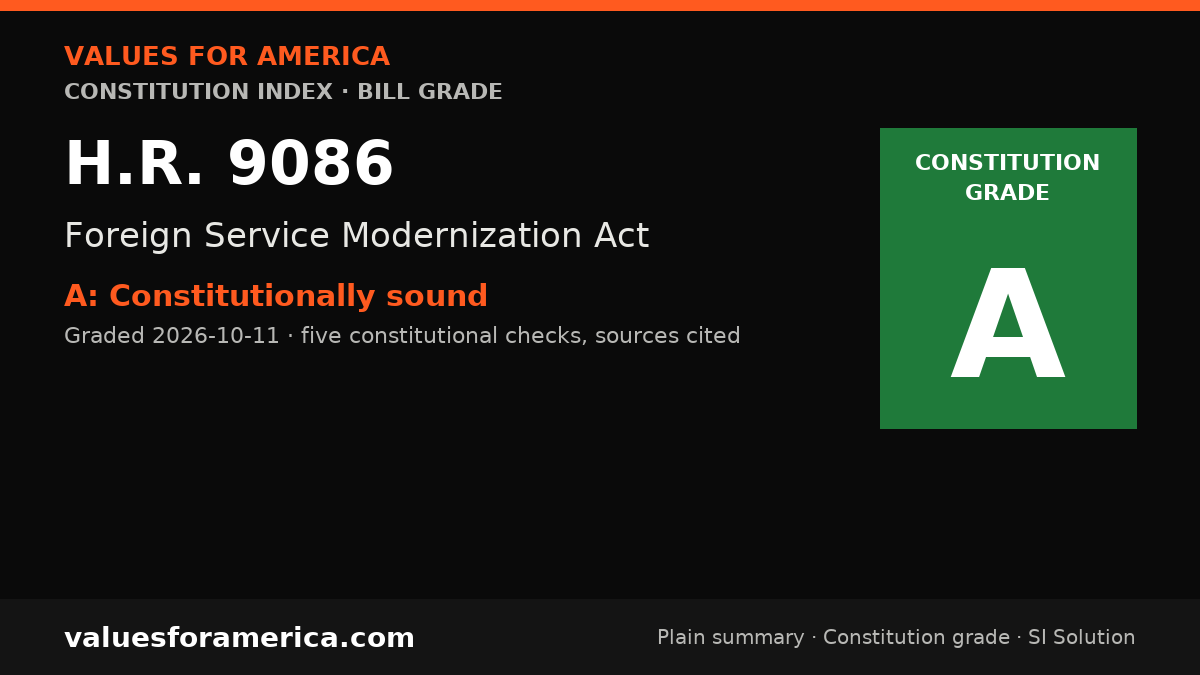
Foreign Service Modernization Act
Cosponsors: 3 (0 D, 3 R) · per Congress.gov, 2026-10-14
Introduced: 2026-06-02
Latest action (2026-09-17): Received in the Senate and Read twice and referred to the Committee on Foreign Relations.
What H.R. 9086 does, in plain terms
Foreign Service Modernization Act This bill requires or authorizes certain actions related to U.S. Foreign Service (FS) management and operations, including an increased focus on expeditionary diplomacy (a concept that emphasizes diplomats conducting direct diplomacy in high-risk environments outside of the embassy), expanded hiring pathways, and additional training requirements. For example, the bill requires the Department of State to establish a team to develop a plan to improve the capability and willingness of FS members and leaders to engage in expeditionary diplomacy; a program to recruit qualified veterans and separating military personnel into the FS, including by integrating FS recruitment into military transition programs; and a Diplomatic Reserve Corps pilot program to assess the feasibility and effectiveness of a trained reserve cadre providing a surge workforce to support foreign affairs contingencies. Additionally, the State Department is authorized to establish a structured training framework that is integrated into normal career progression with protected training periods (similar to the Armed Forces' professional military education model). The bill specifies that FS members must successfully complete specified leadership and management training prior to assuming leadership assignments; who participate in approved external training, education, or details shall have certain employment protections (such as eligibility for promotions and pay increases on the same basis as those not on such assignments); and who undergo full-time, department-funded language training for more than six months must serve at least three consecutive tours in positions requiring proficiency in that language, with assignments beginning immediately after such language training.
Official summary by the Congressional Research Service, via Congress.gov.
Constitution Index
“VFA Constitution grade”
Constitutionally sound
Graded 2026-10-11
SI-generated grade · five published checks · not individually reviewed by a person · methodology
The Foreign Service Modernization Act operates squarely within the federal government's enumerated foreign affairs powers, imposes no restrictions on individual rights, and does not centralize authority beyond the federal level where it already resides. The bill's provisions concern the internal management, training, and recruitment of U.S. Foreign Service personnel, all of which are integral to the conduct of diplomacy and the execution of treaty and foreign commerce powers. No constitutional rights are implicated, and the bill does not affect the sovereignty of individuals or states. The only minor consideration is the mandatory language-training service requirement, which is a reasonable condition of federal employment and does not rise to a constitutional violation.
-
✓ Passes · Enumerated powers
The federal government has explicit constitutional authority over foreign affairs and diplomacy. Article I, Section 8, Clause 3 grants Congress the power to regulate commerce with foreign nations, and Article II, Section 2, Clause 2 empowers the President to appoint ambassadors and other public ministers. The management and training of the Foreign Service is a necessary incident to the conduct of … -
✓ Passes · Bill of Rights
The bill does not infringe any of the first ten amendments. It imposes no restrictions on speech, religion, assembly, press, or petition. It does not affect the right to keep and bear arms, nor does it involve searches, seizures, self-incrimination, due process, takings, or trial rights. The training and service requirements are conditions of federal employment, not restrictions on individual libe… -
✓ Passes · Individual sovereignty
The bill does not restrict what individuals can do with their own person, property, speech, labor, or belief. It only sets conditions for those who voluntarily choose to enter or remain in the Foreign Service. The mandatory language-training service requirement is a reasonable condition of employment, akin to military service obligations, and does not burden individual sovereignty because individu… -
✓ Passes · Decentralization
Foreign affairs are inherently a federal responsibility. The Constitution reserves the conduct of diplomacy to the national government, and states are expressly prohibited from entering into treaties or engaging in foreign compacts (Article I, Section 10). An individual, family, local community, or state cannot handle foreign diplomacy. The bill does not consolidate decision-making upward; it oper… -
✓ Passes · Due process and takings
The bill does not deprive any person of life, liberty, or property without due process of law, nor does it take private property for public use without just compensation. The employment protections for FS members on external training ensure that they are not arbitrarily denied promotions or pay increases, which aligns with procedural due process principles. The mandatory service requirement is a c…
Sources: Congress.gov: HR 9086 summary
Report an error in this grade
What should pass
“VFA SI Solution”
SI-generated · passed automated checks (Constitution citation, source verification, independent SI critic) · not individually reviewed by a person · Report an error: hello@valuesforamerica.com
Foreign Service Readiness With Cost Limits and Review
Generated by VFA SI Solutions
Strengthen the Foreign Service so diplomats are better prepared, led, and staffed for difficult overseas work, including direct work outside secure compounds.
Bipartisan rationale: VFA assesses this draft honors Democratic priorities by strengthening professional diplomacy, protecting fair standing for promotion and pay during approved study, and building surge capacity for crises. VFA assesses it honors Republican priorities by capping costs within existing funds, requiring readiness for high-risk posts, requiring service payback after costly language training, and ending all new authority after five years unless Congress reviews results and extends it.
Possible legislative path: Support may come in both chambers from members focused on national security readiness and veterans, while opposition may come from members concerned about State Department staffing costs or expanded personnel rules.
Source limits: The official summary does not state full bill text, current law, eligibility rules, appeal rights, pay details, or cost effects; readers should verify those points and the bill stage at Congress.gov before relying on them. Proposed protections, exceptions, caps, and service rules are described here as new VFA proposals.
Article I, Section 8, Clause 1 Article I, Section 8, Clause 18 Article II, Section 2, Clause 2 Amendment V
Report an error in this Solution
Citizen Consensus
“Do you support this VFA SI Solution?”
One vote per verified account; you can change it any time. Only verified accounts count, results publish once 30 verified people have voted, and state and district results count only people who attested a home ZIP code. How this works.
Email verification is not switched on yet, so no vote counts toward results yet. Votes cast now are saved and count once the voter verifies their email address.
Sign in or create a free account to vote.
Add a short reason (optional)
/280 · no links or contact details · reasons are reviewed before anyone sees them, and many never are shown.
Your vote is saved but held out of published results by an automated integrity check (for example, several accounts voting from one browser).
Your vote is saved. It will count once you verify your email address. Verify on your account page.
Your vote counts nationally. Add your home ZIP code to count in your state and district too.
Your vote counts nationally and in .
Reason saved privately; it is shown only if it passes review.
Verified participants nationwide · n =
Self-selected participants, not a random sample; ± is the 95% sampling margin.
Not enough verified votes yet. Results publish at verified votes.
A sudden surge of votes on this item was flagged and is under review; votes from new accounts in that surge are held out until it is resolved.
Related on VFA

For journalists and bloggers
“Embed this grade”
Free to use with the link back. The badge and card update when the grade changes. Embed terms →
