H.R. 901 explained · 119th Congress · Pending in Congress
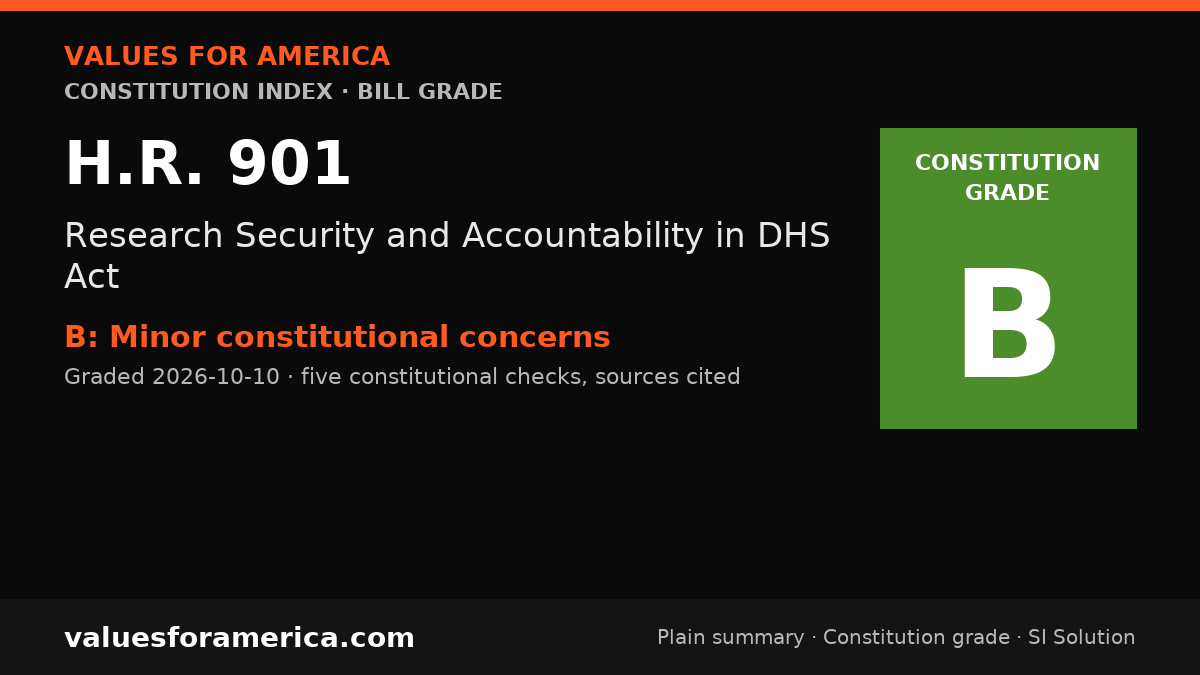
Research Security and Accountability in DHS Act
Cosponsors: 2 (0 D, 2 R) · per Congress.gov, 2026-10-12
Introduced: 2025-01-31
Latest action (2025-03-11): Received in the Senate and Read twice and referred to the Committee on Homeland Security and Governmental Affairs.
What H.R. 901 does, in plain terms
Research Security and Accountability in DHS Act This bill requires the Science and Technology Directorate in the Department of Homeland Security (DHS) to develop a department-wide policy for safeguarding research and development from unauthorized access or disclosures of sensitive information in related acquisitions. Additionally, the Government Accountability Office must report on the compliance of DHS with a 2021 presidential memorandum and related guidance that required certain disclosures about government-funded research and development (e.g., conflicts of interest involving foreign governments).
Official summary by the Congressional Research Service, via Congress.gov.
Constitution Index
“VFA Constitution grade”
Minor constitutional concerns
Graded 2026-10-10
SI-generated grade · five published checks · not individually reviewed by a person · methodology
This bill is mostly sound but has minor constitutional tensions. It operates within DHS's enumerated powers over internal security and acquisitions, does not directly infringe the Bill of Rights, and respects individual sovereignty by targeting institutional compliance rather than personal restrictions. However, it consolidates oversight at the federal level without clear evidence that states or localities could not handle some aspects of research security, and the reporting requirements could create minor procedural due process concerns if applied retroactively or without clear standards.
-
✓ Passes · Enumerated powers
The bill directs the DHS Science and Technology Directorate to develop internal policies for safeguarding research and development from unauthorized access or disclosure in acquisitions. This falls within Congress's power under Article I, Section 8, Clause 18 (Necessary and Proper Clause) to make laws for executing the enumerated powers of the federal government, including the power to provide for… -
✓ Passes · Bill of Rights
The bill does not restrict speech, press, assembly, religion, petition, arms, quartering, search and seizure, self-incrimination, due process, takings, fair trial, jury, cruel and unusual punishment, or unenumerated rights. It imposes no criminal penalties, no surveillance, no prior restraints, and no restrictions on individual expression or association. The Fourth Amendment is not implicated beca… -
✓ Passes · Individual sovereignty
The bill does not restrict what individuals may do with their own person, property, speech, labor, or belief. It imposes obligations on a federal agency (DHS) and a federal oversight body (GAO), not on private citizens. The burden of justification is on the government, and here the government is regulating itself. No individual right is burdened, so no compelling justification is required. -
✗ Concern · Decentralization
The bill fails the decentralization test because it consolidates decision-making at the federal level without demonstrating that states or localities could not handle some aspects of research security. While DHS has a legitimate federal role in protecting sensitive research from foreign threats, the bill does not consider whether state-level research institutions or local security protocols could … -
✓ Passes · Due process and takings
The bill does not bypass due process or take property without just compensation. It requires DHS to develop a policy for safeguarding R&D in acquisitions, which is an internal administrative procedure. The GAO reporting requirement is informational and does not impose penalties or deprive anyone of life, liberty, or property. No hearing, notice, or compensation issues arise. The Fifth Amendment's …
Sources: Congress.gov: HR 901 summary
Report an error in this grade
What should pass
“VFA SI Solution”
No solution yet
A sourced SI draft appears here once it passes automated checks (Constitution citation, source verification, independent SI critic). How publication works.
Related on VFA

For journalists and bloggers
“Embed this grade”
Free to use with the link back. The badge and card update when the grade changes. Embed terms →
