H.R. 896 explained · 119th Congress · Pending in Congress
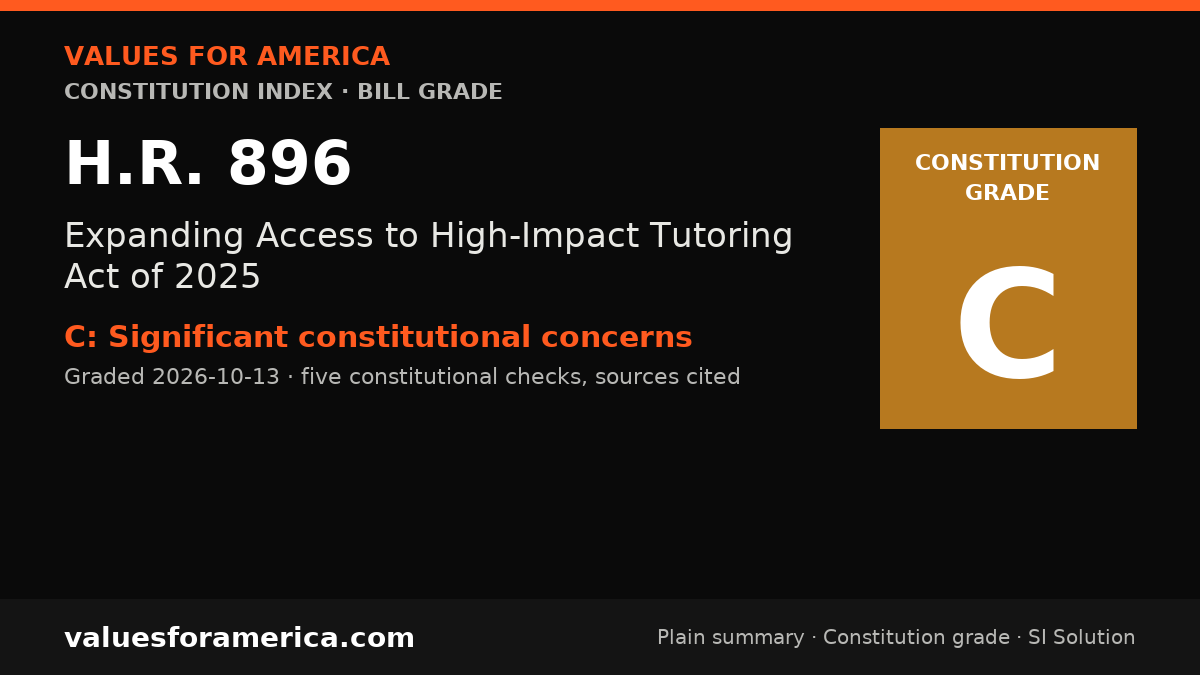
Expanding Access to High-Impact Tutoring Act of 2025
Cosponsors: 6 (5 D, 1 R) · per Congress.gov, 2026-10-12
Introduced: 2025-01-31
Latest action (2025-01-31): Referred to the House Committee on Education and Workforce.
What H.R. 896 does, in plain terms
Expanding Access to High-Impact Tutoring Act of 2025 This bill directs the Department of Education (ED) to award grants to state educational agencies and, through them, subgrants to local educational agencies (LEAs) for implementing, administering, and evaluating tutoring programs in elementary and secondary schools. Additionally, the bill directs ED to establish an advisory board. Among its duties, the advisory board must (1) evaluate and approve plans to ensure that LEAs will meet tutoring program requirements, (2) provide technical assistance and guidance to grant recipients, and (3) develop a nationwide tutoring workforce.
Official summary by the Congressional Research Service, via Congress.gov.
Constitution Index
“VFA Constitution grade”
Significant constitutional concerns
Graded 2026-10-13
SI-generated grade · five published checks · not individually reviewed by a person · methodology
The bill raises significant constitutional concerns because it uses federal funding to direct state and local education policy, an area traditionally reserved to the states under the Tenth Amendment. While Congress has broad spending power, the bill's creation of a federal advisory board to approve local plans and develop a nationwide tutoring workforce goes beyond merely funding and intrudes into state and local control of education. The bill is not a direct violation of individual rights, but it consolidates decision-making at the federal level in a way that is not minimal necessary.
-
✓ Passes · Enumerated powers
Congress may spend for the general welfare under Article I, Section 8, Clause 1, and education grants have been upheld as a valid exercise of the spending power. However, the bill's provisions directing the Department of Education to establish an advisory board that evaluates and approves local plans and develops a nationwide tutoring workforce may exceed the spending power by coercing states into… -
✓ Passes · Bill of Rights
The bill does not directly infringe on any of the first ten amendments. It does not restrict speech, religion, assembly, press, petition, arms, quartering, search and seizure, self-incrimination, due process, takings, fair trial, jury, cruel and unusual punishment, or unenumerated rights. The Tenth Amendment is implicated, but that is addressed under decentralization. -
✓ Passes · Individual sovereignty
The bill does not restrict individual liberty directly. It provides funding for tutoring programs, which is a benefit, not a restriction. However, the federal advisory board's role in developing a nationwide tutoring workforce could potentially lead to federal control over educational content, but as written, it does not directly restrict individual action. -
✗ Concern · Decentralization
The bill fails the decentralization test because it consolidates decision-making at the federal level. While individuals and families can arrange for tutoring privately, and local communities and states can implement tutoring programs without federal involvement, the bill creates a federal advisory board to approve local plans and develop a nationwide tutoring workforce, which is a clear consolida… -
✓ Passes · Due process and takings
The bill does not bypass due process or take property without just compensation. It is a grant program, not a regulatory or enforcement action. There is no deprivation of life, liberty, or property, and no takings issue.
Sources: Congress.gov: HR 896 summary
Report an error in this grade
What should pass
“VFA SI Solution”
No solution yet
A sourced SI draft appears here once it passes automated checks (Constitution citation, source verification, independent SI critic). How publication works.
Related on VFA

For journalists and bloggers
“Embed this grade”
Free to use with the link back. The badge and card update when the grade changes. Embed terms →
