H.R. 875 explained · 119th Congress · Pending in Congress
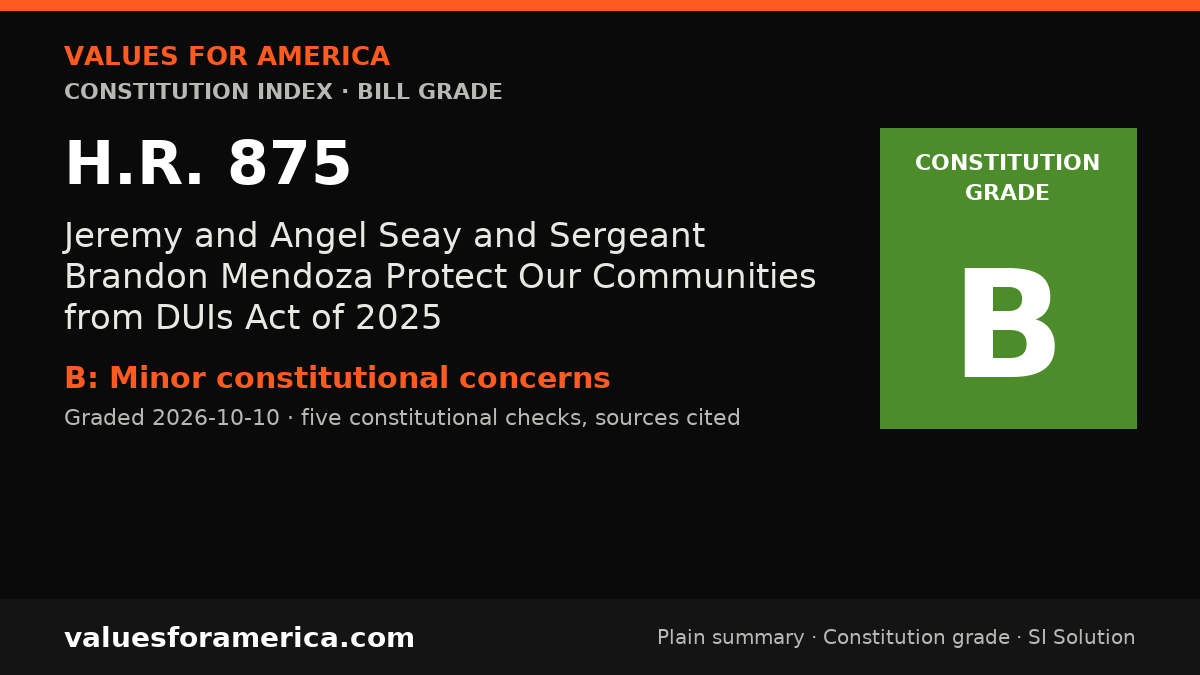
Jeremy and Angel Seay and Sergeant Brandon Mendoza Protect Our Communities from DUIs Act of 2025
Cosponsors: 23 (0 D, 23 R) · per Congress.gov, 2026-10-11
Introduced: 2025-01-31
Latest action (2025-06-27): Received in the Senate and Read twice and referred to the Committee on the Judiciary.
What H.R. 875 does, in plain terms
Jeremy and Angel Seay and Sergeant Brandon Mendoza Protect Our Communities from DUIs Act of 2025 This bill makes driving while intoxicated or impaired a ground for (1) barring a non-U.S. national (alien under federal law) from admission into the United States, or (2) deporting the individual. The bar to admission shall apply to an individual who has been convicted of the offense or has admitted to having committed the acts which constitute the elements of the offense. As a ground for deportability, the individual must have been convicted of the offense.
Official summary by the Congressional Research Service, via Congress.gov.
Constitution Index
“VFA Constitution grade”
Minor constitutional concerns
Graded 2026-10-10
SI-generated grade · five published checks · not individually reviewed by a person · methodology
The bill is a federal immigration measure that falls within Congress's plenary power over immigration and naturalization. It does not infringe on the Bill of Rights, as it applies only to non-citizens seeking admission or already removable, and it respects due process by requiring a conviction for deportation. The main constitutional tension is the admission bar based on an admission of acts, which could raise due process concerns if not accompanied by adequate procedural safeguards. Overall, the bill is mostly sound but requires careful implementation to ensure fairness.
-
✓ Passes · Enumerated powers
Congress has explicit authority over immigration and naturalization under Article I, Section 8, Clause 4, which grants the power to establish a uniform rule of naturalization. Additionally, the Supreme Court has long recognized Congress's plenary power over the admission and deportation of non-citizens. This bill directly exercises that authority by defining grounds for inadmissibility and deporta… -
✓ Passes · Bill of Rights
The bill does not implicate the rights of U.S. citizens or persons within the jurisdiction of the United States in a way that violates the Bill of Rights. Non-citizens seeking admission do not have the same constitutional rights as citizens, and deportation proceedings are civil, not criminal, so the Sixth Amendment right to trial by jury does not apply. The bill does not restrict speech, religion… -
✓ Passes · Individual sovereignty
The bill restricts the ability of non-citizens to enter or remain in the United States, but this is a core exercise of national sovereignty. The government has a compelling interest in public safety and controlling its borders. The restriction is not arbitrary; it is based on criminal conduct or admission of such conduct, which is a legitimate basis for exclusion. The burden on the individual is j… -
✓ Passes · Decentralization
Immigration policy is inherently a federal matter. The Constitution grants the federal government exclusive authority over naturalization and immigration, and the Supreme Court has consistently held that states cannot regulate immigration. This bill does not consolidate decision-making at a higher level than necessary; it is the appropriate level of government for this issue. The four-question tes… -
✗ Concern · Due process and takings
The bill's deportation ground requires a conviction, which satisfies procedural due process. However, the admission bar applies to individuals who have 'admitted to having committed the acts which constitute the elements of the offense.' This could be problematic if the admission was not made knowingly, voluntarily, or with the benefit of counsel. In immigration proceedings, an admission of a crim…
Sources: Congress.gov: HR 875 summary
Report an error in this grade
What should pass
“VFA SI Solution”
No solution yet
A sourced SI draft appears here once it passes automated checks (Constitution citation, source verification, independent SI critic). How publication works.
Related on VFA

For journalists and bloggers
“Embed this grade”
Free to use with the link back. The badge and card update when the grade changes. Embed terms →
