H.R. 8481 explained · 119th Congress · Pending in Congress
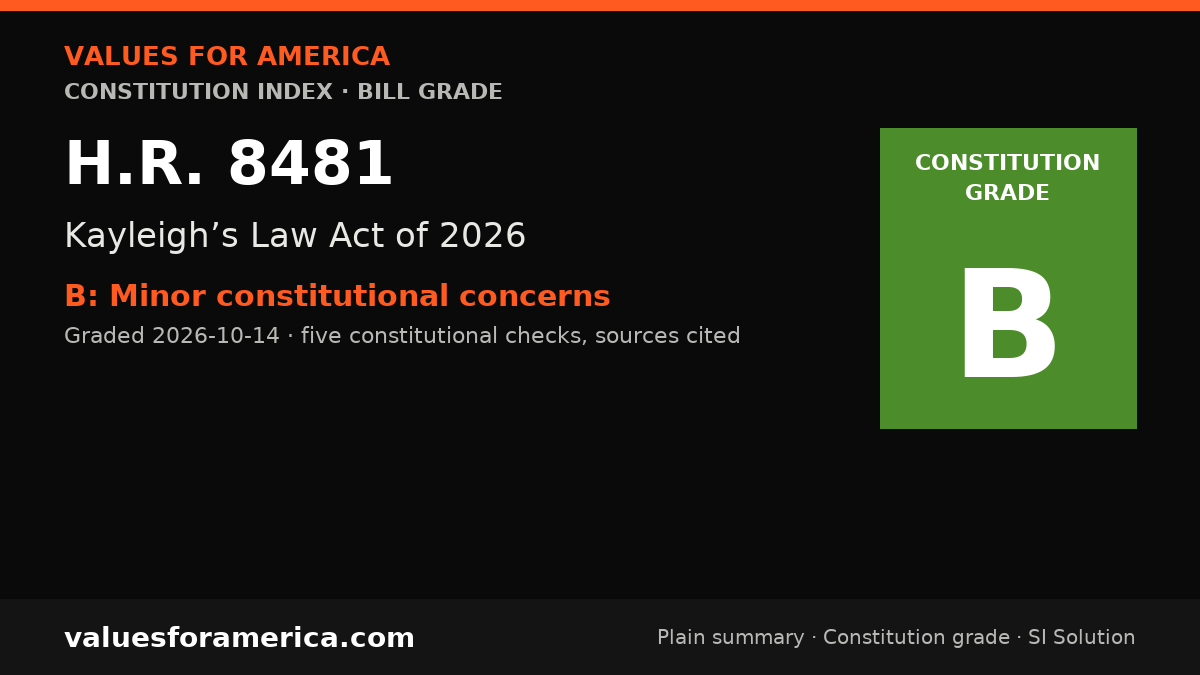
Kayleigh’s Law Act of 2026
Cosponsors: 21 (0 D, 21 R) · per Congress.gov, 2026-10-14
Introduced: 2026-04-23
Latest action (2026-09-14): Received in the Senate and Read twice and referred to the Committee on the Judiciary.
What H.R. 8481 does, in plain terms
Kayleigh’s Law Act of 2026 This bill establishes a federal statutory framework to require federal courts to issue an order prohibiting contact with a victim (i.e., a no-contact order) in the case of a defendant who is convicted of certain violent crimes or sex crimes. Specifically, in the case of a defendant convicted of a felony offense that is a crime of violence or that involves a sexual act or sexual conduct, on a motion by the victim or federal government, the court must issue a no-contact order. Under the framework, the no-contact order must be imposed at sentencing and be in effect for the lifetime of the defendant unless it is terminated or suspended in accordance with specified procedures. Additionally, no fee may be assessed or collected from a victim in connection with the issuance of a no-contact order.
Official summary by the Congressional Research Service, via Congress.gov.
Constitution Index
“VFA Constitution grade”
Minor constitutional concerns
Graded 2026-10-14
SI-generated grade · five published checks · not individually reviewed by a person · methodology
The bill is largely constitutional as it operates within federal criminal jurisdiction over violent and sex crimes, and it does not infringe on core rights. However, the lifetime duration of no-contact orders, absent periodic review, raises due process concerns that warrant amendment.
-
✓ Passes · Enumerated powers
The federal government has enumerated power under Article I, Section 8, Clause 6 (to define and punish offenses against the law of nations) and, more relevantly, under the Necessary and Proper Clause (Article I, Section 8, Clause 18) to enact laws governing federal criminal procedure. The bill applies to defendants convicted of federal violent or sex crimes, which are within Congress's authority t… -
✓ Passes · Bill of Rights
The bill does not implicate the First, Second, Third, Fourth, Sixth, Seventh, Eighth, or Ninth Amendments. It does not restrict speech, assembly, or religion; it does not involve searches or seizures; it does not affect trial rights; and it does not impose cruel or unusual punishment. The no-contact order is a civil regulatory condition of sentencing, not a criminal penalty, and does not violate t… -
✓ Passes · Individual sovereignty
The bill restricts a convicted felon's liberty by prohibiting contact with a victim, but this restriction is directly tied to the conviction for a violent or sex crime. The government has a compelling interest in protecting victims from further harm. The restriction is narrowly tailored to the offense and does not restrict lawful activities unrelated to the victim. The burden on the individual is … -
✓ Passes · Decentralization
The bill addresses federal criminal procedure, which cannot be handled by individuals, local communities, or states because it applies to federal courts and federal crimes. The federal government is the appropriate level to regulate its own judicial processes. The bill does not consolidate decision-making upward; it merely sets a uniform rule for federal courts, which is within federal authority. -
✗ Concern · Due process and takings
The bill's lifetime no-contact order, without mandatory periodic review, raises substantive due process concerns. While the government has a legitimate interest in protecting victims, a permanent restriction on association with a specific person, imposed at sentencing, may be overbroad if the defendant's circumstances change (e.g., rehabilitation, victim's consent). The bill does provide procedure…
Sources: Congress.gov: HR 8481 summary
Report an error in this grade
What should pass
“VFA SI Solution”
No solution yet
A sourced SI draft appears here once it passes automated checks (Constitution citation, source verification, independent SI critic). How publication works.
Related on VFA

For journalists and bloggers
“Embed this grade”
Free to use with the link back. The badge and card update when the grade changes. Embed terms →
