H.R. 8466 explained · 119th Congress · Pending in Congress
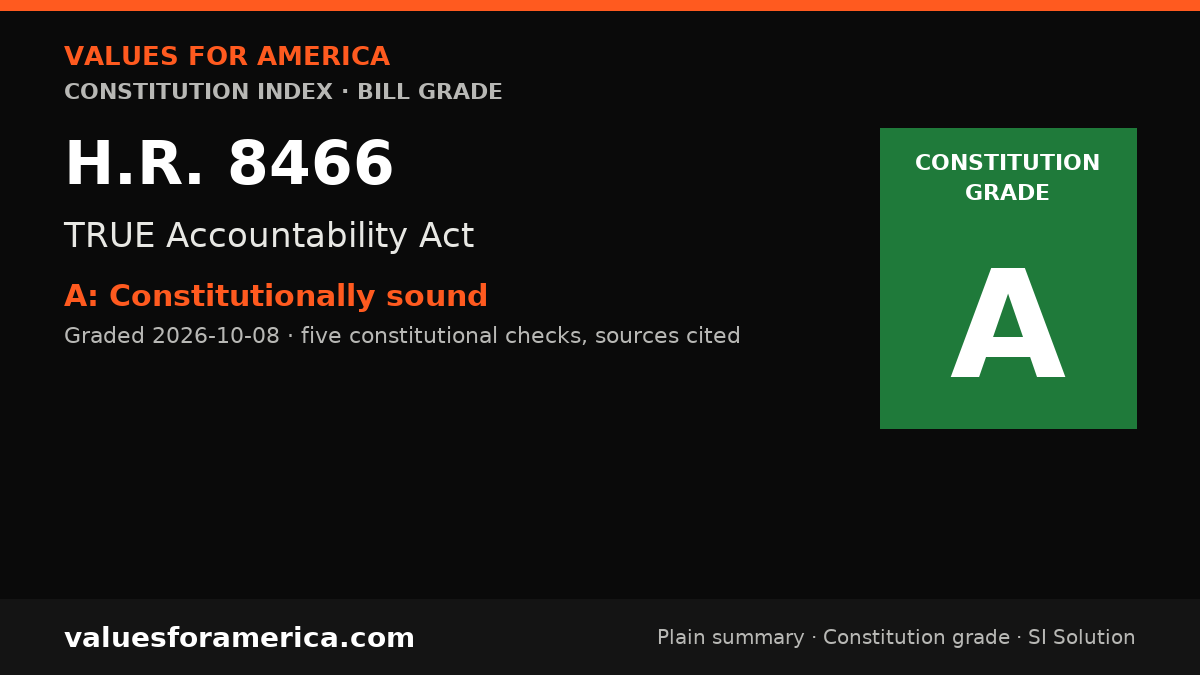
TRUE Accountability Act
Cosponsors: 1 (1 D, 0 R) · per Congress.gov, 2026-10-08
Introduced: 2026-04-23
Latest action (2026-06-09): Received in the Senate and Read twice and referred to the Committee on Homeland Security and Governmental Affairs.
What H.R. 8466 does, in plain terms
Taxpayer Resources Used in Emergencies Accountability Act or the TRUE Accountability Act This bill requires agencies to develop and implement plans for preventing fraud and improper payments relating to federal emergency spending (e.g., providing funding relating to disasters or pandemics). The Office of Management and Budget (OMB) must issue, and review every three years, guidance to agencies for developing plans with appropriate internal controls. The guidance must incorporate the current Government Accountability Office frameworks for managing fraud risk in federal programs and managing improper payments in federal emergency assistance. Within one year after the bill’s enactment, agencies must submit to OMB plans required by the guidance. Each plan must include procedures to (1) evaluate the risk of financial loss to the federal government caused by improper payments and fraud relating to the agency’s federal emergency spending; (2) develop risk reduction strategies that are, to the extent possible, implemented prior to expenditure; and (3) adopt payment monitoring to identify and reduce improper and fraudulent payments (e.g., anomaly detection). Agencies must revise and resubmit plans, as necessary, at least every three years. OMB must annually submit the plans to Congress along with information relating to helping agencies implement the plans and legislative recommendations for emergency appropriations.
Official summary by the Congressional Research Service, via Congress.gov.
Constitution Index
“VFA Constitution grade”
Constitutionally sound
Graded 2026-10-08
SI-generated grade · five published checks · not individually reviewed by a person · methodology
Internal fraud-control planning for federal emergency funds is a proper exercise of Congress spending and oversight authority, with no rights restriction, private mandate, taking, or upward consolidation of power.
-
✓ Passes · Enumerated powers
Congress has express authority over federal spending through Article I, Section 8, Clause 1 on laying and collecting revenue and providing for the general welfare, and Article I, Section 9, Clause 7 requiring appropriations for withdrawals from the Treasury. Directing OMB and agencies to plan against fraud in emergency appropriations is a necessary and proper means of executing that spending power… -
✓ Passes · Bill of Rights
The bill creates internal planning, risk assessment, and payment monitoring duties for federal agencies. It does not restrict speech under the First Amendment, does not regulate arms under the Second Amendment, does not authorize searches or seizures under the Fourth Amendment, and does not compel testimony under the Fifth Amendment. No criminal penalty, speech code, or property seizure is created… -
✓ Passes · Individual sovereignty
The bill regulates government fiscal administration, not private conduct. It does not restrict what a person may do with their person, property, speech, labor, or belief. No mandate, prohibition, or license is imposed on private citizens, so no compelling justification burden arises under the Ninth Amendment and the liberty protected by the Fifth Amendment. -
✓ Passes · Decentralization
Federal emergency spending is already federal money appropriated by Congress. Individuals, local communities, and states cannot set internal controls for federal agency disbursements. The bill does not transfer state or local decisions to Washington; it only governs how federal agencies manage funds Congress already provided, consistent with the Tenth Amendment reservation for non-delegated powers… -
✓ Passes · Due process and takings
No fines, forfeitures, criminal presumptions, or property seizures are authorized. The bill requires risk plans and anomaly detection to reduce improper payments, but does not permit taking private property without just compensation under the Fifth Amendment Takings Clause, nor does it remove notice or hearing required by the Fifth Amendment Due Process Clause and Article III, Section 2.
Sources: Congress.gov: HR 8466 summary
Report an error in this grade
What should pass
“VFA SI Solution”
No solution yet
A sourced SI draft appears here once it passes automated checks (Constitution citation, source verification, independent SI critic). How publication works.
Related on VFA

For journalists and bloggers
“Embed this grade”
Free to use with the link back. The badge and card update when the grade changes. Embed terms →
