H.R. 845 explained · 119th Congress · Pending in Congress
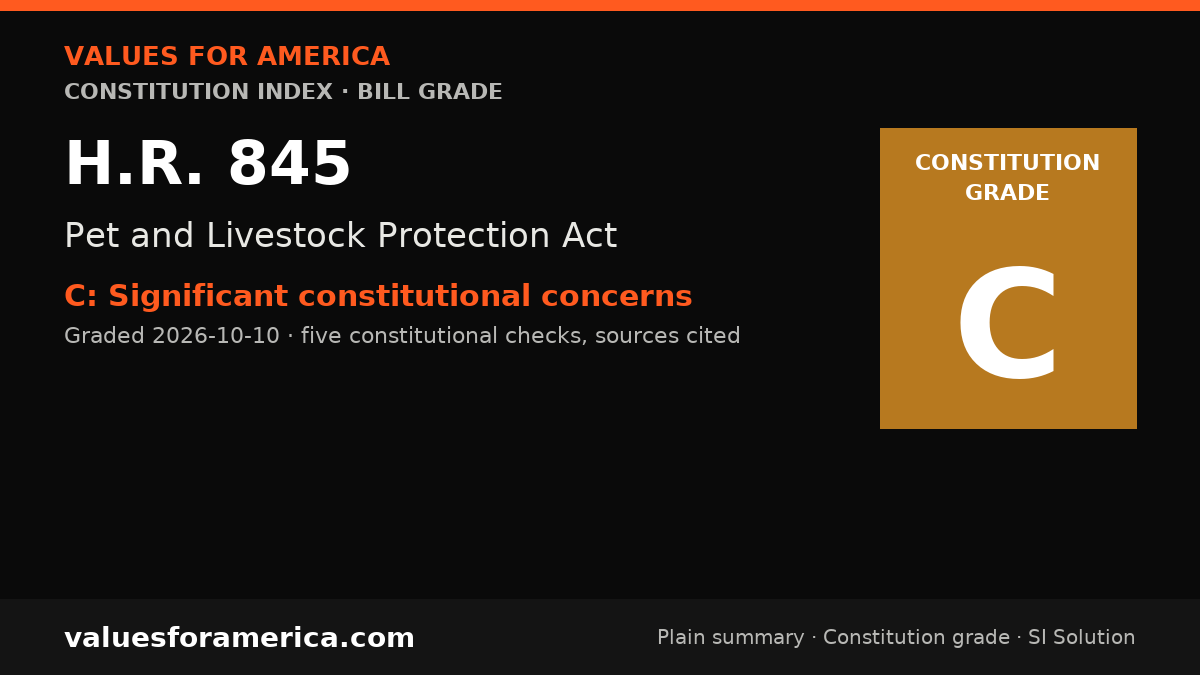
Pet and Livestock Protection Act
Cosponsors: 37 (0 D, 37 R) · per Congress.gov, 2026-10-09
Introduced: 2025-01-31
Latest action (2025-12-18): Received in the Senate and Read twice and referred to the Committee on Environment and Public Works.
What H.R. 845 does, in plain terms
Pet and Livestock Protection Act of 2025 This bill directs the Department of the Interior to remove protections for the gray wolf under the Endangered Species Act of 1973 (ESA). Specifically, the bill requires Interior to reissue the final rule titled Endangered and Threatened Wildlife and Plants; Removing the Gray Wolf (Canis lupus) From the List of Endangered and Threatened Wildlife and published on November 3, 2020. The rule removed the gray wolf in the lower 48 United States, except for the Mexican wolf (C. l. baileyi) subspecies, from the endangered and threatened species list. However, the U.S. District Court for the Northern District of California vacated the rule on February 10, 2022. As a result, the gray wolf reattained the protection status it had prior to the rule's promulgation. The bill also prohibits the reissuance of the rule from being subject to judicial review.
Official summary by the Congressional Research Service, via Congress.gov.
Constitution Index
“VFA Constitution grade”
Significant constitutional concerns
Graded 2026-10-10
SI-generated grade · five published checks · not individually reviewed by a person · methodology
The Pet and Livestock Protection Act raises significant constitutional concerns primarily because it prohibits judicial review of an agency action, which likely violates Article III's vesting of judicial power and the Due Process Clause of the Fifth Amendment. While the substantive delisting of the gray wolf falls within Congress's enumerated powers under the Commerce Clause, the removal of court oversight undermines the separation of powers and individual rights to challenge government action.
-
✓ Passes · Enumerated powers
Congress has authority under Article I, Section 8, Clause 3 (Commerce Clause) to regulate endangered species, as the Supreme Court has consistently upheld the Endangered Species Act as a valid exercise of federal power over interstate commerce. Directing the Department of the Interior to reissue a specific rule is a permissible delegation of legislative authority. -
✗ Concern · Bill of Rights
The provision prohibiting judicial review of the reissued rule implicates the Fifth Amendment's Due Process Clause, which guarantees access to courts for challenges to agency actions that affect property or liberty interests. While the Bill of Rights does not explicitly guarantee judicial review of every administrative action, the Supreme Court has held that Congress cannot completely bar review o… -
✓ Passes · Individual sovereignty
The bill does not directly restrict individual conduct, property, speech, labor, or belief. It addresses federal management of a species under the ESA, which does not impose direct burdens on individual sovereignty. However, the prohibition on judicial review indirectly affects individuals who might seek to challenge the rule, but this is more properly analyzed under due process. -
✗ Concern · Decentralization
The bill fails the decentralization test because it consolidates decision-making at the federal level regarding wolf management, which could be handled by states. The gray wolf's recovery has led to successful state-level management in several states (e.g., Montana, Idaho, Wyoming). The federal government's continued involvement under the ESA preempts state authority, violating the Tenth Amendment… -
✗ Concern · Due process and takings
The provision barring judicial review of the reissued rule violates procedural due process under the Fifth Amendment. The Supreme Court has held that 'the opportunity to be heard must be granted at a meaningful time and in a meaningful manner' (Mathews v. Eldridge, 424 U.S. 319 (1976)). Completely precluding judicial review of an agency action that affects property interests (e.g., livestock owner…
Sources: Congress.gov: HR 845 summary
Report an error in this grade
What should pass
“VFA SI Solution”
No solution yet
A sourced SI draft appears here once it passes automated checks (Constitution citation, source verification, independent SI critic). How publication works.
Related on VFA

For journalists and bloggers
“Embed this grade”
Free to use with the link back. The badge and card update when the grade changes. Embed terms →
