H.R. 8312 explained · 119th Congress · Pending in Congress
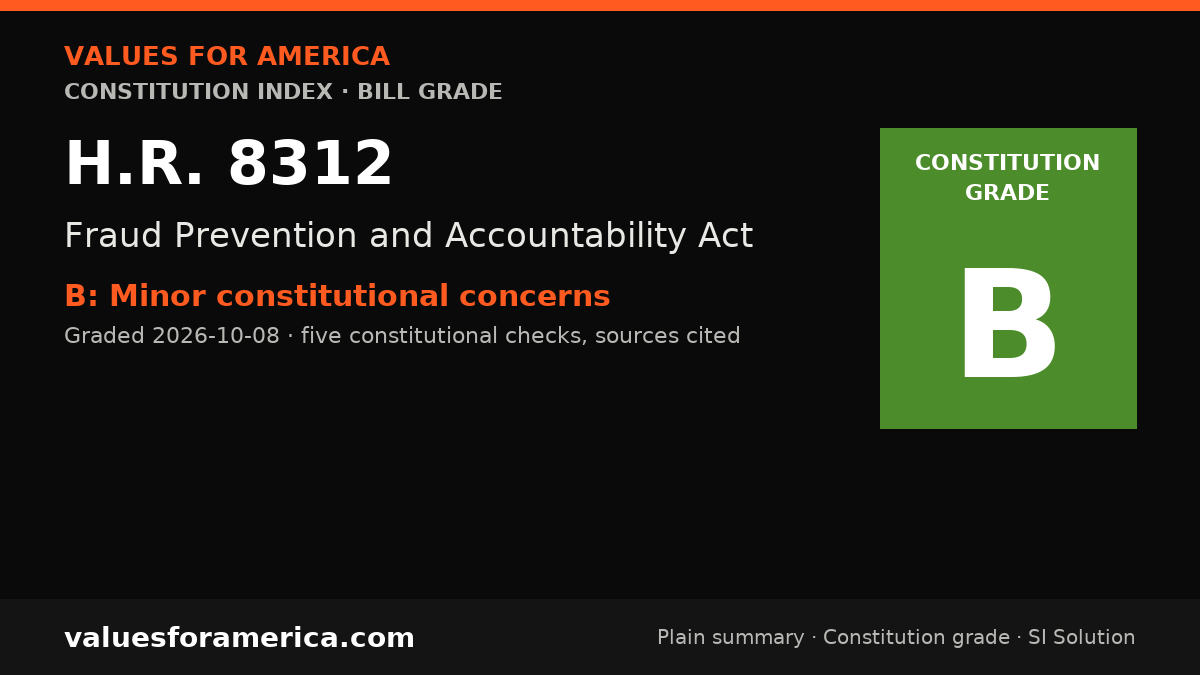
Fraud Prevention and Accountability Act
Cosponsors: 1 (0 D, 1 R) · per Congress.gov, 2026-10-14
Introduced: 2026-04-15
Latest action (2026-06-11): Received in the Senate.
What H.R. 8312 does, in plain terms
Fraud Prevention and Accountability Act This bill (1) assigns financial integrity, improper payment prevention, and spending transparency functions to the Bureau of the Fiscal Service (BFS) within the Department of the Treasury; (2) establishes an Office of the Inspector General for Fraud, Accountability, and Recovery (OIGFAR) within Treasury; and (3) requires Treasury to enter into data sharing agreements with other federal agencies and allowable private entities to prevent fraud and improper payments. Functions assigned to BFS by the bill include administering the Do Not Pay system (which provides federal agencies and federally funded state-administered programs the ability to verify recipient identity and eligibility before making an award or issuing a payment); maintaining a voluntary governmentwide program to provide data sharing and analysis to federal agencies and to state, local, or tribal governments responsible for administering a federally funded program in order to detect fraud and prevent improper payments that result in financial loss; and supporting OIGFAR by providing access to information technology and data. The duties of OIGFAR include auditing and investigating the use of certain federal funds, such as funds, loans, and tax credits made available by various coronavirus response laws; any federal award of $50,000 or more; and emergency spending related to disaster relief or economic recovery. OIGFAR must ensure the expeditious reporting of suspected violations of federal criminal law to the Department of Justice. OIGFAR is authorized to provide investigative support to prosecutive and enforcement authorities to protect program integrity and prevent, detect, and prosecute fraud.
Official summary by the Congressional Research Service, via Congress.gov.
Constitution Index
“VFA Constitution grade”
Minor constitutional concerns
Graded 2026-10-08
SI-generated grade · five published checks · not individually reviewed by a person · methodology
Constitutional exercise of the spending and necessary-and-proper powers to prevent fraud in federal payments, with oversight retained in courts. Minor Fourth Amendment tension from interagency and private-entity data sharing requires privacy safeguards, but no direct rights violation, warranting a B.
-
✓ Passes · Enumerated powers
Congress has explicit authority under Article I, Section 8, Clause 1 to lay and collect taxes and provide for the general welfare through spending, and to safeguard that spending from fraud and improper payments. Assignment of integrity functions to Treasury BFS and creation of a Treasury Inspector General office is authorized by Article I, Section 8, Clause 18, the Necessary and Proper Clause, to… -
✓ Passes · Bill of Rights
No direct infringement of First, Second, Fifth self-incrimination, Sixth, Seventh, or Eighth Amendment rights. The data-sharing provisions implicate Fourth Amendment reasonableness because Treasury will share payment-eligibility data with other agencies and allowable private entities. Because the program is limited to verifying identity and eligibility for federal payments and awards under the Do … -
✓ Passes · Individual sovereignty
The bill does not restrict what a person may do with their person, property, speech, labor, or belief. It conditions receipt of federal funds, loans, tax credits, and awards on identity and eligibility verification and subjects use of federal funds to audit. No compelled speech, no restriction on private labor or belief, and no general mandate on private conduct. The burden on recipients is limite… -
✓ Passes · Decentralization
Federal funds require federal stewardship. (1) Individuals cannot prevent government-wide improper payments. (2) Local or county governments cannot oversee federal agency payments. (3) States cannot audit federal disaster, coronavirus, and $50,000+ federal awards government-wide. (4) The bill does not consolidate new substantive regulatory power upward; it centralizes integrity functions for exist… -
✓ Passes · Due process and takings
No taking of property without just compensation under Fifth Amendment Takings Clause, and no bypass of procedural due process under Fifth Amendment Due Process Clause. OIGFAR audits, investigates, and refers suspected criminal violations to the Department of Justice and provides investigative support, but prosecution and adjudication remain with executive prosecutors and Article III courts with no…
Sources: Congress.gov: HR 8312 summary
Report an error in this grade
The Framers
“Founders’ Verdict”
Confidence 0.75
Archived SI output (machine-generated)No editorial review recorded. This historical SI verdict was machine-generated by software and predates the review desk; check it against the official bill text.
Synthesis
The bill is constitutional only if its scope is strictly limited to preventing fraud involving federal funds or programs, and does not infringe upon state police powers or individual rights such as those protected by the First and Fourth Amendments. Congress must ensure its provisions are directly tied to an enumerated power and that any new agency's authority is confined to federal matters.
The Fraud Prevention and Accountability Act, pertaining to government operations and politics, falls within Congress's constitutional authority to administer federal programs and ensure the integrity of public funds. Under Article I, Section 8, Clause 18, Congress has the power to make all laws which shall be necessary and proper for carrying into execution its enumerated powers, including the power to spend for the general welfare and to regulate federal property and operations. The Act's aim to prevent fraud in government operations is a legitimate exercise of this implied power, as it secur…
This bill, by creating new federal oversight and enforcement mechanisms for fraud prevention, exceeds the limited powers delegated to the general government by the Constitution. The Tenth Amendment reserves to the States or to the people all powers not expressly granted to the United States. The enumerated powers in Article I, Section 8 do not include a general police power to regulate fraud across all domains; such authority belongs to the several States under their reserved powers. Furthermore, the First Amendment protects the freedom of speech and press, and any federal law that chills or p…
The proposed act’s establishment of a new federal agency for fraud detection must be assessed under the necessary and proper clause (Article I, Section 8, Clause 18) and the principle of enumerated powers. Congress may create agencies to execute its express powers, such as regulating interstate commerce or ensuring the faithful execution of laws. However, in accordance with Federalist No. 45, where the powers delegated by the proposed Constitution to the federal government are few and defined, any new agency’s authority must be strictly tied to a constitutionally enumerated power. If the agenc…
This Act, if it imposes new duties on federal officers beyond those enumerated in the Constitution, must be examined under the necessary and proper clause. Congress may enact laws that are necessary and proper for carrying into execution its enumerated powers, but it cannot exceed the limits of those powers. If the Act merely provides for the faithful execution of existing laws and the punishment of fraud against the United States, it is constitutional. However, if it creates new offices or powers not incident to any enumerated power, it would be void. The judiciary, as established in Marbury …
Report an error in this Founders' Verdict
What should pass
“VFA SI Solution”
Archived SI output (machine-generated) · No editorial review recorded
This historical draft has no editorial review time on record. Check its claims against the original bill and current law.
Federal Program Integrity and Oversight Enhancement Act
Generated by VFA SI Solutions
To reduce fraud in federal programs by increasing penalties, expanding surveillance authority, and creating new federal crimes for misuse of government funds.
Bipartisan rationale: Honors Democratic priorities by preserving state enforcement roles under the Tenth Amendment, requiring warrants for investigations, and limiting criminal penalties to high-threshold cases. Honors Republican priorities by creating a focused oversight body, imposing civil fines, and including a sunset clause to prevent permanent expansion of federal authority.
Article I, Section 8, Clause 1 Article I, Section 8, Clause 18 Amendment IV Amendment V Amendment VI Amendment X
Report an error in this Solution
Citizen Consensus
“Do you support this VFA SI Solution?”
One vote per verified account; you can change it any time. Only verified accounts count, results publish once 30 verified people have voted, and state and district results count only people who attested a home ZIP code. How this works.
Email verification is not switched on yet, so no vote counts toward results yet. Votes cast now are saved and count once the voter verifies their email address.
Sign in or create a free account to vote.
Add a short reason (optional)
/280 · no links or contact details · reasons are reviewed before anyone sees them, and many never are shown.
Your vote is saved but held out of published results by an automated integrity check (for example, several accounts voting from one browser).
Your vote is saved. It will count once you verify your email address. Verify on your account page.
Your vote counts nationally. Add your home ZIP code to count in your state and district too.
Your vote counts nationally and in .
Reason saved privately; it is shown only if it passes review.
Verified participants nationwide · n =
Self-selected participants, not a random sample; ± is the 95% sampling margin.
Not enough verified votes yet. Results publish at verified votes.
A sudden surge of votes on this item was flagged and is under review; votes from new accounts in that surge are held out until it is resolved.
Related on VFA

For journalists and bloggers
“Embed this grade”
Free to use with the link back. The badge and card update when the grade changes. Embed terms →
