H.R. 825 explained · 119th Congress · Pending in Congress
Assisting Small Businesses Not Fraudsters Act
Cosponsors: 3 (3 D, 0 R) · per Congress.gov, 2026-10-12
Introduced: 2025-01-28
Latest action (2025-02-25): Received in the Senate and Read twice and referred to the Committee on Small Business and Entrepreneurship.
What H.R. 825 does, in plain terms
Assisting Small Businesses Not Fraudsters Act This bill prohibits individuals convicted of certain financial crimes from receiving assistance from the Small Business Administration (SBA). Specifically, the bill prohibits individuals who have been convicted of a crime involving financial misconduct or a false statement with respect to certain COVID-19 loans (e.g., Paycheck Protection Program loans, Restaurant Revitalization Fund grants, and Shuttered Venue Operators grants) from receiving any financial assistance from the SBA (other than a disaster loan). The prohibition includes SBA assistance to small businesses that have an owner, officer, director, or key employee who has been convicted of such a crime.
Official summary by the Congressional Research Service, via Congress.gov.
Constitution Index
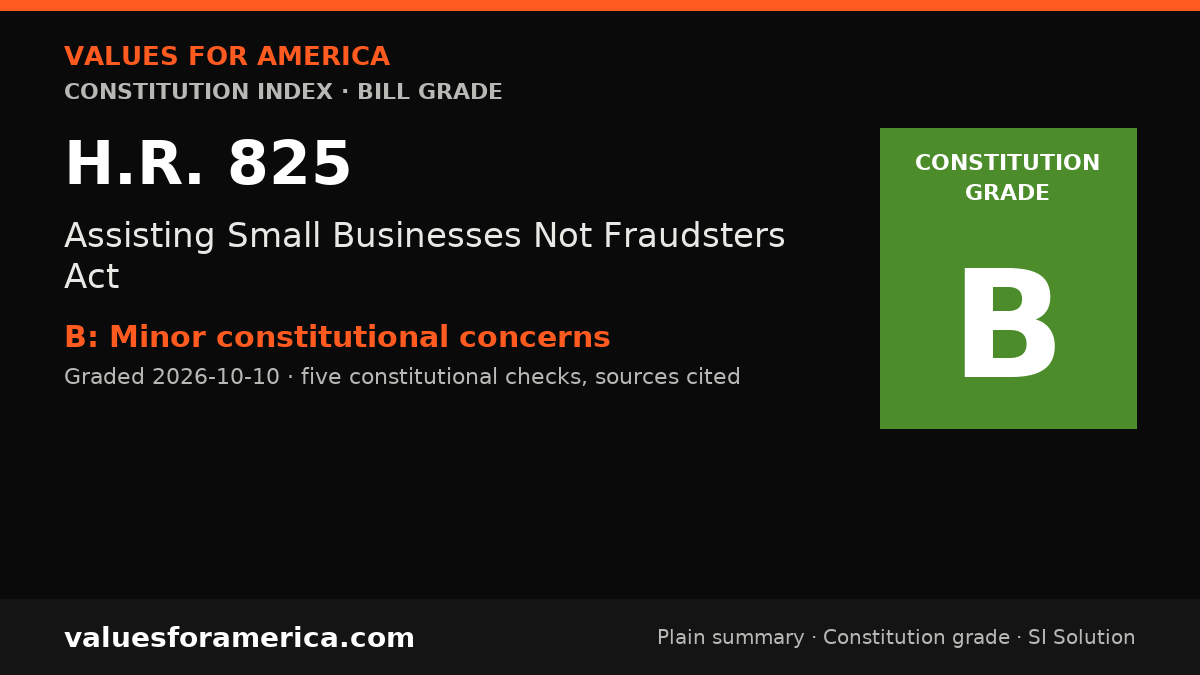
“VFA Constitution grade”
Minor constitutional concerns
Graded 2026-10-10
SI-generated grade · five published checks · not individually reviewed by a person · methodology
The bill is mostly sound but has minor constitutional tensions. It operates within Congress's enumerated commerce power and does not directly infringe the Bill of Rights, but the permanent ban on SBA assistance for individuals convicted of financial crimes raises minor concerns under the Eighth Amendment's prohibition on excessive penalties and the Fifth Amendment's due process protections. The decentralization check shows the bill appropriately leaves implementation to the federal agency without consolidating power upward beyond necessity.
-
✓ Passes · Enumerated powers
Congress has authority under Article I, Section 8, Clause 3 (Commerce Clause) to regulate small business lending programs, including the Small Business Administration. The bill's restriction on SBA assistance is a valid exercise of Congress's power to set conditions on federal spending programs under the Spending Clause (Article I, Section 8, Clause 1). -
✓ Passes · Bill of Rights
The bill does not restrict speech, religion, assembly, press, petition, arms, quartering, search and seizure, self-incrimination, trial rights, or cruel and unusual punishment. The permanent ban on SBA assistance for convicted individuals could be argued as an additional punishment beyond the criminal sentence, but it is a civil regulatory measure tied to eligibility for federal benefits, not a cr… -
✓ Passes · Individual sovereignty
The restriction applies only to individuals convicted of specific financial crimes after due process. The government has a compelling interest in preventing fraud in federal lending programs. The burden on individuals is proportional to the harm caused by their criminal conduct. The bill does not restrict lawful behavior or impose arbitrary conditions on innocent persons. -
✓ Passes · Decentralization
The bill passes all four questions: (1) Individuals cannot self-regulate fraud in federal lending programs; (2) Local communities cannot enforce uniform eligibility rules for a federal agency; (3) States cannot set conditions on federal SBA assistance; (4) The bill does not consolidate decision-making upward beyond necessity—it merely restricts eligibility for an existing federal program. The Tent… -
✓ Passes · Due process and takings
The bill applies only to individuals who have been convicted after a full criminal trial or guilty plea, satisfying procedural due process. There is no taking of private property—SBA assistance is a discretionary government benefit, not a vested property right. The bill does not impose punishment without trial or deprive anyone of life, liberty, or property without fair notice and hearing.
Sources: Congress.gov: HR 825 summary
Report an error in this grade
What should pass
“VFA SI Solution”
No solution yet
A sourced SI draft appears here once it passes automated checks (Constitution citation, source verification, independent SI critic). How publication works.
Related on VFA

For journalists and bloggers
“Embed this grade”
Free to use with the link back. The badge and card update when the grade changes. Embed terms →
