H.R. 815 explained · 119th Congress · Pending in Congress
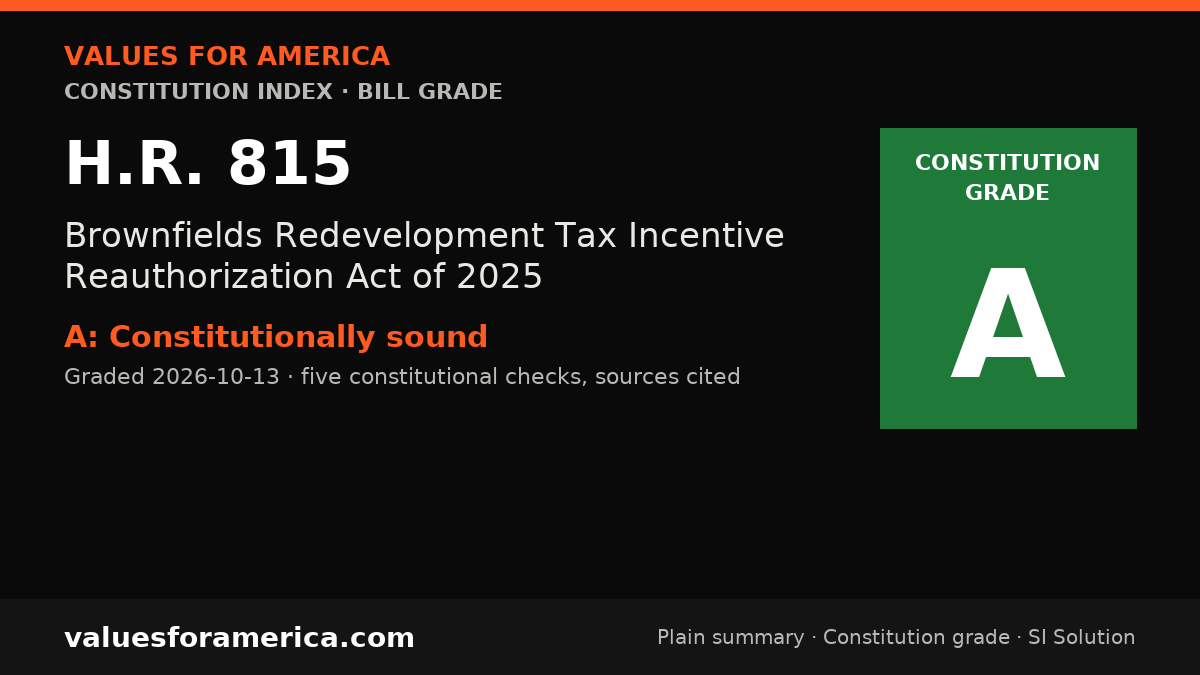
Brownfields Redevelopment Tax Incentive Reauthorization Act of 2025
Cosponsors: 3 (1 D, 2 R) · per Congress.gov, 2026-10-12
Introduced: 2025-01-28
Latest action (2025-01-28): Referred to the House Committee on Ways and Means.
What H.R. 815 does, in plain terms
Brownfields Redevelopment Tax Incentive Reauthorization Act of 2025 This bill temporarily reinstates the election to expense environmental remediation costs paid or incurred in connection with the cleanup of certain business property (also known as the brownfields redevelopment tax incentive). (The election to expense allows a taxpayer to deduct such costs in the year incurred rather than treat such costs as capital expenses that are depreciated over a period of time.) The brownfields redevelopment tax incentive allows a taxpayer to elect to expense costs that would otherwise be capitalized and are paid or incurred before 2012 in connection with the abatement or control of a hazardous substance on property (1) used in a trade or business, (2) for the production of income, or (3) held by the taxpayer primarily for sale in the ordinary course of a trade or business. (Some limitations apply.) Under the bill, a taxpayer may elect to expense such environmental remediation costs paid or incurred in 2025-2028.
Official summary by the Congressional Research Service, via Congress.gov.
Constitution Index
“VFA Constitution grade”
Constitutionally sound
Graded 2026-10-13
SI-generated grade · five published checks · not individually reviewed by a person · methodology
The bill is a temporary tax incentive that falls squarely within Congress's enumerated power to lay and collect taxes under Article I, Section 8, Clause 1. It does not infringe on any constitutional right, does not restrict individual sovereignty, and does not centralize decision-making beyond the federal level—it merely adjusts the timing of deductions for federal tax purposes. The bill also respects due process and does not involve any taking of property.
-
✓ Passes · Enumerated powers
Congress has the explicit power to lay and collect taxes under Article I, Section 8, Clause 1. This bill modifies the tax code by temporarily reinstating an election to expense environmental remediation costs, which is a direct exercise of that taxing power. No other enumerated power is needed, as the bill is purely a tax measure. -
✓ Passes · Bill of Rights
The bill does not implicate any of the first ten amendments. It does not restrict speech, religion, assembly, press, petition, arms, quartering, search and seizure, self-incrimination, due process, takings, trial rights, or cruel and unusual punishment. It is a tax incentive that encourages voluntary cleanup, not a restriction on any right. -
✓ Passes · Individual sovereignty
The bill does not restrict what individuals can do with their person, property, speech, labor, or belief. Instead, it provides a tax benefit to taxpayers who voluntarily incur environmental remediation costs. The burden is on the government to justify restrictions, and here there is no restriction—only an optional tax election. -
✓ Passes · Decentralization
The bill passes all four questions of the decentralization test. (1) Individuals and families can handle their own tax filings without government involvement, but the federal tax system is already established; this bill merely adjusts a deduction. (2) Local communities and counties do not need to be involved in federal tax policy. (3) States cannot regulate federal income tax, so the federal gover… -
✓ Passes · Due process and takings
The bill does not bypass due process or take property without just compensation. It is a voluntary tax election that provides a benefit to taxpayers. There is no deprivation of life, liberty, or property, and no arbitrary government action. The Fifth Amendment's Takings Clause is not implicated because the bill does not take any property.
Sources: Congress.gov: HR 815 summary
Report an error in this grade
What should pass
“VFA SI Solution”
No solution yet
A sourced SI draft appears here once it passes automated checks (Constitution citation, source verification, independent SI critic). How publication works.
Related on VFA

For journalists and bloggers
“Embed this grade”
Free to use with the link back. The badge and card update when the grade changes. Embed terms →
