H.R. 8141 explained · 119th Congress · Pending in Congress
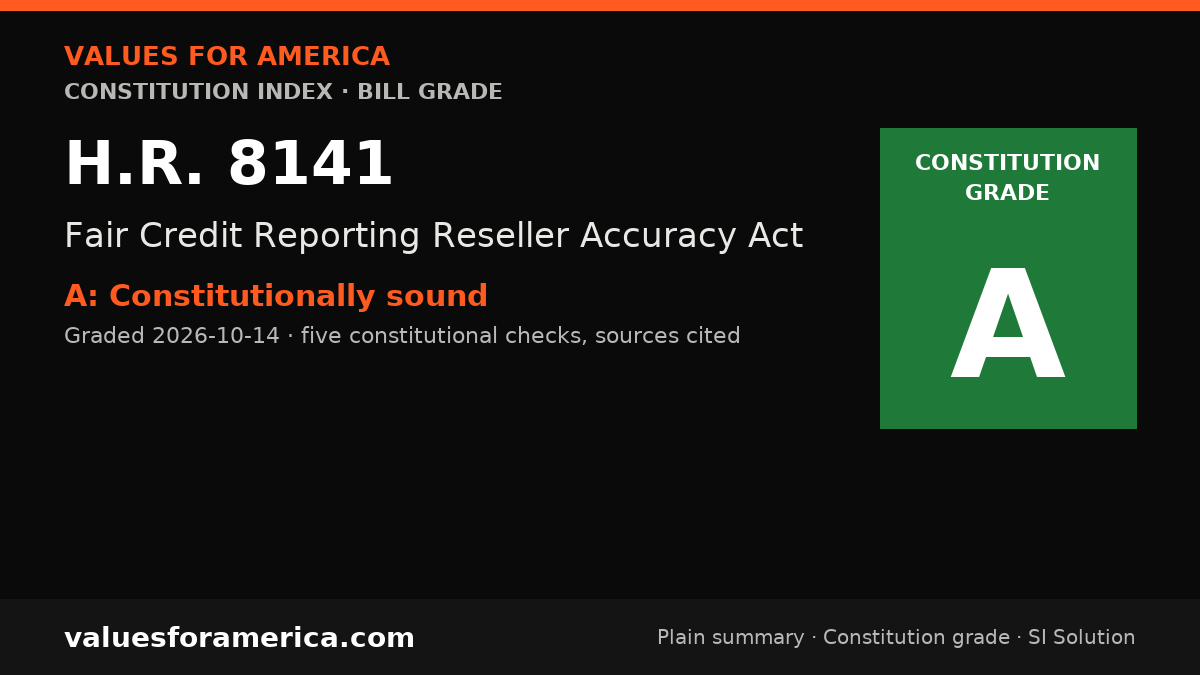
Fair Credit Reporting Reseller Accuracy Act
Cosponsors: 3 (1 D, 2 R) · per Congress.gov, 2026-10-14
Introduced: 2026-03-27
Latest action (2026-09-01): Placed on the Union Calendar, Calendar No. 689.
What H.R. 8141 does, in plain terms
Fair Credit Reporting Reseller Accuracy Act This bill requires a consumer credit data reseller (a consumer reporting agency that does not maintain a credit database of its own, but assembles and merges a consumer's credit information from other agencies that it provides to a third party) to follow reasonable procedures to ensure the maximum possible accuracy of the credit information it provides. A reseller may not be held liable under the Fair Credit Reporting Act for the information it provides if the reseller accurately communicates the information obtained from another consumer reporting agency.
Official summary by the Congressional Research Service, via Congress.gov.
Constitution Index
“VFA Constitution grade”
Constitutionally sound
Graded 2026-10-14
SI-generated grade · five published checks · not individually reviewed by a person · methodology
The bill is a modest consumer protection measure that imposes accuracy requirements on credit data resellers, a category of consumer reporting agencies. It operates within Congress's enumerated power over interstate commerce, does not infringe on any constitutional right, and does not centralize authority beyond what is necessary for a national credit reporting system. The liability shield for accurate resellers preserves fairness and due process.
-
✓ Passes · Enumerated powers
Congress has authority under Article I, Section 8, Clause 3 (Commerce Clause) to regulate consumer credit reporting because credit reporting agencies operate across state lines and credit information is an article of interstate commerce. The Fair Credit Reporting Act (FCRA) has long been upheld as a valid exercise of this power, and this bill amends the FCRA to address resellers specifically. The … -
✓ Passes · Bill of Rights
The bill does not implicate any of the first ten amendments. It imposes procedural accuracy requirements on businesses, not on individuals' speech, religion, assembly, press, petition, arms, quartering, search, self-incrimination, trial rights, or cruel punishment. It does not restrict any protected activity. -
✓ Passes · Individual sovereignty
The bill does not restrict individual liberty. Instead, it enhances consumer sovereignty by requiring credit resellers to follow reasonable procedures to ensure accuracy, thereby protecting individuals from the harms of inaccurate credit reporting. The liability shield for accurate resellers does not burden individuals; it merely clarifies that a reseller who faithfully transmits information from … -
✓ Passes · Decentralization
Credit reporting is inherently national in scope; a single consumer's credit file may be assembled from multiple agencies across state lines, and the credit system relies on uniform national standards. An individual cannot realistically manage the accuracy of all credit data without government assistance, and local or state governments cannot effectively regulate a national network of data reselle… -
✓ Passes · Due process and takings
The bill does not deprive any person of life, liberty, or property without due process. It imposes a regulatory obligation on resellers but provides a clear liability shield: a reseller is not liable if it accurately communicates information obtained from another agency. This provides fair notice and a reasonable standard of conduct. There is no taking of property; the bill merely regulates busine…
Sources: Congress.gov: HR 8141 summary
Report an error in this grade
What should pass
“VFA SI Solution”
No solution yet
A sourced SI draft appears here once it passes automated checks (Constitution citation, source verification, independent SI critic). How publication works.
Related on VFA

For journalists and bloggers
“Embed this grade”
Free to use with the link back. The badge and card update when the grade changes. Embed terms →
