H.R. 8005 explained · 119th Congress · Pending in Congress
Stop Pills That Kill Act
Cosponsors: none · per Congress.gov, 2026-10-14
Introduced: 2026-03-19
Latest action (2026-09-16): Received in the Senate and Read twice and referred to the Committee on the Judiciary.
What H.R. 8005 does, in plain terms
Stop Pills That Kill Act This bill increases criminal penalties for offenses relating to the manufacture of fentanyl or counterfeit substances. It also establishes requirements for federal agencies to address the use of counterfeit substances. Specifically, the bill applies an increased criminal penalty for possessing, manufacturing, or distributing certain equipment or materials that are used to illegally manufacture fentanyl, an analogue of fentanyl, or a counterfeit substance (the increased penalty is currently limited to offenses involving methamphetamine). The Drug Enforcement Administration must establish and implement a plan to address counterfeit fentanyl or methamphetamine substances through law enforcement action and education and prevention efforts. In addition, the Department of Justice must annually report on the collection of counterfeit fentanyl or methamphetamine substances by law enforcement and on related prosecutions.
Official summary by the Congressional Research Service, via Congress.gov.
Constitution Index
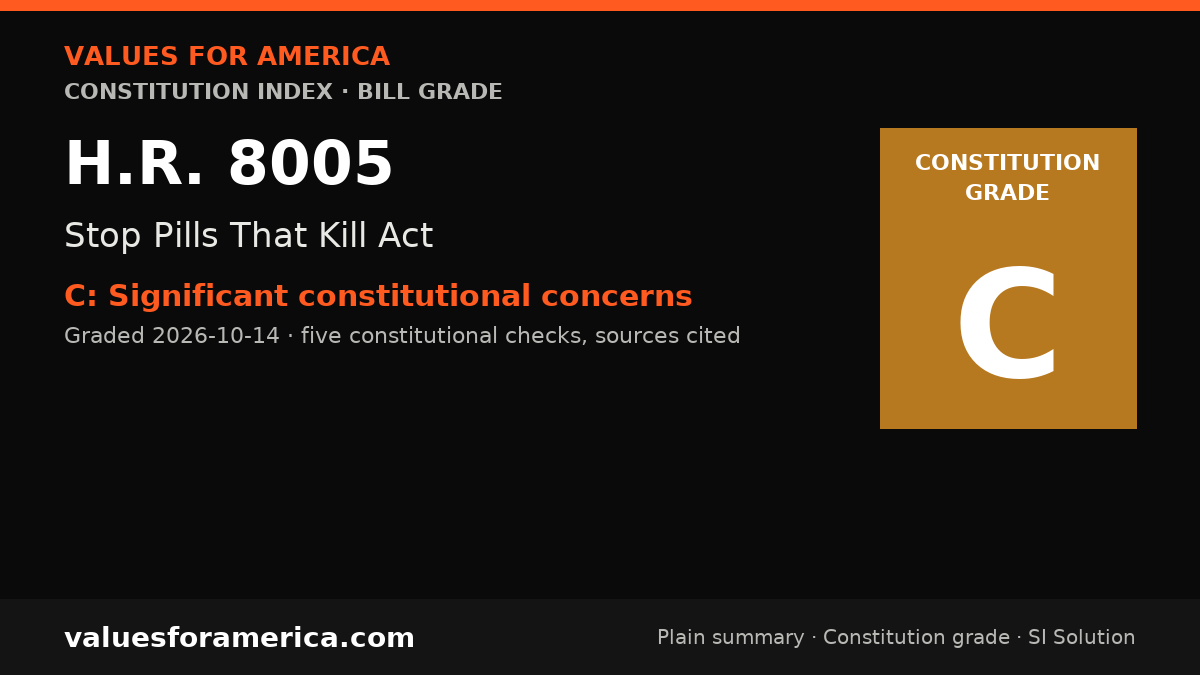
“VFA Constitution grade”
Significant constitutional concerns
Graded 2026-10-14
SI-generated grade · five published checks · not individually reviewed by a person · methodology
The bill raises significant constitutional concerns. While Congress has clear authority under the Commerce Clause to regulate the interstate drug trade, the bill's expansion of criminal penalties for possessing manufacturing equipment may overreach by criminalizing mere possession of common items without requiring intent to manufacture illegal substances. This creates a risk of violating due process and individual sovereignty. The bill also centralizes enforcement and reporting at the federal level, failing the decentralization test. The bill is not a direct violation of the Bill of Rights, but it requires structural revision to ensure it does not punish innocent conduct and to better respect federalism.
-
✓ Passes · Enumerated powers
Congress has authority under Article I, Section 8, Clause 3 (the Commerce Clause) to regulate the interstate market in controlled substances, including fentanyl and counterfeit drugs. The bill's provisions targeting the manufacture and distribution of these substances fall within this enumerated power. The increased penalties for equipment used in illegal manufacturing are also tied to interstate … -
✗ Concern · Bill of Rights
The bill does not directly infringe on the First, Second, Third, Fourth, Fifth, Sixth, Seventh, Eighth, or Ninth Amendments. However, the expansion of criminal penalties for possessing or distributing equipment that could be used to manufacture fentanyl or counterfeit substances raises a potential Fifth Amendment due process concern. If the statute does not require knowledge or intent that the equ… -
✗ Concern · Individual sovereignty
The bill restricts an individual's freedom to possess and use equipment and materials that may have legitimate uses. The government has a compelling interest in combating the fentanyl crisis, but the burden is on the government to justify the restriction. Without a clear requirement that the possession be with intent to manufacture illegal substances, the bill could punish individuals for lawful c… -
✗ Concern · Decentralization
The bill fails the decentralization test. (1) Individuals and families cannot handle the fentanyl crisis alone, so federal involvement is necessary. (2) Local communities and counties cannot fully address the interstate drug trade, so state involvement is necessary. (3) States can and do handle drug enforcement, but the interstate nature of fentanyl trafficking may require federal coordination. (4… -
✗ Concern · Due process and takings
The bill raises procedural due process concerns. The increased penalties for possessing or distributing equipment used in fentanyl manufacturing may lack adequate notice of what conduct is criminal. If the statute does not require intent to manufacture illegal substances, it could impose criminal liability without a fair warning, violating the Fifth Amendment's Due Process Clause. The bill does no…
Sources: Congress.gov: HR 8005 summary
Report an error in this grade
What should pass
“VFA SI Solution”
No solution yet
A sourced SI draft appears here once it passes automated checks (Constitution citation, source verification, independent SI critic). How publication works.
Related on VFA

For journalists and bloggers
“Embed this grade”
Free to use with the link back. The badge and card update when the grade changes. Embed terms →
