H.R. 7994 explained · 119th Congress · Pending in Congress
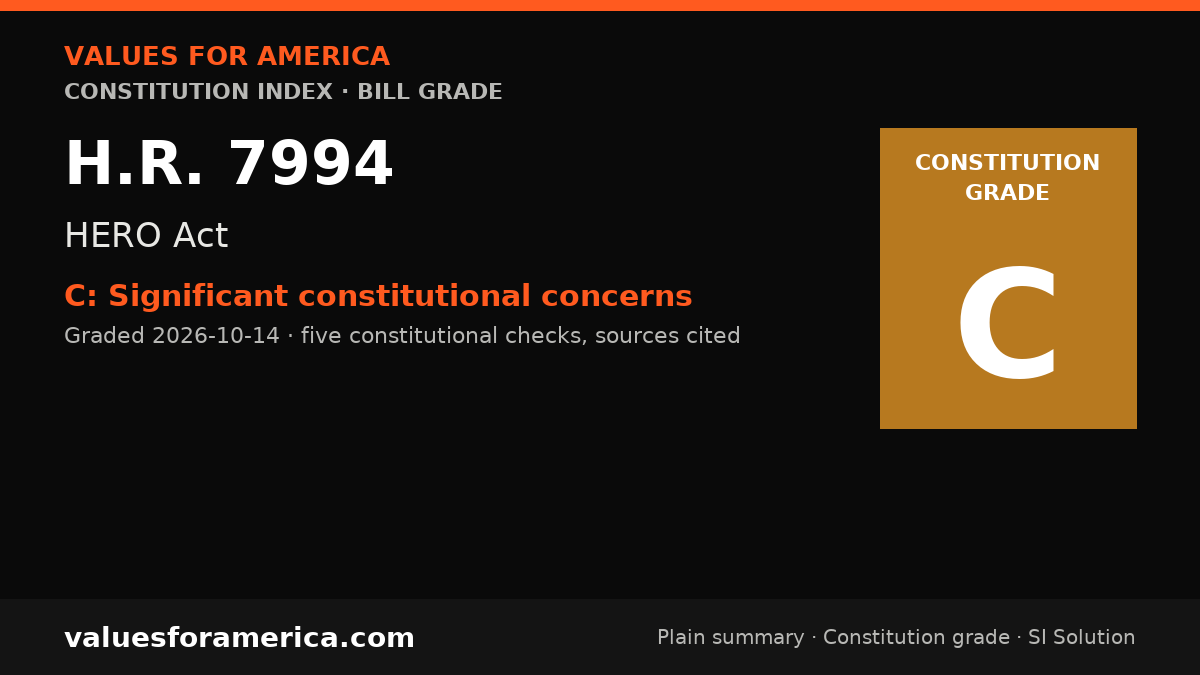
HERO Act
Cosponsors: 1 (0 D, 1 R) · per Congress.gov, 2026-10-15
Introduced: 2026-03-19
Latest action (2026-07-21): Ordered to be Reported (Amended) by the Yeas and Nays: 48 - 0.
What H.R. 7994 does, in plain terms
Helping Educators Respond to Overdoses Act or the HERO Act This bill establishes a grant program to provide schools with opioid overdose reversal drugs and requires reporting related to the distribution of such drugs. First, the bill requires the Substance Abuse and Mental Health Services Administration to award competitive grants to eligible entities for (1) purchasing approved opioid overdose reversal drugs; and (2) developing and implementing educational programming or resources to promote student and community knowledge of cardiopulmonary resuscitation, drug-use prevention and intervention, and emergency responses to drug overdoses. Eligible entities include private elementary and secondary schools, local educational agencies (LEAs), charter schools that are LEAs, and consortia of LEAs. Second, the bill requires a covered educational institution (i.e., a private school, LEA, or charter school that is an LEA) that receives federal funds to submit a description of any distribution of an opioid overdose reversal drug by such institution to the National Emergency Medical Services Information System and the Overdose Detection Mapping Application Program of the Washington/Baltimore High Intensity Drug Trafficking Area.
Official summary by the Congressional Research Service, via Congress.gov.
Constitution Index
“VFA Constitution grade”
Significant constitutional concerns
Graded 2026-10-14
SI-generated grade · five published checks · not individually reviewed by a person · methodology
The HERO Act establishes a federal grant program for opioid overdose reversal drugs in schools and imposes reporting requirements on recipients. While the spending power under Article I, Section 8, Clause 1 authorizes conditional grants, the reporting mandate on private schools raises significant federalism and Tenth Amendment concerns, and the program's centralized design fails the decentralization test. The bill does not directly infringe individual rights, but it consolidates educational and public health decision-making at the federal level beyond what is necessary.
-
✓ Passes · Enumerated powers
The bill operates through the federal spending power (Article I, Section 8, Clause 1), which authorizes Congress to tax and spend for the general welfare. The grant program is a conditional exercise of that power, and the reporting requirement is attached to federal funds. However, the reporting mandate on private schools that receive funds may be challenged as exceeding the spending power if it i… -
✓ Passes · Bill of Rights
The bill does not directly infringe any of the first ten amendments. It does not restrict speech, religion, assembly, press, petition, arms, quartering, search and seizure, self-incrimination, due process, takings, trial rights, or cruel and unusual punishment. The reporting requirement does not compel self-incrimination because it applies to institutions, not individuals, and does not involve cri… -
✓ Passes · Individual sovereignty
The bill does not restrict individual liberty. It provides resources and education to schools, which is a benefit, not a restriction. The reporting requirement applies to institutions, not individuals, and does not limit personal autonomy. The burden is on the government to justify restrictions, but here there is no restriction on individual action. -
✗ Concern · Decentralization
The bill fails the decentralization test. While individuals and families could not easily handle opioid overdose reversal on their own, local communities and states are fully capable of addressing this issue without federal involvement. The federal grant program and reporting requirements consolidate decision-making at the federal level, which is not the minimum necessary. The Tenth Amendment rese… -
✓ Passes · Due process and takings
The bill does not bypass due process or take property without just compensation. The grant program is voluntary, and the reporting requirement is a condition on accepting federal funds. There is no deprivation of life, liberty, or property without procedural safeguards. The reporting requirement is clear and does not impose arbitrary or retroactive obligations.
Sources: Congress.gov: HR 7994 summary
Report an error in this grade
What should pass
“VFA SI Solution”
No solution yet
A sourced SI draft appears here once it passes automated checks (Constitution citation, source verification, independent SI critic). How publication works.
Related on VFA

For journalists and bloggers
“Embed this grade”
Free to use with the link back. The badge and card update when the grade changes. Embed terms →
