H.R. 7959 explained · 119th Congress · Pending in Congress
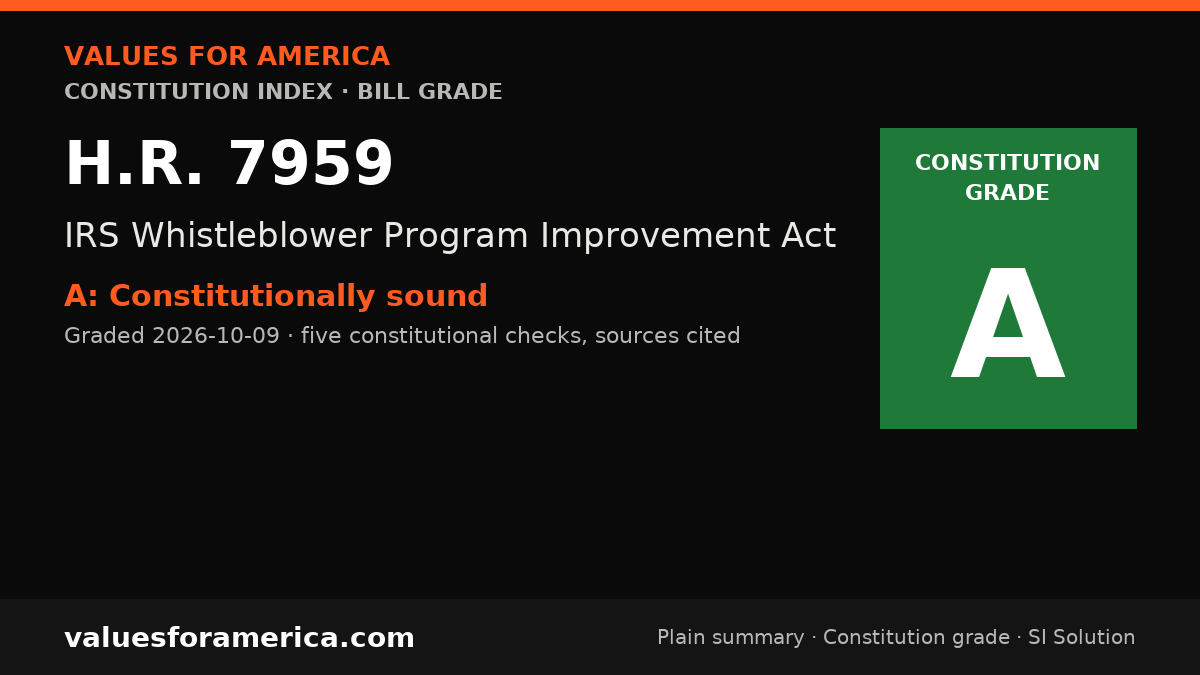
IRS Whistleblower Program Improvement Act
Cosponsors: 5 (1 D, 4 R) · per Congress.gov, 2026-10-08
Introduced: 2026-03-17
Latest action (2026-04-28): Received in the Senate and Read twice and referred to the Committee on Finance.
What H.R. 7959 does, in plain terms
IRS Whistleblower Program Improvement Act This bill modifies provisions of the Internal Revenue Code relating to whistleblower awards and protections. Specifically, the bill revises the standard for review of whistleblower awards in the Tax Court to require a de novo review (rather than the current abuse of discretion review) based on the administrative record established at the time of the whistleblower award determination and any new or previously unavailable evidence, allows whistleblowers anonymity in proceedings before the Tax Court (unless a societal interest in disclosing a whistleblower's identity outweighs potential harm to the whistleblower), modifies the Internal Revenue Service (IRS) whistleblower report to require inclusion of a list and description of up to 10 of the top tax avoidance schemes disclosed by whistleblowers, and requires payment of interest on mandatory whistleblower awards if the IRS fails to provide timely notice to a whistleblower of an award recommendation. The bill also allows payments of the attorney fees of whistleblowers to be deducted when calculating adjusted gross income for tax purposes regardless of whether the whistleblower award was paid through the mandatory or the discretionary whistleblower award program. (Under current law, the deduction is limited to attorney fees paid in connection with mandatory awards.)
Official summary by the Congressional Research Service, via Congress.gov.
Constitution Index
“VFA Constitution grade”
Constitutionally sound
Graded 2026-10-09
SI-generated grade · five published checks · not individually reviewed by a person · methodology
HR 7959 is constitutional. Congress has explicit authority under Article I, Section 8, Clause 1 to lay and collect taxes, and this bill is a reasonable and proper measure for administering the federal tax system. It improves whistleblower procedures and protections without infringing any constitutional right. The federal tax system is inherently national, so the bill does not improperly consolidate authority. Its de novo review and interest-payment provisions strengthen, rather than weaken, due process.
-
✓ Passes · Enumerated powers
Congress has the enumerated power to lay and collect taxes under Article I, Section 8, Clause 1. The IRS Whistleblower Program Improvement Act directly concerns the administration and enforcement of federal tax law, including whistleblower awards, Tax Court review, and tax deductions for attorney fees. These provisions are within Congress's taxing power and are necessary and proper for carrying th… -
✓ Passes · Bill of Rights
The bill does not infringe any provision of the Bill of Rights. It does not restrict speech, religion, press, assembly, petition, or the right to keep and bear arms. Tax Court proceedings are civil, not criminal, so the Sixth Amendment's confrontation and jury trial protections are not implicated. The anonymity provision protects whistleblowers and does not deprive any party of a constitutional ri… -
✓ Passes · Individual sovereignty
The bill expands individual options by improving whistleblower protections, allowing anonymity in appropriate cases, and permitting attorney-fee deductions for mandatory and discretionary awards. It does not restrict what a person may do with their person, property, speech, labor, or beliefs. Any tax enforcement involved is pursuant to Congress's lawful taxing authority and does not impose an unju… -
✓ Passes · Decentralization
Federal tax collection is an inherently national function. An individual cannot independently enforce the federal tax laws, a local community cannot administer the IRS whistleblower program, and a state cannot collect federal taxes. The bill operates at the federal level only because the underlying power to tax belongs to Congress. It does not consolidate decision-making above the minimum necessar… -
✓ Passes · Due process and takings
The bill strengthens procedural due process by requiring de novo Tax Court review based on the administrative record and any newly available evidence. The anonymity provision includes a balancing test: disclosure is permitted when a societal interest outweighs harm to the whistleblower. The interest-payment requirement compensates whistleblowers for IRS delay. No property is taken without just com…
Sources: Congress.gov: HR 7959 summary
Report an error in this grade
What should pass
“VFA SI Solution”
No solution yet
A sourced SI draft appears here once it passes automated checks (Constitution citation, source verification, independent SI critic). How publication works.
Related on VFA

For journalists and bloggers
“Embed this grade”
Free to use with the link back. The badge and card update when the grade changes. Embed terms →
