H.R. 7892 explained · 119th Congress · Pending in Congress
No Aid for Ghost Students Act of 2026
Cosponsors: 4 (0 D, 4 R) · per Congress.gov, 2026-10-08
Introduced: 2026-03-12
Latest action (2026-06-11): Received in the Senate and Read twice and referred to the Committee on Health, Education, Labor, and Pensions.
What H.R. 7892 does, in plain terms
No Aid for Ghost Students Act of 2026 This bill requires the Department of Education (ED) to establish an identity fraud detection system for the Free Application for Federal Student Aid (FAFSA). Beginning on October 1, 2026, ED must use an identity fraud detection system to review each submitted application to determine whether the applicant presents a reasonable suspicion of identity fraud. If ED makes such a determination, it must notify the applicant and each institution of higher education (IHE) designated on the application that the applicant is subject to additional identity verification. An IHE may not disburse federal financial aid to an applicant that presents a reasonable suspicion of fraud unless the IHE verifies the applicant's identity in person or by live video. If the applicant's identity is confirmed, the IHE must notify ED that the applicant's identity has been verified. ED must establish guidelines for the identity verification procedures conducted by IHEs. (On April 26, 2026, ED began implementing a real-time identity fraud detection process within the FAFSA form that places applicants into one of four risk categories. High-risk applicants must confirm their identity by presenting documentation during the online application process, including via a live camera process. Applicants who are rejected via this automated process must then have their identity verified in person by IHEs.)
Official summary by the Congressional Research Service, via Congress.gov.
Constitution Index
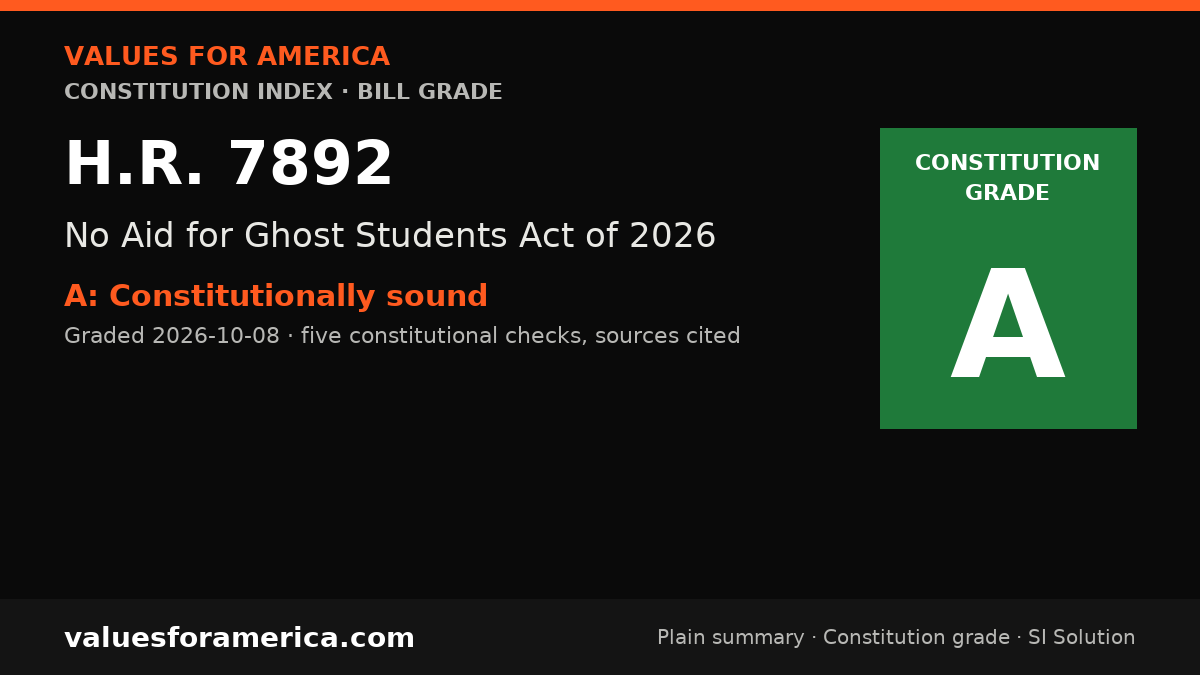
“VFA Constitution grade”
Constitutionally sound
Graded 2026-10-08
SI-generated grade · five published checks · not individually reviewed by a person · methodology
Constitutional fraud-prevention condition on federal spending. Congress uses its Spending Clause authority to protect public funds, with notice and a clear cure, no rights infringement, and no upward consolidation beyond the federal program itself.
-
✓ Passes · Enumerated powers
Congress acts under Article I, Section 8, Clause 1, the Spending Clause, which authorizes provision of federal funds for the general welfare and conditions to ensure funds reach eligible recipients. Fraud detection and identity verification are necessary and proper under Article I, Section 8, Clause 18 to administration of the existing federal student assistance program, not a new unenumerated reg… -
✓ Passes · Bill of Rights
No First through Tenth Amendment right is infringed. Verification requires in-person or live-video identity confirmation only after reasonable suspicion of fraud, plus notice to applicant. This is not a Fourth Amendment unreasonable search, not compelled testimony under Fifth Amendment, and does not restrict speech, arms, assembly, or trial rights. -
✓ Passes · Individual sovereignty
The burden is limited to proving identity when reasonable suspicion of fraud exists before receiving public funds. It does not restrict person, property, speech, labor, or belief generally. The government meets its burden to justify the restriction: preventing disbursement of taxpayer funds to false identities under Article I, Section 8, Clause 1. -
✓ Passes · Decentralization
Federal student assistance is exclusively federal spending; individuals, local communities, and states cannot administer eligibility for federal funds or detect nationwide fraud rings. The bill does not consolidate new power upward - it adds integrity procedures to an existing federal program and leaves final verification with the designated institution of higher education under Tenth Amendment pr… -
✓ Passes · Due process and takings
Satisfies Fifth Amendment Due Process: requires notice to applicant and schools, a clear path to cure through verification, and disbursement once identity is confirmed. No property is taken without just compensation because no vested benefit exists for a fraudulent applicant, and eligible applicants are delayed only for verification, not deprived.
Sources: Congress.gov: HR 7892 summary
Report an error in this grade
What should pass
“VFA SI Solution”
No solution yet
A sourced SI draft appears here once it passes automated checks (Constitution citation, source verification, independent SI critic). How publication works.
Related on VFA

For journalists and bloggers
“Embed this grade”
Free to use with the link back. The badge and card update when the grade changes. Embed terms →
