H.R. 7890 explained · 119th Congress · Pending in Congress
Science of Reading Act of 2026
Cosponsors: 3 (1 D, 2 R) · per Congress.gov, 2026-10-14
Introduced: 2026-03-12
Latest action (2026-09-17): Received in the Senate and Read twice and referred to the Committee on Health, Education, Labor, and Pensions.
What H.R. 7890 does, in plain terms
Science of Reading Act of 2026 This bill revises the Comprehensive Literacy State Development (CLSD) grant program to prioritize literacy instruction that is aligned to the science of reading. Under the bill, science of reading is defined as an interdisciplinary body of evidence-based research about reading and issues related to reading and writing that (1) identifies instruction in phonemic awareness, phonics, vocabulary, fluency, comprehension, and writing as essential components to skilled reading; (2) demonstrates the importance of background knowledge, oral language, the connection between reading and writing, and strong writing instruction; (3) explains why some students have difficulty with reading and writing; and (4) does not use a three-cueing model. Three-cueing model means an instructional approach or model that (1) uses meaning drawn from context, pictures, or syntax as the primary basis for teaching word recognition; or (2) teaches visual memory as the primary basis for word recognition. Current law authorizes competitive CLSD grants to state educational agencies (SEAs) and, through them, competitive subgrants to local educational agencies for the development and implementation of a comprehensive literacy instruction plan, professional development, and other activities. Eligible early childhood education programs may also receive subgrants for early literacy services. The bill (1) specifies that comprehensive literacy instruction for CLSD grants does not include the use of a three-cueing model, and (2) requires the Department of Education and SEAs to prioritize awarding CLSD grants and subgrants for evidence-based activities that are aligned to the science of reading.
Official summary by the Congressional Research Service, via Congress.gov.
Constitution Index
“VFA Constitution grade”
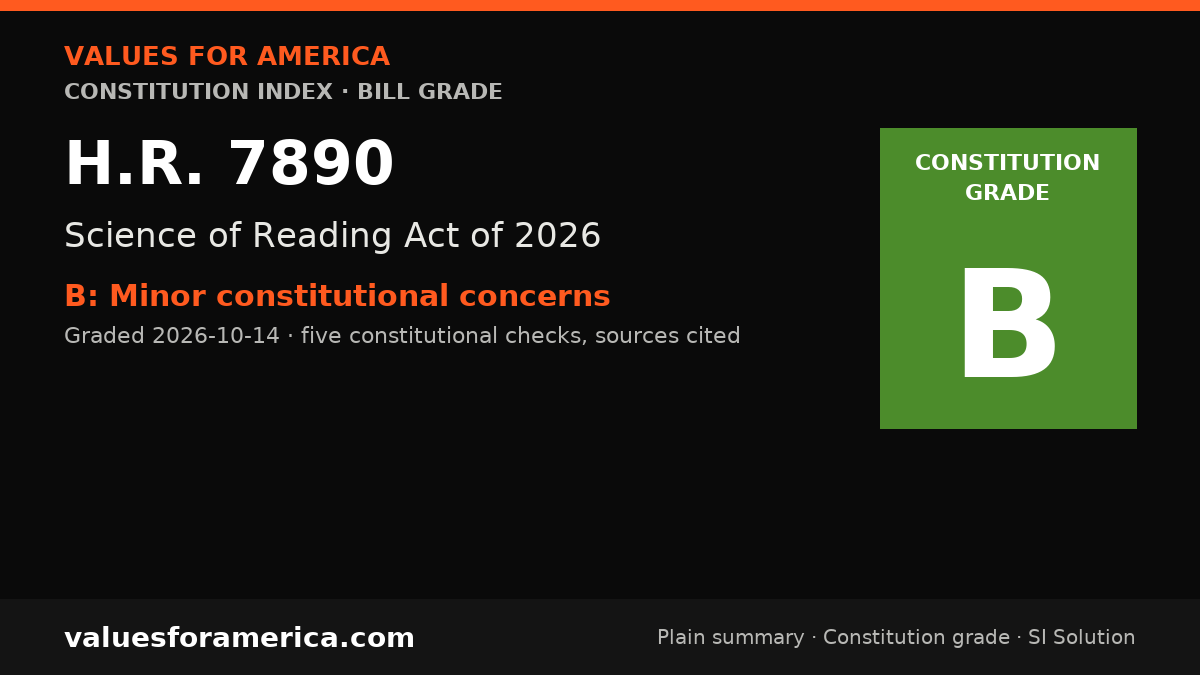
Minor constitutional concerns
Graded 2026-10-14
SI-generated grade · five published checks · not individually reviewed by a person · methodology
The Science of Reading Act of 2026 is a conditional federal grant program that falls within Congress's spending power under Article I, Section 8, Clause 1. It does not directly mandate curriculum or prohibit any instructional method; rather, it conditions the receipt of federal funds on alignment with the science of reading. While the bill's definition of 'science of reading' and its exclusion of the three-cueing model may raise concerns about federal influence over state and local educational decisions, the conditional nature of the grant and the absence of a direct mandate keep it within constitutional bounds. The bill does not infringe on individual rights, and it does not bypass due process or take property. However, the federal government's role in education is not an enumerated power, and the bill's prescriptive definition may push the boundaries of federal influence, warranting a grade of B rather than A.
-
✓ Passes · Enumerated powers
Congress has the power to tax and spend for the general welfare under Article I, Section 8, Clause 1. The bill operates through the existing CLSD grant program, which is a conditional spending program. The Supreme Court has upheld the use of the spending power to attach conditions to federal grants, provided the conditions are clear and related to the federal interest in the program. Here, the con… -
✓ Passes · Bill of Rights
The bill does not directly infringe on any of the first ten amendments. It does not restrict speech, religion, assembly, press, or petition. It does not affect the right to bear arms, quartering of soldiers, search and seizure, self-incrimination, due process, trial rights, or cruel and unusual punishment. The bill's definition of 'science of reading' and its exclusion of the three-cueing model do… -
✓ Passes · Individual sovereignty
The bill does not restrict what individuals can do with their own person, property, speech, labor, or belief. It does not impose any direct regulation on individuals. It affects state and local educational agencies that choose to accept federal funds. The bill does not compel any individual to adopt a particular teaching method; it only affects the allocation of federal funds. The burden is on the… -
✗ Concern · Decentralization
The bill fails the decentralization test because it consolidates decision-making at the federal level regarding the definition of 'science of reading' and the exclusion of the three-cueing model. While the grant program is voluntary, the federal government is using its spending power to influence state and local educational decisions. The questions: (1) Could an individual or family handle this wi… -
✓ Passes · Due process and takings
The bill does not bypass due process or take property without just compensation. It does not impose any penalty or deprivation on individuals or entities. The bill merely conditions the receipt of federal funds on compliance with certain requirements. There is no deprivation of life, liberty, or property without due process. The bill does not involve any taking of private property for public use. …
Sources: Congress.gov: HR 7890 summary
Report an error in this grade
What should pass
“VFA SI Solution”
SI-generated · passed automated checks (Constitution citation, source verification, independent SI critic) · not individually reviewed by a person · Report an error: hello@valuesforamerica.com
Reading Results and State Control Literacy Grants Act
Generated by VFA SI Solutions
Help more children become strong readers by focusing federal literacy funds on reading instruction backed by research on phonics, vocabulary, fluency, comprehension, and writing.
Bipartisan rationale: VFA assesses this draft honors Republican priorities for fiscal restraint, state control of schools, and evidence-based use of federal funds by barring federal support for a discredited method and capping costs with a sunset. VFA assesses it honors Democratic priorities for early literacy equity, teacher training, and support for struggling readers by keeping competitive funds focused on proven reading instruction for high-need districts and early childhood programs.
Possible legislative path: House and Senate support may come from members focused on early reading results and teacher support, while opposition may come from members wary of federal limits on curriculum or from members seeking larger or permanent funding.
Source limits: The full bill text and current law were not part of the official summary reviewed, so detailed eligibility rules, existing appeal rights, current funding levels, cost effects, and conflicts with state law remain unverified; proposed review and appeal steps described here are new safeguards and readers should verify the official record at Congress.gov before relying on funding or rights claims.
Article I, Section 8, Clause 1 Article I, Section 8, Clause 18 Amendment X Amendment V
Report an error in this Solution
Citizen Consensus
“Do you support this VFA SI Solution?”
One vote per verified account; you can change it any time. Only verified accounts count, results publish once 30 verified people have voted, and state and district results count only people who attested a home ZIP code. How this works.
Email verification is not switched on yet, so no vote counts toward results yet. Votes cast now are saved and count once the voter verifies their email address.
Sign in or create a free account to vote.
Add a short reason (optional)
/280 · no links or contact details · reasons are reviewed before anyone sees them, and many never are shown.
Your vote is saved but held out of published results by an automated integrity check (for example, several accounts voting from one browser).
Your vote is saved. It will count once you verify your email address. Verify on your account page.
Your vote counts nationally. Add your home ZIP code to count in your state and district too.
Your vote counts nationally and in .
Reason saved privately; it is shown only if it passes review.
Verified participants nationwide · n =
Self-selected participants, not a random sample; ± is the 95% sampling margin.
Not enough verified votes yet. Results publish at verified votes.
A sudden surge of votes on this item was flagged and is under review; votes from new accounts in that surge are held out until it is resolved.
Related on VFA

For journalists and bloggers
“Embed this grade”
Free to use with the link back. The badge and card update when the grade changes. Embed terms →
