H.R. 788 explained · 119th Congress · Pending in Congress
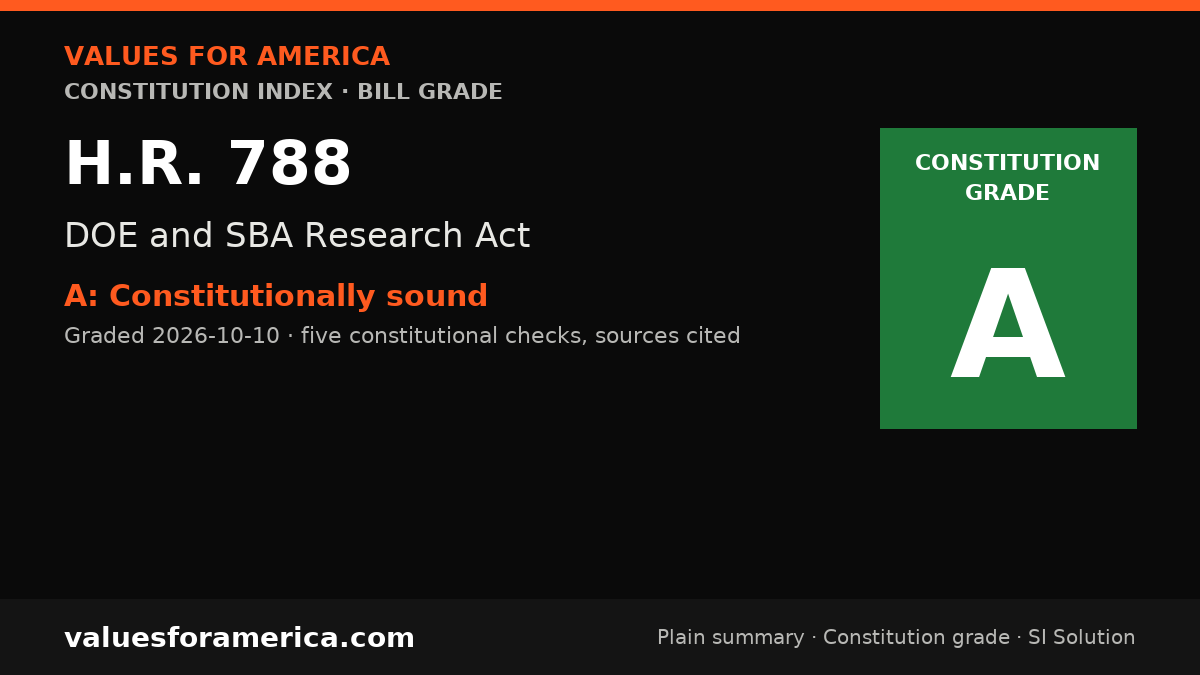
DOE and SBA Research Act
Cosponsors: 3 (3 D, 0 R) · per Congress.gov, 2026-10-12
Introduced: 2025-01-28
Latest action (2025-02-26): Received in the Senate and Read twice and referred to the Committee on Energy and Natural Resources.
What H.R. 788 does, in plain terms
DOE and SBA Research Act This bill requires the Department of Energy and the Small Business Administration to enter into an agreement to collaborate on research and development activities. These activities must include, as appropriate, small businesses. The agencies must report on any collaborative research achievements and potential opportunities to expand the technical capabilities of the agencies.
Official summary by the Congressional Research Service, via Congress.gov.
Constitution Index
“VFA Constitution grade”
Constitutionally sound
Graded 2026-10-10
SI-generated grade · five published checks · not individually reviewed by a person · methodology
This bill directs two federal agencies to collaborate on research and development activities, including with small businesses, and to report on outcomes. It operates squarely within Congress's enumerated powers under the Commerce Clause and the Spending Clause, does not infringe any rights, respects individual sovereignty, passes all decentralization tests, and imposes no due process or takings issues. It is fully constitutional.
-
✓ Passes · Enumerated powers
Congress has authority under Article I, Section 8, Clause 3 (Commerce Clause) to regulate and promote interstate commerce, including research and development that supports small businesses. Additionally, Article I, Section 8, Clause 1 (Spending Clause) authorizes Congress to appropriate funds for the general welfare, which includes funding collaborative R&D between federal agencies. The bill does … -
✓ Passes · Bill of Rights
The bill imposes no restrictions on speech, religion, assembly, press, petition, arms, quartering, search and seizure, self-incrimination, due process, takings, trial rights, or cruel and unusual punishment. It does not touch any right protected by the first ten amendments. -
✓ Passes · Individual sovereignty
The bill does not restrict any individual's person, property, speech, labor, or belief. It merely authorizes interagency cooperation and reporting. No individual is compelled or prohibited from any action. The government bears no burden to justify a restriction because none exists. -
✓ Passes · Decentralization
The bill involves federal agencies collaborating on research, which is a proper federal function under the Commerce and Spending Clauses. It does not preempt state or local action, nor does it prevent individuals or communities from conducting their own R&D. All four questions are answered in favor of decentralization. -
✓ Passes · Due process and takings
The bill imposes no penalties, deprivations, or property takings. It does not create any adjudicative or enforcement mechanism that would trigger procedural or substantive due process requirements. No takings clause issue arises.
Sources: Congress.gov: HR 788 summary
Report an error in this grade
What should pass
“VFA SI Solution”
No solution yet
A sourced SI draft appears here once it passes automated checks (Constitution citation, source verification, independent SI critic). How publication works.
Related on VFA

For journalists and bloggers
“Embed this grade”
Free to use with the link back. The badge and card update when the grade changes. Embed terms →
