H.R. 7809 explained · 119th Congress · Pending in Congress
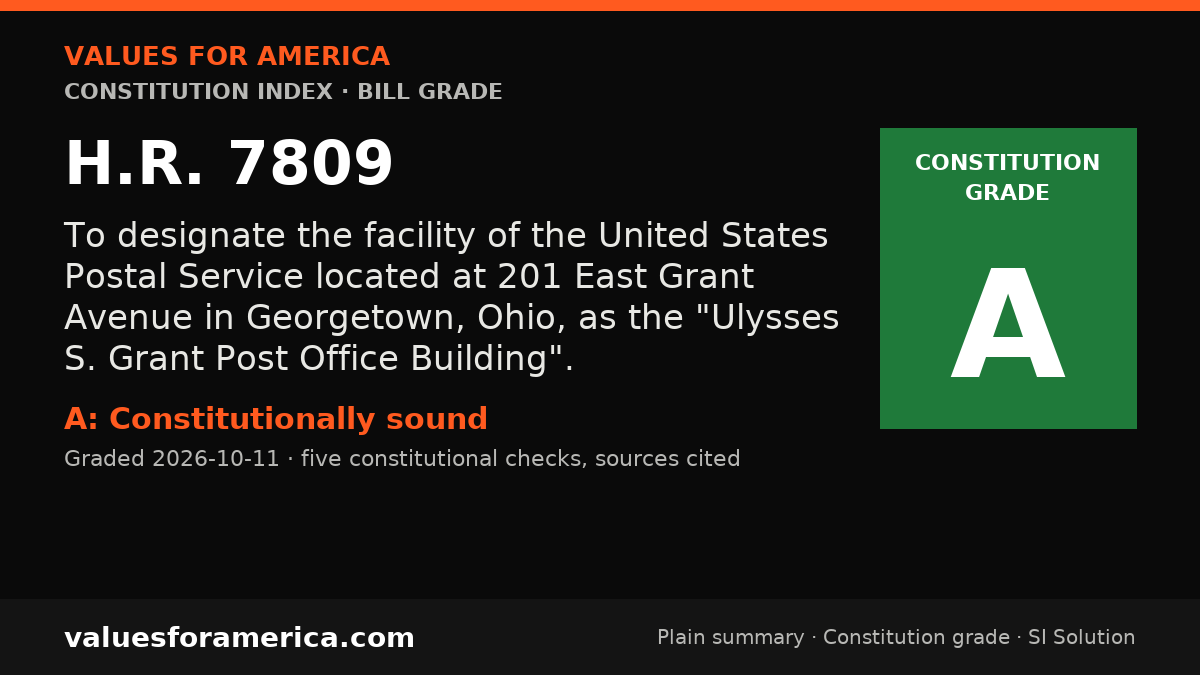
To designate the facility of the United States Postal Service located at 201 East Grant Avenue in Georgetown, Ohio, as the "Ulysses S. Grant Post Office Building".
Cosponsors: 14 (5 D, 9 R) · per Congress.gov, 2026-10-14
Introduced: 2026-03-04
Latest action (2026-09-14): Placed on Senate Legislative Calendar under General Orders. Calendar No. 615.
What H.R. 7809 does, in plain terms
This bill designates the facility of the United States Postal Service located at 201 East Grant Avenue in Georgetown, Ohio, as the "Ulysses S. Grant Post Office Building".
Official summary by the Congressional Research Service, via Congress.gov.
Constitution Index
“VFA Constitution grade”
Constitutionally sound
Graded 2026-10-11
SI-generated grade · five published checks · not individually reviewed by a person · methodology
This bill merely names a federal post office building after a historical figure. It involves no exercise of coercive power, no restriction on rights, and no transfer of authority. The action falls squarely within Congress's enumerated power to establish post offices under Article I, Section 8, Clause 7, and does not implicate any constitutional prohibition.
-
✓ Passes · Enumerated powers
Congress has explicit authority under Article I, Section 8, Clause 7 to establish post offices and post roads. Naming a postal facility is a routine exercise of that power, akin to managing federal property. There is no overreach because the action is directly tied to the postal system. -
✓ Passes · Bill of Rights
The bill does not affect speech, religion, assembly, press, petition, arms, quartering, search and seizure, self-incrimination, due process, takings, trial rights, or cruel and unusual punishment. It imposes no obligation or prohibition on any person. No amendment in the Bill of Rights is implicated. -
✓ Passes · Individual sovereignty
The bill restricts no individual's use of person, property, speech, labor, or belief. It merely designates a name for a government building. There is no burden on the individual, and no compelling justification is needed because no restriction exists. -
✓ Passes · Decentralization
The action is a federal housekeeping matter regarding a federal facility. It does not consolidate decision-making upward in any meaningful way; the naming of a federal building is inherently a federal function. The four-question test is satisfied because the action is purely administrative and does not preempt or override state or local authority. -
✓ Passes · Due process and takings
The bill does not deprive any person of life, liberty, or property, nor does it take private property for public use. It involves no adjudicative process, no penalty, and no confiscation. Procedural and substantive due process are not implicated.
Sources: Congress.gov: HR 7809 summary
Report an error in this grade
The Framers
“Founders’ Verdict”
Confidence 1.00
Archived SI output (machine-generated)No editorial review recorded. This historical SI verdict was machine-generated by software and predates the review desk; check it against the official bill text.
Synthesis
All four Founders agree that naming a specific postal facility is a permissible exercise of Congress's enumerated power under the Postal Clause (Article I, Section 8, Clause 7), and does not violate any other constitutional provision.
This bill is a straightforward exercise of Congress's power to establish post offices under Article I, Section 8, Clause 7. The designation of a specific postal facility's name is an incidental administrative detail that falls within the scope of that enumerated power. No constitutional provision prohibits such naming, and it does not infringe upon any other branch's authority or individual rights. As I argued in Federalist No. 23, the powers necessary to execute the enumerated ends must be liberally construed; naming a post office is a necessary and proper means of managing the postal system.
The Constitution expressly grants Congress the power to establish post offices. Naming a specific postal facility is a permissible exercise of that enumerated power, as it pertains to the administration and designation of a federal building. The Tenth Amendment reserves to the states or the people only those powers not delegated to the United States; here, the power over post offices is clearly delegated. No provision of the Bill of Rights is implicated, as the action does not abridge any individual liberty or right.
This bill merely designates a name for a federal building, an action well within the enumerated powers of Congress under the Postal Clause, which grants Congress the power to establish Post Offices and post roads. Naming a facility is a routine administrative matter that does not exceed the limited and defined powers of the federal government. It does not create any new office, appropriate funds beyond normal operations, or infringe upon the powers reserved to the states or the people. The designation of a specific name for a post office is a de minimis exercise of legislative authority, consi…
This bill is a constitutional exercise of Congress's power to establish post offices, as granted by Article I, Section 8, Clause 7. The naming of a specific postal facility is a necessary and proper measure for the operation of the postal system, consistent with the implied powers recognized in McCulloch v. Madison (1819). There is no conflict with any constitutional provision, and the designation does not exceed the scope of federal authority.
Report an error in this Founders' Verdict
What should pass
“VFA SI Solution”
No solution yet
A sourced SI draft appears here once it passes automated checks (Constitution citation, source verification, independent SI critic). How publication works.
Related on VFA

For journalists and bloggers
“Embed this grade”
Free to use with the link back. The badge and card update when the grade changes. Embed terms →
