H.R. 7730 explained · 119th Congress · Pending in Congress
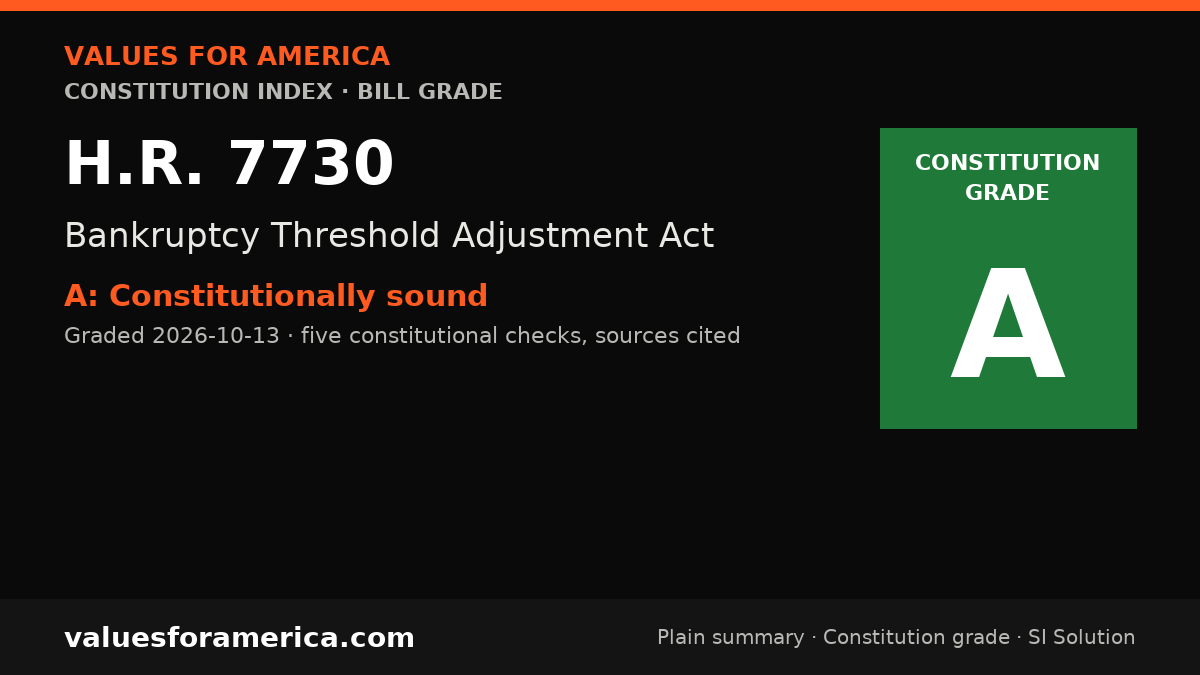
Bankruptcy Threshold Adjustment Act
Cosponsors: 6 (3 D, 3 R) · per Congress.gov, 2026-10-14
Introduced: 2026-02-26
Latest action (2026-10-14): Message on Senate action sent to the House.
What H.R. 7730 does, in plain terms
Bankruptcy Threshold Adjustment Act of 2026 This bill restores changes that expired in 2024 applicable to debt limits for Subchapter V (small business reorganization) and Chapter 13 (the wage earner's plan) bankruptcies. Specifically, the bill increases the debt limit under Subchapter V from approximately $3.4 million to $7.5 million and increases the cumulative debt limit under Chapter 13 from approximately $2.1 million to $2.75 million. The bill also applies both secured and unsecured debt towards the Chapter 13 limit. (Currently, separate limits apply to secured and unsecured debt under Chapter 13 bankruptcy.)
Official summary by the Congressional Research Service, via Congress.gov.
Constitution Index
“VFA Constitution grade”
Constitutionally sound
Graded 2026-10-13
SI-generated grade · five published checks · not individually reviewed by a person · methodology
The Bankruptcy Threshold Adjustment Act is a constitutional exercise of Congress's enumerated power to establish uniform laws on the subject of bankruptcies. It adjusts eligibility thresholds for existing bankruptcy chapters, does not infringe on any constitutional rights, and appropriately centralizes bankruptcy law at the federal level as required by the Constitution. The changes are procedural and economic, with no due process or takings concerns.
-
✓ Passes · Enumerated powers
Article I, Section 8, Clause 4 grants Congress the power 'To establish... uniform Laws on the Subject of Bankruptcies throughout the United States.' This bill directly amends the Bankruptcy Code, which is squarely within that enumerated power. Adjusting debt limits for Subchapter V and Chapter 13 is a permissible exercise of this authority. -
✓ Passes · Bill of Rights
The bill does not implicate any of the first ten amendments. It does not affect speech, religion, assembly, press, petition, arms, quartering, search and seizure, self-incrimination, due process, takings, trial rights, jury rights, cruel and unusual punishment, unenumerated rights, or reserved powers. It merely adjusts monetary thresholds for bankruptcy eligibility. -
✓ Passes · Individual sovereignty
The bill expands access to bankruptcy relief by raising debt limits, thereby increasing individual and small business options for financial reorganization. It does not restrict personal liberty, property, speech, labor, or belief. Rather, it enhances individual sovereignty by allowing more debtors to use streamlined bankruptcy procedures. -
✓ Passes · Decentralization
Bankruptcy is a federal constitutional matter, and the Constitution explicitly assigns it to Congress. The four-question test: (1) Individuals cannot handle bankruptcy without government involvement—it requires legal discharge of debt; (2) Local communities cannot handle bankruptcy—it requires uniform national law; (3) States cannot handle bankruptcy—the Constitution reserves this to the federal g… -
✓ Passes · Due process and takings
The bill does not deprive anyone of life, liberty, or property without due process. It does not take property for public use without just compensation. It merely adjusts eligibility thresholds for bankruptcy proceedings, which are themselves designed to provide due process to debtors and creditors. There is no arbitrary government action; the changes are rational and economic.
Sources: Congress.gov: HR 7730 summary
Report an error in this grade
What should pass
“VFA SI Solution”
No solution yet
A sourced SI draft appears here once it passes automated checks (Constitution citation, source verification, independent SI critic). How publication works.
Related on VFA

For journalists and bloggers
“Embed this grade”
Free to use with the link back. The badge and card update when the grade changes. Embed terms →
