H.R. 7726 explained · 119th Congress · Pending in Congress
Stop Child Care Scams Act of 2026
Cosponsors: none · per Congress.gov, 2026-10-08
Introduced: 2026-02-26
Latest action (2026-06-04): Received in the Senate and Read twice and referred to the Committee on Health, Education, Labor, and Pensions.
What H.R. 7726 does, in plain terms
No Funds for Repeat Child Care Violations Act of 2026 This bill subjects states to additional sanctions for improperly using funds under the Child Care and Development Block Grant program. The program provides grants to states to support child care programs for low-income working families. Specifically, if the Office of the Administration for Children and Families (ACF) finds that a state has failed to comply substantially with the requirements of the program, the ACF must impose additional sanctions, which include disqualifying the state from receiving funds under the program. Under current law, the ACF is permitted, but not required, to take such actions for a state's noncompliance.
Official summary by the Congressional Research Service, via Congress.gov.
Constitution Index
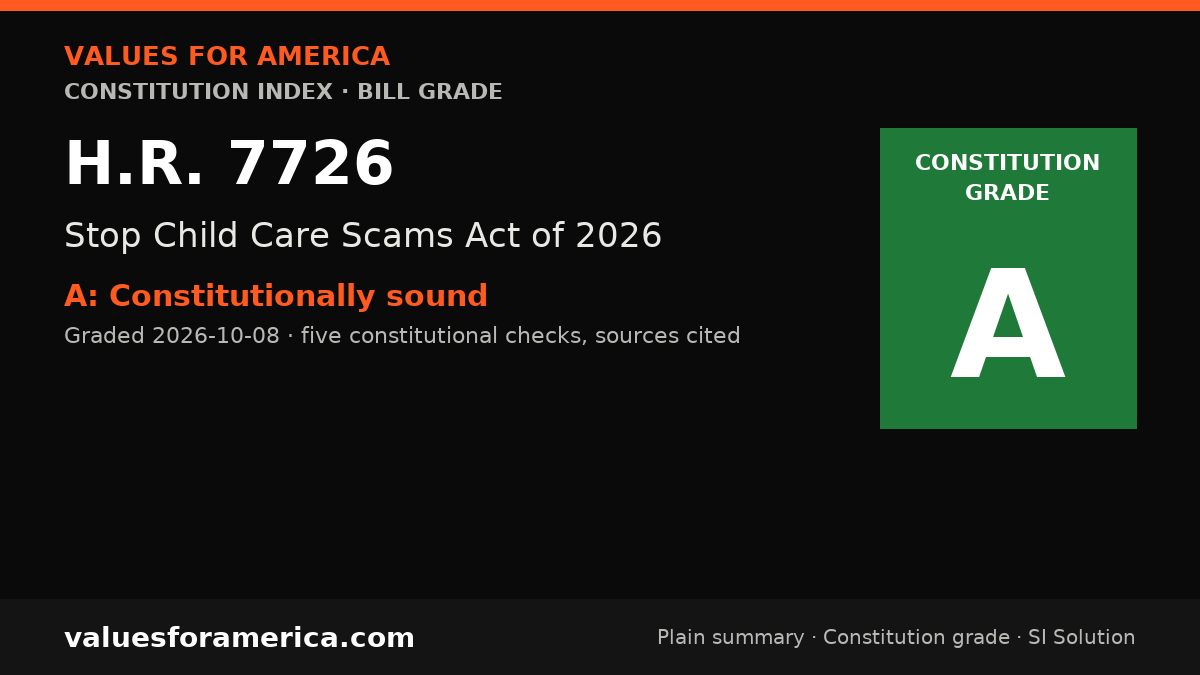
“VFA Constitution grade”
Constitutionally sound
Graded 2026-10-08
SI-generated grade · five published checks · not individually reviewed by a person · methodology
HR 7726 operates within the Spending Clause by tightening accountability for voluntary state child-care grants. It creates no new federal mandate, infringes no Bill of Rights protection, restricts no individual liberty, preserves state choice under the Tenth Amendment, and takes no private property. Constitutionally sound SI-reviewed grant-integrity measure.
-
✓ Passes · Enumerated powers
Federal child-care grants and conditions on those grants rest on Article I, Section 8, Clause 1, the Spending Clause, which authorizes Congress to spend for the general welfare. Conditioning Child Care and Development Block Grant funds on substantial compliance is a classic conditional-spending measure, and making an existing discretionary sanction mandatory does not expand federal power beyond th… -
✓ Passes · Bill of Rights
The bill imposes funding sanctions on state grantees, not on private speech, religion, arms, searches, or other protected rights. No provision authorizes search, seizure, compelled testimony, or restriction of First Amendment activity. No Amendment among the first ten is implicated. -
✓ Passes · Individual sovereignty
The bill directs sanctions at state governments that misuse grant funds. It restricts no individual's decisions regarding person, property, speech, labor, or belief, and imposes no mandate on families or providers. Any burden falls on a state grantee that voluntarily accepted federal funds with stated conditions. -
✓ Passes · Decentralization
Child care itself can be and routinely is handled by individuals, families, local providers, and states, and this bill does not displace that. It only conditions voluntary federal grant funds under the Child Care and Development Block Grant and converts a discretionary sanction into a mandatory one. It adds no new federal regulatory program, does not commandeer states under the Tenth Amendment, an… -
✓ Passes · Due process and takings
No fines, criminal penalties, or seizures of private property are created. The sanction is disqualification from future federal grant funds after an ACF finding of substantial noncompliance, under the Fifth Amendment Due Process Clause framework. Grant conditions provide notice through statute, and existing administrative procedures supply review before sanctions. No Takings Clause taking of priva…
Sources: Congress.gov: HR 7726 summary
Report an error in this grade
What should pass
“VFA SI Solution”
No solution yet
A sourced SI draft appears here once it passes automated checks (Constitution citation, source verification, independent SI critic). How publication works.
Related on VFA

For journalists and bloggers
“Embed this grade”
Free to use with the link back. The badge and card update when the grade changes. Embed terms →
