H.R. 771 explained · 119th Congress · Pending in Congress
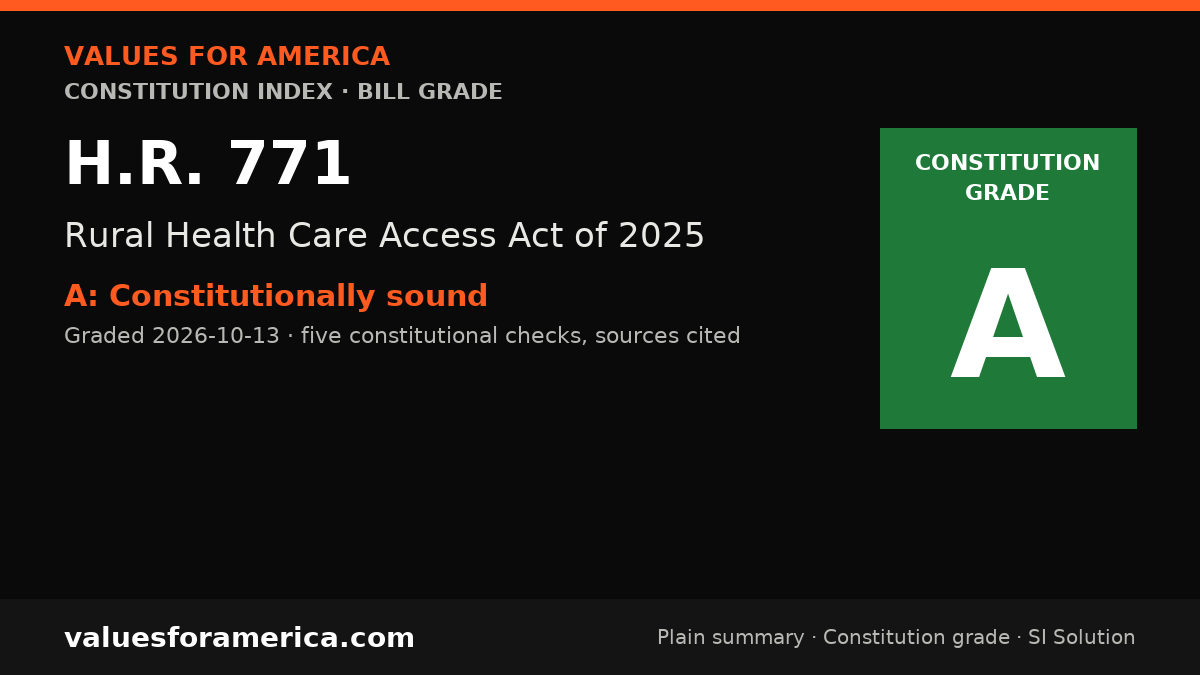
Rural Health Care Access Act of 2025
Cosponsors: 4 (1 D, 3 R) · per Congress.gov, 2026-10-12
Introduced: 2025-01-28
Latest action (2025-01-28): Referred to the House Committee on Ways and Means.
What H.R. 771 does, in plain terms
Rural Health Care Access Act of 2025 This bill eliminates certain criteria that hospitals must meet in order to qualify as critical access hospitals that receive special payment under Medicare. Specifically, the bill eliminates the requirement that a hospital must either (1) be located more than 35 miles (15 miles in mountainous regions or areas with only secondary roads) from another hospital, or (2) have been certified prior to January 1, 2006, by the state as a necessary provider of services in the area.
Official summary by the Congressional Research Service, via Congress.gov.
Constitution Index
“VFA Constitution grade”
Constitutionally sound
Graded 2026-10-13
SI-generated grade · five published checks · not individually reviewed by a person · methodology
The bill is a straightforward modification of Medicare eligibility criteria for critical access hospitals. It does not exceed federal enumerated powers, does not infringe on individual rights, and does not centralize authority beyond what is necessary for a federal health insurance program. The change is procedural and within the scope of Congress's spending power.
-
✓ Passes · Enumerated powers
Congress has authority under Article I, Section 8, Clause 1 (the Spending Clause) to provide for the general welfare, which includes establishing and modifying Medicare payment criteria. The bill adjusts eligibility for a federal health insurance program, a legitimate exercise of the spending power. -
✓ Passes · Bill of Rights
The bill does not implicate any of the first ten amendments. It does not affect speech, religion, assembly, press, petition, arms, quartering, search and seizure, self-incrimination, due process, takings, trial rights, or cruel and unusual punishment. -
✓ Passes · Individual sovereignty
The bill does not restrict individual liberty. It only alters eligibility criteria for hospitals to receive Medicare payments, which is a voluntary participation program. No individual is compelled to act or refrain from acting. -
✓ Passes · Decentralization
The bill does not consolidate decision-making at a higher level than necessary. Medicare is a federal program, and setting eligibility criteria is inherently a federal function. The bill does not shift authority from states or localities; it simply adjusts a federal rule. The four-question test is not directly applicable because the action is a federal spending decision, not a regulatory mandate o… -
✓ Passes · Due process and takings
The bill does not deprive anyone of life, liberty, or property without due process. It does not take private property for public use without just compensation. It merely changes eligibility criteria for a federal benefit program, which does not create a vested property right.
Sources: Congress.gov: HR 771 summary
Report an error in this grade
What should pass
“VFA SI Solution”
No solution yet
A sourced SI draft appears here once it passes automated checks (Constitution citation, source verification, independent SI critic). How publication works.
Related on VFA

For journalists and bloggers
“Embed this grade”
Free to use with the link back. The badge and card update when the grade changes. Embed terms →
