H.R. 77 explained · 119th Congress · Pending in Congress
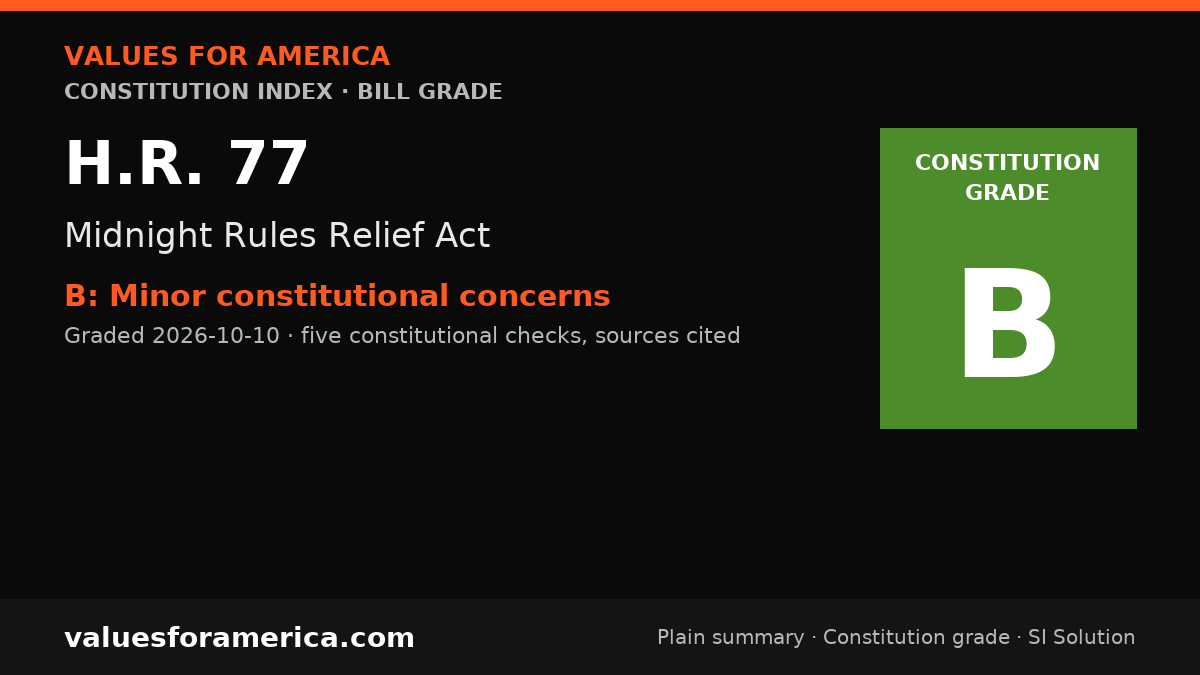
Midnight Rules Relief Act
Cosponsors: 12 (0 D, 12 R) · per Congress.gov, 2026-10-12
Introduced: 2025-01-03
Latest action (2025-02-13): Received in the Senate and Read twice and referred to the Committee on Homeland Security and Governmental Affairs.
What H.R. 77 does, in plain terms
Midnight Rules Relief Act This bill allows Congress to disapprove multiple regulations under one joint resolution of disapproval if the regulations were submitted for review during a portion of the final year of a President's term. Under current law, the Congressional Review Act generally provides for a period of additional review during the succeeding Congress for regulations that were submitted during the last 60 legislative days of the prior Congress. However, each joint resolution may disapprove of only one regulation.
Official summary by the Congressional Research Service, via Congress.gov.
Constitution Index
“VFA Constitution grade”
Minor constitutional concerns
Graded 2026-10-10
SI-generated grade · five published checks · not individually reviewed by a person · methodology
The Midnight Rules Relief Act is a procedural bill that adjusts how Congress reviews and disapproves regulations under the Congressional Review Act. It does not expand federal power beyond the legislative authority granted by Article I, nor does it infringe on individual rights. The primary constitutional tension is the potential for bundling multiple regulations into a single disapproval resolution, which could undermine the clarity and deliberative quality of legislative action, but this is a minor procedural concern rather than a direct constitutional violation.
-
✓ Passes · Enumerated powers
Congress has broad authority under Article I, Section 1 to legislate, and the Necessary and Proper Clause (Article I, Section 8, Clause 18) allows Congress to structure its own review of executive regulations. The bill merely modifies the procedural mechanism for congressional disapproval of regulations, which is within Congress's legislative powers. -
✓ Passes · Bill of Rights
The bill does not implicate any of the first ten amendments. It concerns the internal legislative process for disapproving regulations and does not affect speech, religion, assembly, press, petition, arms, quartering, search and seizure, self-incrimination, due process, trial rights, jury rights, cruel and unusual punishment, unenumerated rights, or reserved powers. -
✓ Passes · Individual sovereignty
The bill does not restrict individual liberty or property rights. It only changes how Congress may bundle disapproval resolutions, which is a procedural matter. It does not impose any new restrictions on individuals or require them to justify their freedoms. -
✓ Passes · Decentralization
This bill operates at the federal level, but it does not consolidate decision-making upward in a way that violates decentralization principles. It concerns the federal government's review of federal regulations, which is inherently a federal function. The questions: (1) individuals cannot handle this—it is a federal legislative procedure; (2) local communities cannot handle this—it is a federal ma… -
✓ Passes · Due process and takings
The bill does not affect due process or takings. It is a procedural rule for Congress, not an executive or judicial action that would deprive individuals of life, liberty, or property. It does not bypass any hearing or notice requirements for individuals.
Sources: Congress.gov: HR 77 summary
Report an error in this grade
What should pass
“VFA SI Solution”
No solution yet
A sourced SI draft appears here once it passes automated checks (Constitution citation, source verification, independent SI critic). How publication works.
Related on VFA

For journalists and bloggers
“Embed this grade”
Free to use with the link back. The badge and card update when the grade changes. Embed terms →
