H.R. 7618 explained · 119th Congress · Pending in Congress
American Battlefield Protection Program Amendments Act of 2026
Cosponsors: 6 (2 D, 4 R) · per Congress.gov, 2026-10-14
Introduced: 2026-02-20
Latest action (2026-09-30): Committee on Energy and Natural Resources. Ordered to be reported without amendment favorably.
What H.R. 7618 does, in plain terms
American Battlefield Protection Program Amendments Act of 2026 This bill extends through FY2036 three National Park Service (NPS) grant programs that preserve U.S. battlefields and requires the NPS to study additional sites for potential preservation. Specifically, the bill extends through FY2036 grant programs for the acquisition, interpretation modernization, and restoration of certain U.S. battlefields. (Under current law, the grants are authorized through FY2028.) The bill also requires the NPS to prepare or certify studies of locations tied to significant events during the French and Indian War (1754-1763) and the Mexican-American War (1846-1848) for potential preservation.
Official summary by the Congressional Research Service, via Congress.gov.
Constitution Index
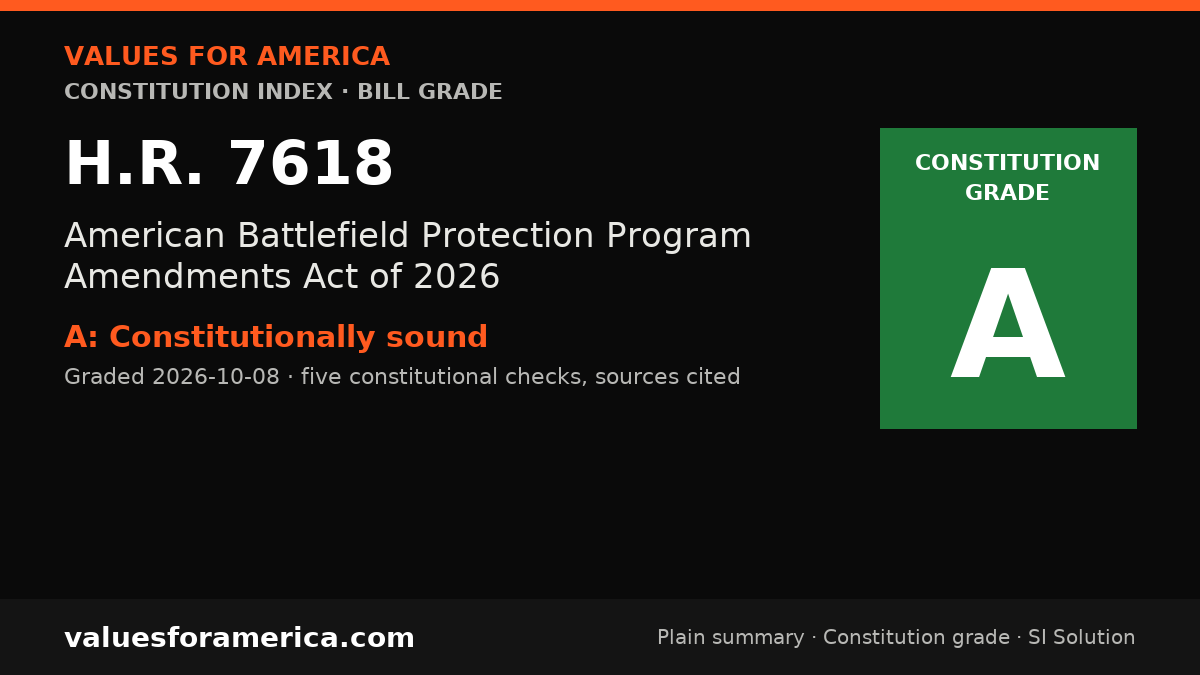
“VFA Constitution grade”
Constitutionally sound
Graded 2026-10-08
SI-generated grade · five published checks · not individually reviewed by a person · methodology
Voluntary federal grants and studies to preserve nationally significant battlefields rest on the spending and property powers, restrict no rights, seize no property, and impose no mandates, making the measure constitutionally sound.
-
✓ Passes · Enumerated powers
Congress acts under Article I, Section 8, Clause 1, the power to tax and spend for the general Welfare, by extending voluntary preservation grants, and under Article IV, Section 3, Clause 2, the Property Clause authority to manage and study property belonging to the United States and matters of national historic concern. The bill regulates no private conduct and compels no state legislation, so it… -
✓ Passes · Bill of Rights
The bill creates no restriction on speech, religion, press, assembly, arms, searches, trial rights, or other protections in Amendments 1-10. It authorizes voluntary preservation grants and historical studies under the First Amendment-compatible government speech and education function, and takes no adverse action against any person. No provision authorizes search, seizure, or compelled testimony u… -
✓ Passes · Individual sovereignty
The bill restricts nothing a person may do with their person, property, speech, labor, or belief. Participation in grant acquisition and interpretation is voluntary, and the required studies of French and Indian War and Mexican-American War sites impose no mandate, prohibition, or condition on private owners. The government bears no additional burden here because no liberty is curtailed under the … -
✓ Passes · Decentralization
Individually and locally, families, counties, and single states cannot uniformly preserve battlefields of national significance spanning multiple states and wars, or maintain consistent interpretive standards. The program uses limited federal grants and studies rather than federal preemption or mandates, leaving states and private owners free to act. It does not consolidate land-use, education, or… -
✓ Passes · Due process and takings
No deprivation of life, liberty, or property and no taking occurs. Grants for acquisition support voluntary transactions, which under the Fifth Amendment require just compensation when property changes hands, and restoration funds improve resources. No civil or criminal penalty, list, forfeiture, or presumption is created, so procedural due process under the Fifth Amendment and substantive non-arb…
Sources: Congress.gov: HR 7618 summary
Report an error in this grade
The Framers
“Founders’ Verdict”
Confidence 0.75
Archived SI output (machine-generated)No editorial review recorded. This historical SI verdict was machine-generated by software and predates the review desk; check it against the official bill text.
Synthesis
The bill is constitutional as a proper exercise of Congress's powers under the Property Clause (Article IV, Section 3, Clause 2) and the General Welfare Clause (Article I, Section 8, Clause 1), with the majority finding that battlefield preservation serves a national purpose and that the grant programs and studies are within federal authority, including implied powers under McCulloch v. Maryland.
This bill is a proper exercise of Congress's power under the Property Clause and the General Welfare Clause. Article IV, Section 3, Clause 2 grants Congress authority to 'dispose of and make all needful Rules and Regulations respecting the Territory or other Property belonging to the United States.' The preservation of battlefields—sites of national historical significance—falls squarely within the care of federal property and the promotion of the general welfare. Furthermore, the extension of grant programs through FY2036 is a legitimate use of the spending power, as the Constitution does not…
The Constitution grants Congress only the powers specifically enumerated in Article I, Section 8. The preservation of battlefields, while laudable, is not among those powers. The bill extends federal grant programs and mandates studies by the National Park Service, which are acts of internal improvement and land management that fall outside the limited federal sphere. The Tenth Amendment reserves all powers not delegated to the United States to the states or to the people. Here, battlefield preservation is a matter of local historical and cultural interest, properly left to state and private a…
The bill authorizes federal expenditures for the preservation and study of battlefields, which falls within the power of Congress to lay and collect taxes for the general welfare. The preservation of historic sites of national significance, such as those from the French and Indian War and the Mexican-American War, serves a national purpose rather than a merely local one. Additionally, the grants and studies involve lands that may be acquired or regulated under the Property Clause, as the National Park Service administers federal lands. However, I caution that the spending power must be exercis…
This bill extends federal grant programs for battlefield preservation and authorizes studies of historic sites. The Constitution grants Congress authority over federal property under Article IV, Section 3, Clause 2, which empowers Congress to 'make all needful Rules and Regulations respecting the Territory or other Property belonging to the United States.' The preservation of battlefields on federal lands or through federal grants falls within this power. Moreover, under McCulloch v. Maryland, Congress possesses implied powers to employ means necessary and proper to execute its enumerated powe…
Report an error in this Founders' Verdict
What should pass
“VFA SI Solution”
No solution yet
A sourced SI draft appears here once it passes automated checks (Constitution citation, source verification, independent SI critic). How publication works.
Related on VFA

For journalists and bloggers
“Embed this grade”
Free to use with the link back. The badge and card update when the grade changes. Embed terms →
