H.R. 7613 explained · 119th Congress · Pending in Congress
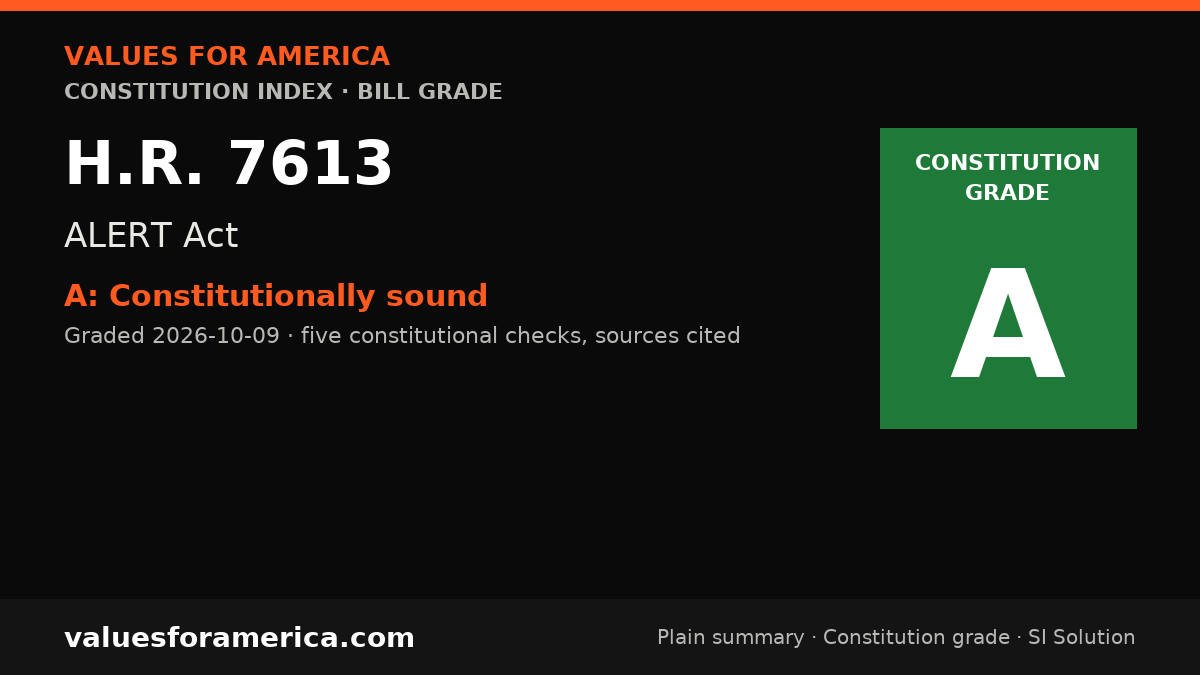
ALERT Act
Cosponsors: 87 (37 D, 50 R) · per Congress.gov, 2026-10-09
Introduced: 2026-02-20
Latest action (2026-04-15): Received in the Senate and Read twice and referred to the Committee on Commerce, Science, and Transportation.
What H.R. 7613 does, in plain terms
Airspace Location and Enhanced Risk Transparency Act of 2026 or the ALERT Act This bill addresses aviation safety by increasing requirements for aircraft tracking and communication using Automatic Dependent Surveillance-Broadcast (ADS-B) technology and expanding oversight. As background, ADS-B for broadcasting (Out) and receiving (In) transmits information (e.g., location and weather) among aircraft and air traffic control (ATC). The bill requires the Department of Defense (DOD) and the Department of Transportation (DOT) to enter into an agreement regarding the use of collision prevention technologies on DOD aircraft. The agreement must require the use of ADS-B Out as the default practice for DOD helicopters operating in the national airspace, unless such use would affect operational security. For DOD helicopters that are carrying out special missions in the Washington, DC, metropolitan area and are exempt from ADS-B Out transmission requirements, DOD must coordinate with DOT to conduct a safety risk assessment and implement appropriate mitigations. By December 31, 2031, DOD aircraft (other than certain special mission aircraft) must be equipped with and operating integrated ADS-B In technology. With respect to civil aircraft, by December 31, 2031, the Federal Aviation Administration (FAA) must generally require aircraft that are currently required to be equipped with ADS-B Out to also be equipped with ADS-B In. Additionally, among other requirements, the FAA must establish time-on-position limits for supervisory ATC personnel; establish a process to timely notify parties involved in certain near-miss incidents; and evaluate and revise, as necessary, helicopter routes around Ronald Reagan Washington National Airport.
Official summary by the Congressional Research Service, via Congress.gov.
Constitution Index
“VFA Constitution grade”
Constitutionally sound
Graded 2026-10-09
SI-generated grade · five published checks · not individually reviewed by a person · methodology
The ALERT Act is fully constitutional. It falls squarely within Congress's enumerated power to regulate interstate commerce and navigable airspace under Article I, Section 8, Clause 3. The bill imposes safety equipment requirements on aircraft, which do not infringe any Bill of Rights protections, including the Fourth Amendment, because aircraft in public airspace have a diminished expectation of privacy and the mandate serves a compelling safety interest. Individual sovereignty is not unduly restricted; the government has a strong justification for the regulation. Decentralization is appropriate because aviation safety inherently requires national coordination—no lower level of government could effectively manage it. Due process is satisfied through standard rulemaking procedures, and the equipment mandate does not constitute a taking under the Fifth Amendment, as it is a reasonable safety regulation with adequate lead time.
-
✓ Passes · Enumerated powers
Congress has authority under the Commerce Clause (Article I, Section 8, Clause 3) to regulate aviation and airspace, which are inherently interstate in nature. The bill's requirements for aircraft tracking and communication fall within this power, as they directly affect the safety and efficiency of interstate and international air travel. -
✓ Passes · Bill of Rights
No provision of the Bill of Rights is infringed. The requirement to equip aircraft with ADS-B technology does not implicate the First, Second, Third, Fifth (except as separately analyzed), Sixth, Seventh, Eighth, Ninth, or Tenth Amendments. Regarding the Fourth Amendment, aircraft operating in public navigable airspace have no reasonable expectation of privacy in their location and identity, espec… -
✓ Passes · Individual sovereignty
The bill imposes a modest equipment mandate on aircraft owners, but the government has a compelling constitutional justification: preventing mid-air collisions and enhancing aviation safety. The restriction is narrowly tailored to achieve that goal, and the burden on individual freedom is minimal compared to the public benefit. This is a reasonable exercise of the police power inherent in the comm… -
✓ Passes · Decentralization
The action passes all four questions of the decentralization test. (1) An individual or family cannot handle aviation safety across the national airspace system. (2) A local community or county cannot manage air traffic control or collision avoidance across multiple jurisdictions. (3) A state cannot regulate aircraft operating across state lines or in federal airspace. (4) Consolidation at the fed… -
✓ Passes · Due process and takings
The bill does not bypass due process. It requires the FAA to engage in rulemaking, which includes notice-and-comment procedures under the Administrative Procedure Act, providing fair notice and opportunity to be heard. The equipment mandate does not constitute a taking under the Fifth Amendment. The Supreme Court has consistently held that reasonable safety regulations that do not deprive the owne…
Sources: Congress.gov: HR 7613 summary
Report an error in this grade
What should pass
“VFA SI Solution”
No solution yet
A sourced SI draft appears here once it passes automated checks (Constitution citation, source verification, independent SI critic). How publication works.
Related on VFA

For journalists and bloggers
“Embed this grade”
Free to use with the link back. The badge and card update when the grade changes. Embed terms →
