H.R. 747 explained · 119th Congress · Pending in Congress
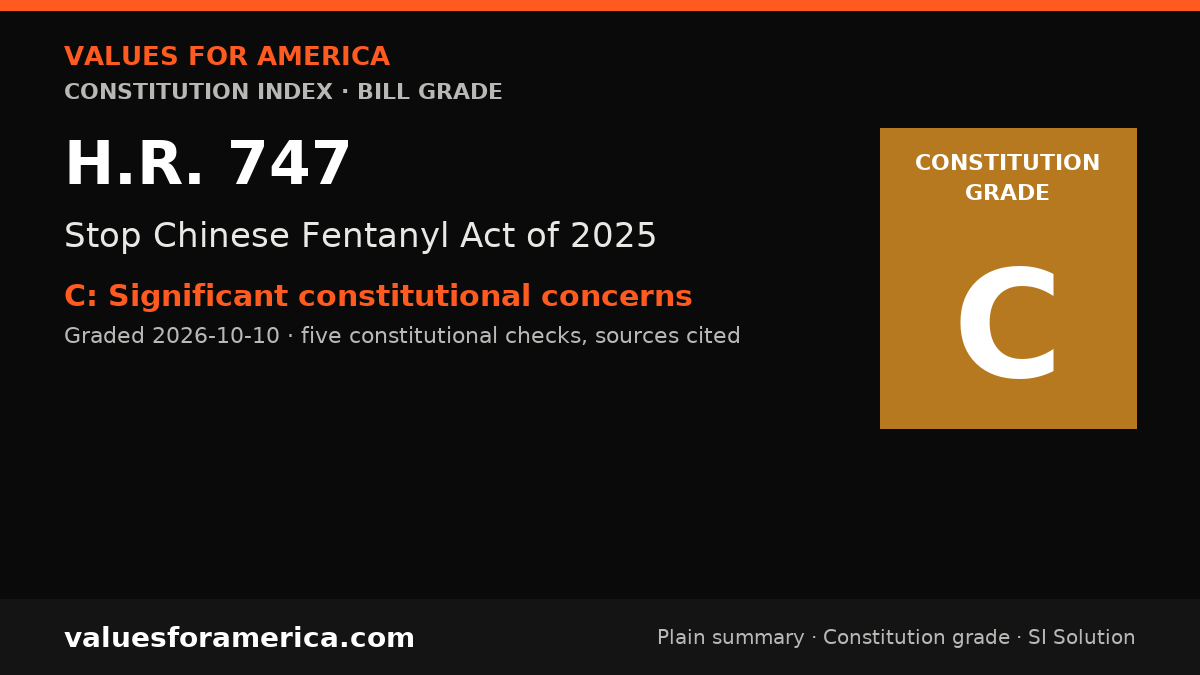
Stop Chinese Fentanyl Act of 2025
Cosponsors: 9 (2 D, 7 R) · per Congress.gov, 2026-10-11
Introduced: 2025-01-28
Latest action (2025-09-03): Received in the Senate and Read twice and referred to the Committee on Banking, Housing, and Urban Affairs.
What H.R. 747 does, in plain terms
Stop Chinese Fentanyl Act of 2025 This bill subjects certain Chinese entities and government officials to potential sanctions related to opioid trafficking and requires the President to conduct certain preliminary analyses before regulating economic transactions in the event of a national emergency related to international drug trafficking. Specifically, for the purposes of the Fentanyl Sanctions Act, the bill changes the definition of foreign opioid trafficker to specify that the term includes (1) Chinese entities involved in the production or sale of synthetic opioids or related pharmaceutical ingredients that fail to take steps to detect or prevent opioid trafficking; and (2) certain senior Chinese government officials that aid and abet opioid trafficking, including through intentional inaction. Under current law, the President must impose certain sanctions on individuals and entities identified as foreign opioid traffickers. Further, the bill extends through 2029 an existing requirement that the President report to Congress annually on identified foreign opioid traffickers and any sanctions imposed on them. (This requirement expired in December 2024.) The bill also requires the President to take additional steps in issuing regulations under the International Emergency Economic Powers Act (IEEPA) pursuant to a declared national emergency related to international drug trafficking. (IEEPA authorizes the President to regulate a variety of economic transactions following a declaration of national emergency.) Under the bill, the President must evaluate the costs and benefits of issuing economic regulations for the purpose of resolving the drug trafficking emergency and publish a discussion of such costs and benefits.
Official summary by the Congressional Research Service, via Congress.gov.
Constitution Index
“VFA Constitution grade”
Significant constitutional concerns
Graded 2026-10-10
SI-generated grade · five published checks · not individually reviewed by a person · methodology
The bill raises significant constitutional concerns regarding federal overreach into foreign affairs and economic regulation, potential infringement on due process through sanctions without judicial review, and a failure to respect the Tenth Amendment's reservation of powers to the states. While Congress has authority over foreign commerce and national security, the broad delegation of sanctioning power and the lack of procedural safeguards for targeted entities create substantial constitutional tension.
-
✗ Concern · Enumerated powers
Congress has authority under Article I, Section 8, Clause 3 (Commerce Clause) to regulate foreign commerce, and under Article I, Section 8, Clause 11 (Declare War) and the Necessary and Proper Clause (Clause 18) to address national emergencies. However, the bill's expansion of sanctions to include Chinese entities for 'intentional inaction' in preventing opioid trafficking stretches beyond enumera… -
✗ Concern · Bill of Rights
The bill's sanctions regime implicates the Fifth Amendment's Due Process Clause by allowing the President to designate entities as 'foreign opioid traffickers' without providing notice or a hearing before imposing penalties. While foreign entities have limited constitutional protections, U.S. persons or entities with property interests affected by sanctions may have due process rights. The bill do… -
✗ Concern · Individual sovereignty
The bill restricts the economic freedom of Chinese entities and potentially U.S. persons doing business with them by imposing sanctions without a clear showing of direct culpability. The 'intentional inaction' standard places the burden on entities to prove they took sufficient steps to prevent trafficking, rather than requiring the government to prove active participation. This shifts the presump… -
✗ Concern · Decentralization
The bill fails the decentralization test on multiple grounds. (1) Individuals and families cannot handle international drug trafficking sanctions—this requires government action. (2) Local communities cannot regulate foreign entities—this requires state or federal action. (3) States cannot impose sanctions on foreign governments—this is exclusively federal under Article I, Section 10. (4) The bill… -
✗ Concern · Due process and takings
The bill fails to provide procedural due process for entities designated as foreign opioid traffickers. Under the Fifth Amendment, property interests (including business assets and contractual rights) cannot be taken without due process. The bill authorizes sanctions—which can freeze assets and prohibit transactions—without requiring notice, a hearing, or judicial review before imposition. The 'in…
Sources: Congress.gov: HR 747 summary
Report an error in this grade
What should pass
“VFA SI Solution”
No solution yet
A sourced SI draft appears here once it passes automated checks (Constitution citation, source verification, independent SI critic). How publication works.
Related on VFA

For journalists and bloggers
“Embed this grade”
Free to use with the link back. The badge and card update when the grade changes. Embed terms →
