H.R. 7257 explained · 119th Congress · Pending in Congress
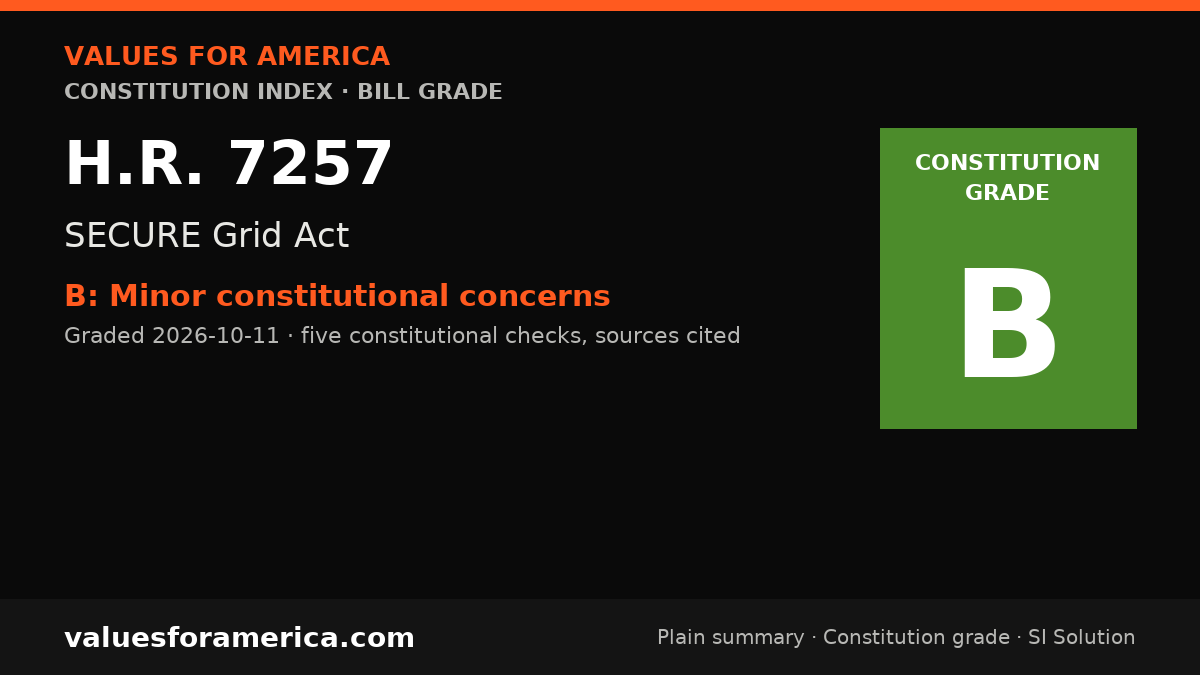
SECURE Grid Act
Cosponsors: 4 (1 D, 3 R) · per Congress.gov, 2026-10-14
Introduced: 2026-01-27
Latest action (2026-09-30): Committee on Energy and Natural Resources. Ordered to be reported without amendment favorably.
What H.R. 7257 does, in plain terms
Securing Community Upgrades for a Resilient Grid Act or the SECURE Grid Act This bill extends through FY2031 and modifies requirements for state energy security plans. Under current law, states are required to submit to the Department of Energy (DOE) state energy security plans that meet certain requirements in order to be eligible to receive federal financial assistance for state energy conservation programs. The bill specifies that DOE is not required to approve the plans. The bill requires DOE to provide information, technical assistance, and other assistance in the development, implementation, or revision of a state energy security plan upon the request of a state. The bill also requires states to address additional factors in their energy security plans, such as (1) weather-related threats and vulnerabilities; (2) supply chain risks for equipment for the generation, transmission, and distribution of electricity; and (3) the security of local distribution systems and the bulk-power system. A local distribution system is energy infrastructure owned and operated by an electric utility at a voltage of 100 kilovolts or less. In addition, the bill directs the Government Accountability Office to report to Congress on the efficacy of state energy security plans.
Official summary by the Congressional Research Service, via Congress.gov.
Constitution Index
“VFA Constitution grade”
Minor constitutional concerns
Graded 2026-10-11
SI-generated grade · five published checks · not individually reviewed by a person · methodology
The SECURE Grid Act is a conditional federal grant program that encourages states to enhance their energy security planning. It does not mandate state action, but it conditions federal financial assistance on compliance with expanded planning requirements. This raises federalism concerns under the Tenth Amendment and the Spending Clause, but the conditions are reasonably related to the federal interest in grid resilience and national security. The bill does not infringe individual rights, and it preserves state discretion by not requiring DOE approval of plans. The main issue is the upward consolidation of energy policy decision-making, which warrants a 'B' grade.
-
✓ Passes · Enumerated powers
The federal government has authority under the Spending Clause (Article I, Section 8, Clause 1) to attach conditions to federal financial assistance. The bill's requirements are related to the federal interest in energy security, interstate commerce, and national defense, which are within Congress's enumerated powers. The bill does not mandate state action but conditions funding, which is a permis… -
✓ Passes · Bill of Rights
The bill does not implicate any of the first ten amendments. It does not restrict speech, religion, assembly, press, petition, arms, quartering, search and seizure, self-incrimination, due process, takings, trial rights, or cruel and unusual punishment. The requirements are administrative and planning-related, not rights-restrictive. -
✓ Passes · Individual sovereignty
The bill does not restrict individual liberty or property rights. It imposes conditions on states receiving federal funds, not on individuals. Individuals are not directly regulated, and the bill does not affect personal conduct, labor, or belief. The burden of compliance falls on state governments, not on individuals. -
✗ Concern · Decentralization
The bill fails the decentralization test because it consolidates energy security planning at the federal level by imposing detailed federal requirements on state plans as a condition of funding. While states retain the option to decline funds, the practical effect is to centralize decision-making in Washington. The bill does not directly violate the Tenth Amendment because it is a conditional gran… -
✓ Passes · Due process and takings
The bill does not deprive any person of life, liberty, or property without due process, nor does it take private property without just compensation. It imposes conditions on federal funding, which is a voluntary program. States have notice of the requirements and can choose to participate or not. There is no arbitrary government action or deprivation of rights.
Sources: Congress.gov: HR 7257 summary
Report an error in this grade
What should pass
“VFA SI Solution”
No solution yet
A sourced SI draft appears here once it passes automated checks (Constitution citation, source verification, independent SI critic). How publication works.
Related on VFA

For journalists and bloggers
“Embed this grade”
Free to use with the link back. The badge and card update when the grade changes. Embed terms →
