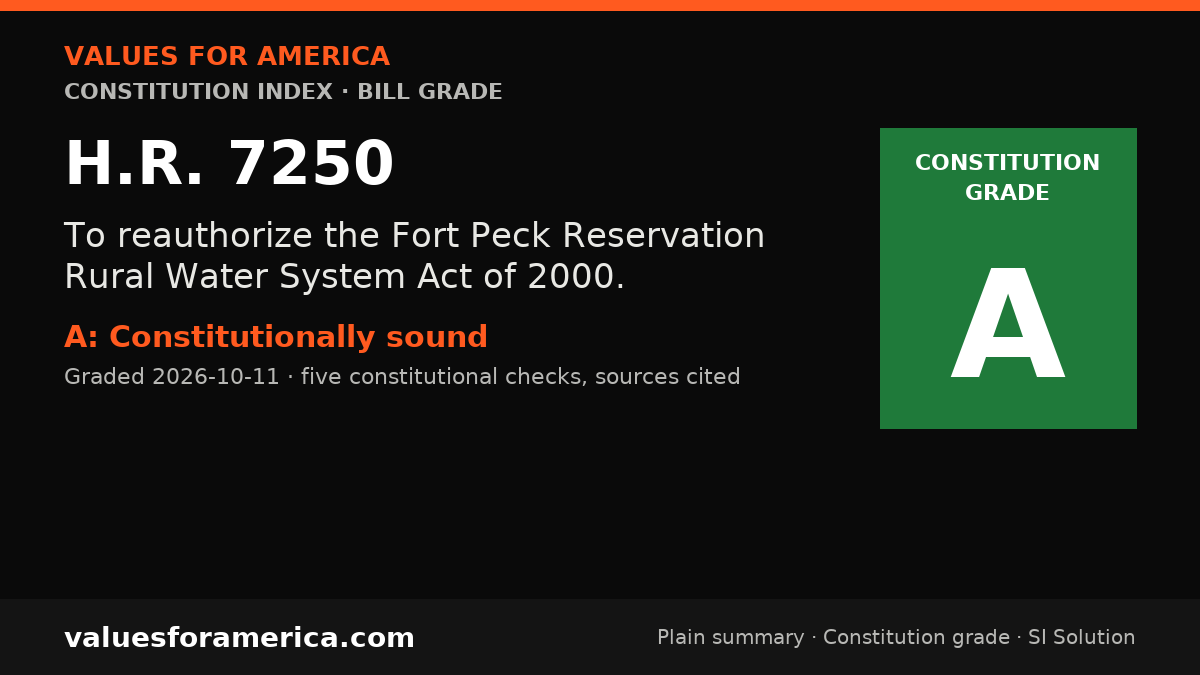
H.R. 7250 explained · 119th Congress · Became law
To reauthorize the Fort Peck Reservation Rural Water System Act of 2000.
Cosponsors: none · per Congress.gov, 2026-10-14
Introduced: 2026-01-27
Latest action (2026-09-25): Became Public Law No: 119-113.
What H.R. 7250 does, in plain terms
This bill reauthorizes through FY2028 the planning, design, and construction of the Assiniboine and Sioux Rural Water System and the Dry Prairie Rural Water System, both located in Montana.
Official summary by the Congressional Research Service, via Congress.gov.
Constitution Index
“VFA Constitution grade”
Constitutionally sound
Graded 2026-10-11
SI-generated grade · five published checks · not individually reviewed by a person · methodology
This bill reauthorizes federal funding for water infrastructure projects on the Fort Peck Reservation in Montana. It is a valid exercise of Congress's enumerated powers under the Indian Commerce Clause and the Property Clause, does not infringe on any constitutional rights, respects individual sovereignty by providing a public benefit without restricting personal freedoms, appropriately involves federal action due to the federal trust responsibility to tribes, and follows proper legislative process without due process or takings concerns.
-
✓ Passes · Enumerated powers
Congress has explicit authority to regulate commerce with Indian tribes under Article I, Section 8, Clause 3. Additionally, the federal government has a unique trust responsibility to Native American tribes, and the Property Clause (Article IV, Section 3, Clause 2) grants Congress power over federal lands and Indian reservations. Reauthorizing water systems for a reservation falls squarely within … -
✓ Passes · Bill of Rights
The bill does not restrict speech, religion, assembly, press, petition, arms, quartering, search and seizure, self-incrimination, due process, takings, trial rights, or cruel and unusual punishment. It is a funding authorization that imposes no restrictions on individual liberties. -
✓ Passes · Individual sovereignty
The bill does not restrict any individual's person, property, speech, labor, or belief. It provides federal funding for water infrastructure, which enhances the well-being of residents on the reservation. There is no burden on individual freedom; rather, it supports community needs. -
✓ Passes · Decentralization
The project involves water systems on a federal Indian reservation, which is a unique federal responsibility. The federal government has a trust obligation to tribes, and the reservation is under federal jurisdiction. While local and state governments could theoretically handle water projects, the federal role is justified by the special legal status of Indian tribes and the need for federal fundi… -
✓ Passes · Due process and takings
The bill is a straightforward reauthorization of funding. It does not involve any taking of property, nor does it deprive anyone of life, liberty, or property without due process. It follows the legislative process and does not bypass any procedural safeguards.
Sources: Congress.gov: HR 7250 summary
Report an error in this grade
What should pass
“VFA SI Solution”
No solution yet
A sourced SI draft appears here once it passes automated checks (Constitution citation, source verification, independent SI critic). How publication works.
Related on VFA

For journalists and bloggers
“Embed this grade”
Free to use with the link back. The badge and card update when the grade changes. Embed terms →
