H.R. 7148 explained · 119th Congress · Became law
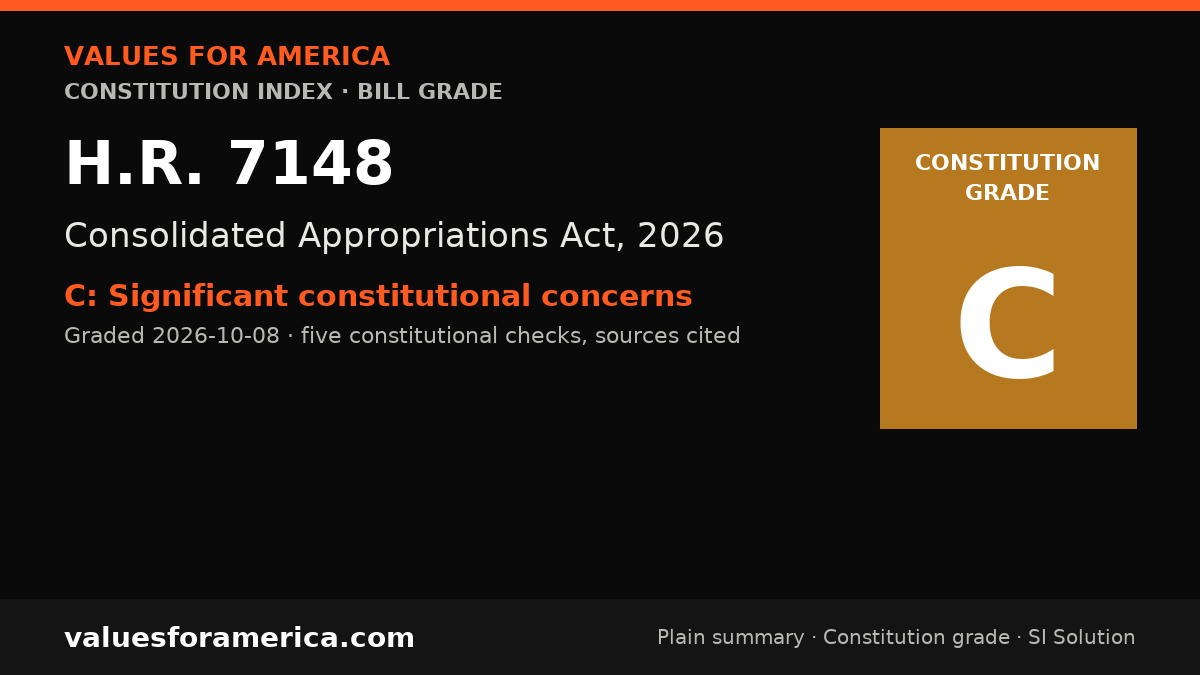
Consolidated Appropriations Act, 2026
Cosponsors: none · per Congress.gov, 2026-10-09
Introduced: 2026-01-20
Latest action (2026-02-03): Became Public Law No: 119-75.
What H.R. 7148 does, in plain terms
Consolidated Appropriations Act, 2026 This bill provides appropriations to several federal departments and agencies for the remainder of FY2026 and provides continuing FY2026 appropriations for the Department of Homeland Security (DHS) through February 13, 2026. It also extends various expiring programs and authorities. Specifically, the bill includes 5 of the 12 regular FY2026 appropriations bills: the Department of Defense Appropriations Act, 2026; the Departments of Labor, Health and Human Services, and Education, and Related Agencies Appropriations Act, 2026; the Transportation, Housing and Urban Development, and Related Agencies Appropriations Act, 2026; the Financial Services and General Government Appropriations Act, 2026; and the National Security, Department of State, and Related Programs Appropriations Act, 2026. The departments, agencies, and activities funded in the bill include the Department of Defense, the Department of Labor, the Department of Health and Human Services, the Department of Education, the Department of Transportation, the Department of Housing and Urban Development, the Department of the Treasury, the Executive Office of the President, the judiciary, the District of Columbia, the Department of State and related programs, the administration and oversight of foreign assistance programs, bilateral economic assistance, international security assistance, multilateral assistance, export and investment assistance, and several related and independent agencies. In addition, the bill includes a continuing resolution (CR) that provides continuing FY2026 appropriations to DHS through the earlier of February 13, 2026, or the enactment of the DHS appropriations act. The CR funds most DHS programs and activities at the FY2025 levels. The bill also extends several expiring programs and authorities, including the U.S. Grain Standards Act; the Commodity Futures Trading Commission’s whistleblower program; the National Flood Insurance Program; the Forest Service's participation in the Agriculture Conservation Experienced Services Program; the Transportation Security Administration’s Reimbursable Screening Services Program; the Motor Carrier Safety Advisory Committee; several authorities and programs related to cybersecurity; the technology modernization fund and board; the U.S. Parole Commission; the special assessment on nonindigent persons or entities convicted of certain offenses involving sexual abuse or human trafficking; several immigration-related programs and authorities; the authority for the U.S. Sentencing Commission to promulgate certain guidelines or amendments related to the use of unmanned aircraft; certain bankruptcy fees; trade preferences for Haiti and countries in sub-Saharan Africa; the Temporary Assistance for Needy Families (TANF) program; and several health care authorities and programs.
Official summary by the Congressional Research Service, via Congress.gov.
Constitution Index
“VFA Constitution grade”
Significant constitutional concerns
Graded 2026-10-08
SI-generated grade · five published checks · not individually reviewed by a person · methodology
A funding law with clear authority for defense, foreign affairs, and core federal operations, but it also sustains broad federal control over education, housing, health, labor, and welfare properly left to states. No direct Bill of Rights breach or takings breach is shown, so the grade reflects power overreach and centralization rather than a direct rights breach.
-
✗ Concern · Enumerated powers
Congress has express power to tax, spend for common defense and general welfare, and appropriate funds under Article I, Section 8, Clause 1 and Article I, Section 9, Clause 7. Defense, State Department functions, judiciary, District of Columbia under Article I, Section 8, Clause 17, and homeland security border functions therefore have clear authority. The same vehicle funds Departments and progra… -
✓ Passes · Bill of Rights
The text summarized is a funding and extension measure. It does not on its face direct censorship, religious establishment, disarmament, warrantless search, compelled testimony, unfair trial, or cruel punishment. No provision described authorizes speech suppression under the First Amendment, seizure under the Fourth Amendment, or other direct infringement of Amendments 1-8. Severity is none becaus… -
✓ Passes · Individual sovereignty
The summarized bill directs public funds to agencies and extends existing authorities. It does not on its face prohibit private speech, belief, labor, movement, ownership, or family choice, nor compel private conduct without justification. Any burden on sovereignty is indirect through taxation and future regulation. Because no direct personal restriction is imposed by the appropriation language de… -
✗ Concern · Decentralization
An individual or county cannot fund national defense, interstate transport, or foreign assistance, so questions 1-2 remain federal in nature. A state could handle several funded areas such as education, housing support, labor programs, health services, and flood insurance, under powers reserved by the Tenth Amendment. By continuing those programs at federal level and extending them centrally, the … -
✓ Passes · Due process and takings
The bill was enacted through bicameral passage and presentment under Article I, Section 7, giving notice and legislative process. It does not declare guilt, impose forfeiture on named persons, or seize specific private property for public use without compensation under the Fifth Amendment. Tax-funded spending is governed by Article I, Section 8, Clause 1 and Article I, Section 9, Clause 7, not by …
Sources: Congress.gov: HR 7148 summary
Report an error in this grade
What should pass
“VFA SI Solution”
No solution yet
A sourced SI draft appears here once it passes automated checks (Constitution citation, source verification, independent SI critic). How publication works.
Related on VFA

For journalists and bloggers
“Embed this grade”
Free to use with the link back. The badge and card update when the grade changes. Embed terms →
