H.R. 7128 explained · 119th Congress · Pending in Congress
TRIA Program Reauthorization Act of 2026
Cosponsors: 4 (3 D, 1 R) · per Congress.gov, 2026-10-08
Introduced: 2026-01-16
Latest action (2026-07-13): Received in the Senate and Read twice and referred to the Committee on Banking, Housing, and Urban Affairs.
What H.R. 7128 does, in plain terms
TRIA Program Reauthorization Act of 2026 This bill reauthorizes the Terrorism Risk Insurance Program through 2034. The program covers a portion of the losses incurred by private insurers for property and casualty insurance coverage for terrorism risk. The bill also increases the amount of property and casualty insurance losses required for certification under the program beginning in 2029 and provides statutory authority for Department of the Treasury public notification requirements regarding the determination process for whether an act qualifies as an act of terrorism under this program.
Official summary by the Congressional Research Service, via Congress.gov.
Constitution Index
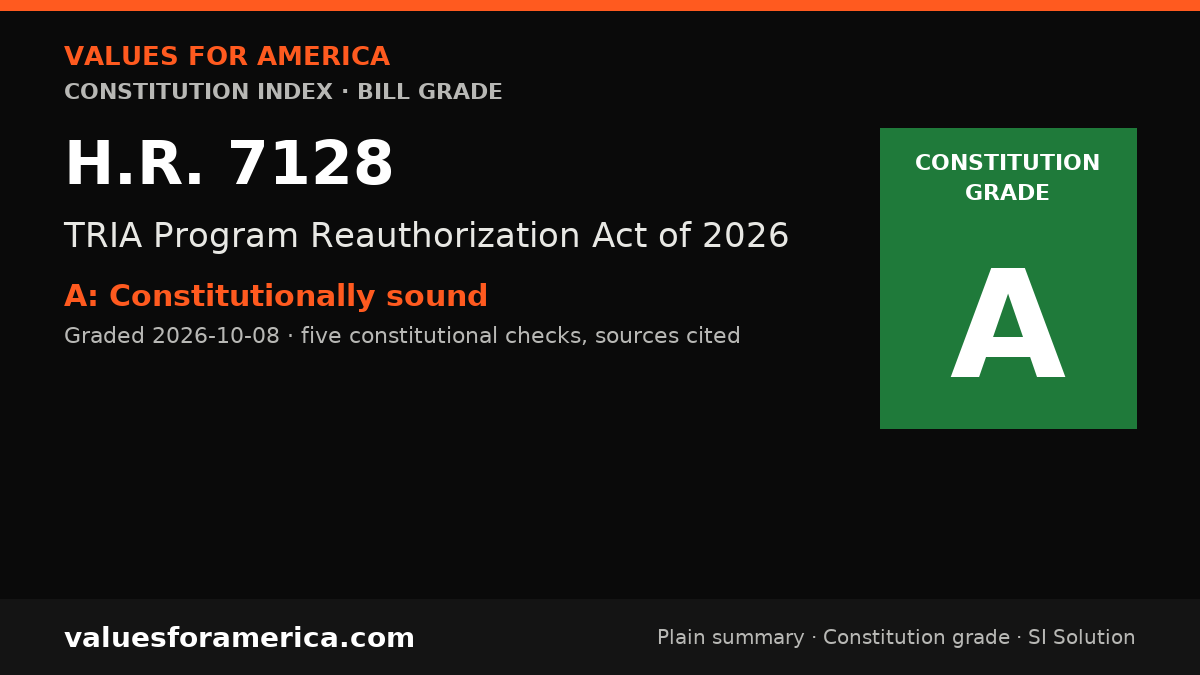
“VFA Constitution grade”
Constitutionally sound
Graded 2026-10-08
SI-generated grade · five published checks · not individually reviewed by a person · methodology
SI review finds the TRIA reauthorization through 2034 is a routine exercise of commerce and necessary-and-proper authority to stabilize interstate insurance markets, with no rights restriction, sovereignty burden, or due-process taking.
-
✓ Passes · Enumerated powers
Congress has authority over interstate commerce and authority to make laws necessary and proper to carry out its powers under Article I, Section 8, Clause 3 and Clause 18. Terrorism risk insurance affects interstate financial markets and property-casualty commerce across states. Reauthorizing a temporary federal loss-sharing backstop and Treasury notification rules is within those grants. -
✓ Passes · Bill of Rights
No provision restricts speech, religion, press, assembly, arms, searches, trial rights, or other protections in Amendments 1-10. The bill adjusts a federal financial backstop for private property-casualty insurers and Treasury public notification procedures. It compels no belief, search, seizure, or self-incrimination under the First, Second, Fourth, or Fifth Amendments. -
✓ Passes · Individual sovereignty
The bill does not restrict what a person may do with their person, property, speech, labor, or belief. It does not mandate purchase, prohibit coverage, or condition private conduct. It supports continued availability of private terrorism-risk coverage, leaving individual choice intact without needing compelling justification. -
✓ Passes · Decentralization
Terrorism risk is national, interstate, and beyond capacity of individuals, localities, or single states to insure against catastrophic loss. The program does not displace state insurance regulation but provides a limited federal backstop and public notice process. It uses the minimum higher level needed for a genuinely interstate catastrophic risk, consistent with the Tenth Amendment. -
✓ Passes · Due process and takings
No person is deprived of life, liberty, or property without notice and hearing under the Fifth Amendment Due Process Clause, and no property is taken for public use without just compensation under the Fifth Amendment Takings Clause. Certification thresholds and Treasury notice requirements add transparency rather than summary adjudication or confiscation.
Sources: Congress.gov: HR 7128 summary
Report an error in this grade
What should pass
“VFA SI Solution”
No solution yet
A sourced SI draft appears here once it passes automated checks (Constitution citation, source verification, independent SI critic). How publication works.
Related on VFA

For journalists and bloggers
“Embed this grade”
Free to use with the link back. The badge and card update when the grade changes. Embed terms →
