H.R. 7022 explained · 119th Congress · Sent to the President
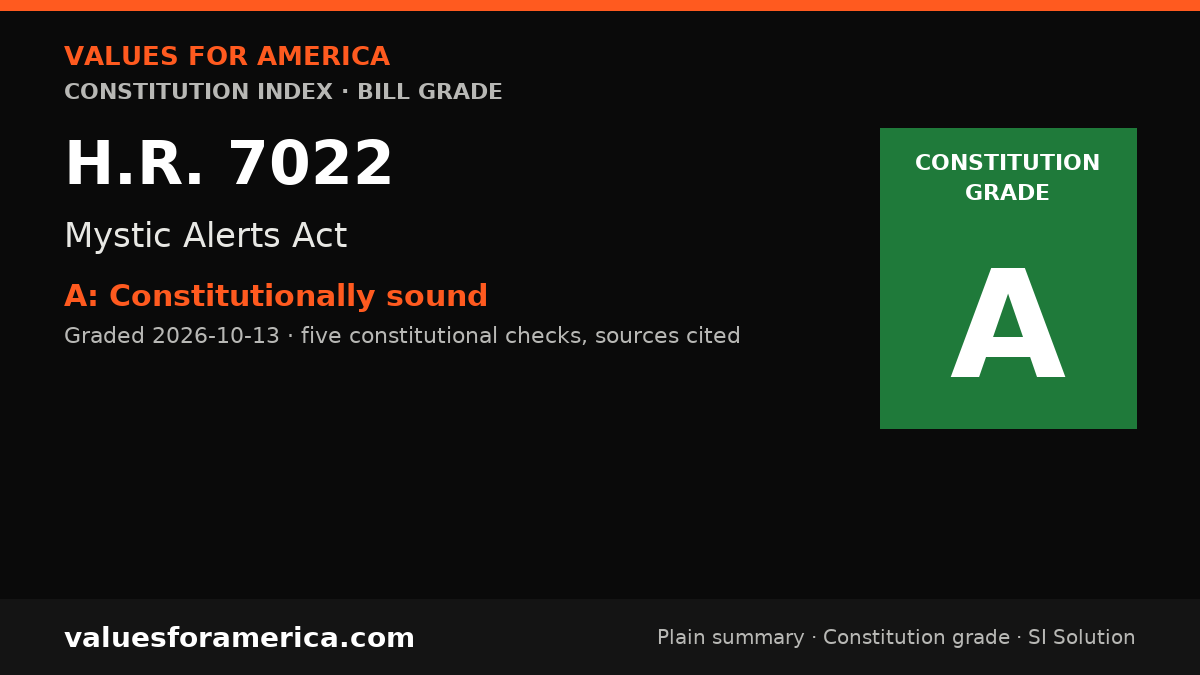
Mystic Alerts Act
Cosponsors: 4 (2 D, 2 R) · per Congress.gov, 2026-10-14
Introduced: 2026-01-12
Latest action (2026-10-15): Presented to President.
What H.R. 7022 does, in plain terms
Mystic Alerts Act This bill provides for wireless emergency alerts to be transmitted to mobile devices via satellite. (Currently, wireless emergency alerts are sent via terrestrial mobile networks to individual devices in geographically targeted areas. Commercial mobile service providers are not required to participate; only devices connected to a participating service provider’s network receive alerts.) Under the bill, commercial mobile service providers that participate in the wireless emergency alerts system must give notice to the Federal Communications Commission (FCC) indicating whether they will transmit such alerts via satellite (in addition to sending alerts via terrestrial networks). The FCC must establish technical standards and other regulations to enable satellite emergency alerts. Providers that opt to transmit emergency alerts via satellite must comply with such regulations. If a provider elects not to transmit satellite alerts, the provider must give notice of that election to new and existing subscribers. Separately, mobile service subscribers may opt out of receiving satellite alerts.
Official summary by the Congressional Research Service, via Congress.gov.
Constitution Index
“VFA Constitution grade”
Constitutionally sound
Graded 2026-10-13
SI-generated grade · five published checks · not individually reviewed by a person · methodology
The Mystic Alerts Act is a federal statute that expands the existing Wireless Emergency Alerts (WEA) system to include satellite transmission. It operates within Congress's enumerated power to regulate interstate and foreign commerce (Article I, Section 8, Clause 3) and to establish post offices and post roads (Article I, Section 8, Clause 7), as emergency alerts are a matter of national public safety and communications infrastructure. The bill does not infringe on any constitutional right: it does not compel participation by providers or subscribers, it respects individual choice by allowing subscribers to opt out, and it imposes only notice requirements on providers. The law is appropriately federal because emergency alerts must reach people across state lines and in remote areas, and a patchwork of state or local systems would be less effective. The bill does not take property, and it provides clear notice and procedural requirements for providers. Therefore, it passes all five checks and is fully constitutional.
-
✓ Passes · Enumerated powers
Congress has authority under the Commerce Clause (Article I, Section 8, Clause 3) to regulate wireless communications, which are inherently interstate. Additionally, the bill supports the federal interest in public safety and disaster response, which falls within the general welfare and commerce powers. The FCC's role in setting technical standards is a valid exercise of the federal government's a… -
✓ Passes · Bill of Rights
The bill does not restrict speech, religion, assembly, press, or petition. It does not infringe on the Second Amendment or any other enumerated right. The opt-out provision for subscribers respects individual autonomy and does not compel speech or association. The notice requirements for providers are commercial disclosure requirements, not compelled ideological speech, and are consistent with the… -
✓ Passes · Individual sovereignty
The bill does not restrict what individuals can do with their person, property, or speech. It actually enhances individual safety by providing emergency alerts. The opt-out provision ensures that individuals are not forced to receive satellite alerts if they do not want them. The burden on providers is minimal and justified by the compelling public interest in emergency communication. -
✓ Passes · Decentralization
The four-question test: (1) Individuals cannot effectively create a nationwide emergency alert system on their own. (2) Local communities cannot coordinate satellite alerts across jurisdictions. (3) States cannot ensure seamless alerts across state lines or in remote areas without federal coordination. (4) The bill does not consolidate decision-making upward beyond the minimum necessary; it sets n… -
✓ Passes · Due process and takings
The bill does not take property without just compensation. It imposes regulatory requirements on providers, but these are within the scope of the FCC's existing authority and are not arbitrary. Providers have notice of the requirements and can choose whether to participate. Subscribers have the right to opt out, ensuring no deprivation of service without consent. Procedural due process is satisfie…
Sources: Congress.gov: HR 7022 summary
Report an error in this grade
What should pass
“VFA SI Solution”
No solution yet
A sourced SI draft appears here once it passes automated checks (Constitution citation, source verification, independent SI critic). How publication works.
Related on VFA

For journalists and bloggers
“Embed this grade”
Free to use with the link back. The badge and card update when the grade changes. Embed terms →
