H.R. 702 explained · 119th Congress · Pending in Congress
Improving Federal Assistance to Families Act
Cosponsors: none · per Congress.gov, 2026-10-12
Introduced: 2025-01-23
Latest action (2025-01-23): Referred to the Committee on Oversight and Government Reform, and in addition to the Committee on Ways and Means, for a period to be subsequently determined by the Speaker, in each case for consideration of such provisions as fall within the jurisdiction of the committee concerned.
What H.R. 702 does, in plain terms
Improving Federal Assistance to Families Act This bill directs the Bureau of the Census to develop and publish a new regional poverty line index for each state, and requires the Department of Health and Human Services (HHS) to use the new index to determine eligibility for federal programs in certain circumstances. Specifically, the bureau must develop and publish a new poverty line index, to be known as the Regionally Adjusted Poverty Line, that is measured separately for each state on an annual basis. The Regionally Adjusted Poverty Line must use new poverty thresholds calculated based on the most recent poverty thresholds and each state’s most recent regional price parity. (Poverty thresholds are specified dollar amounts used by the bureau to determine a household’s poverty status. Regional price parities are measurements of the differences in price levels between states and the national average, and are published by the Bureau of Economic Analysis.) For each state, HHS must determine annually which poverty line index—the Regionally Adjusted Poverty Line or the current poverty line—results in a greater percentage of households falling below the poverty line. HHS must generally use the identified poverty line index for administrative purposes applicable to each state, including to determine residents’ financial eligibility for certain federal programs. Finally, the Government Accountability Office must study and report to Congress on the Asset Limited, Income Constrained, Employed threshold, an alternate poverty measure that includes consideration of regional costs of necessities like housing, child care, taxes, and transportation.
Official summary by the Congressional Research Service, via Congress.gov.
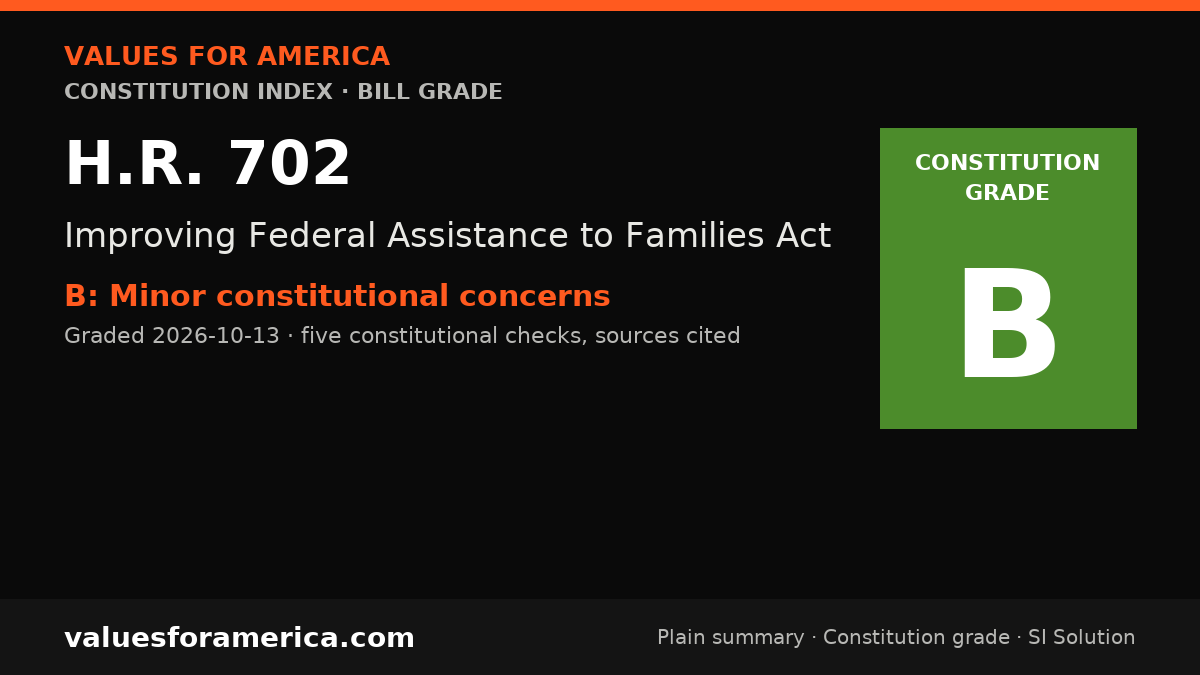
Constitution Index
“VFA Constitution grade”
Minor constitutional concerns
Graded 2026-10-13
SI-generated grade · five published checks · not individually reviewed by a person · methodology
The bill directs federal agencies to adjust poverty line calculations and use them for federal program eligibility, which falls within Congress's spending power and is a routine administrative matter. It does not infringe on individual rights, and while it centralizes data collection and eligibility determinations at the federal level, it does so within the scope of existing federal programs. The main constitutional tension is the federal role in defining poverty thresholds, which could be seen as an overreach into areas traditionally managed by states, but it does not rise to a direct violation.
-
✓ Passes · Enumerated powers
Congress has the power to spend for the general welfare under Article I, Section 8, Clause 1, and to make all laws necessary and proper for executing that power under Article I, Section 8, Clause 18. Directing the Census Bureau and HHS to calculate and use a new poverty index for federal programs is a valid exercise of the spending power, as it determines eligibility for federal benefits. The bill… -
✓ Passes · Bill of Rights
The bill does not implicate any of the first ten amendments. It does not restrict speech, religion, assembly, press, petition, arms, quartering, search and seizure, self-incrimination, due process, takings, trial rights, or cruel and unusual punishment. It merely adjusts statistical measures for federal benefit eligibility. -
✓ Passes · Individual sovereignty
The bill does not restrict individual liberty. It changes how poverty is measured for federal program eligibility, which may affect who qualifies for benefits, but it does not prohibit any action or compel any behavior. Individuals retain full sovereignty over their person, property, speech, labor, and belief. The change in eligibility criteria is a policy choice within the government's authority … -
✗ Concern · Decentralization
The bill centralizes poverty measurement and eligibility determination at the federal level, which fails the question of whether a state could handle this without federal involvement. States already administer many federal programs and could potentially adjust poverty thresholds themselves, but the bill mandates a uniform federal index. However, it does not consolidate decision-making beyond the f… -
✓ Passes · Due process and takings
The bill does not deprive any person of life, liberty, or property without due process. It does not take private property for public use without just compensation. It merely changes the formula for determining eligibility for federal benefits, which is a legislative policy decision. There is no arbitrary or capricious action; the bill requires the use of objective data (regional price parity) and …
Sources: Congress.gov: HR 702 summary
Report an error in this grade
What should pass
“VFA SI Solution”
No solution yet
A sourced SI draft appears here once it passes automated checks (Constitution citation, source verification, independent SI critic). How publication works.
Related on VFA

For journalists and bloggers
“Embed this grade”
Free to use with the link back. The badge and card update when the grade changes. Embed terms →
