H.R. 701 explained · 119th Congress · Pending in Congress
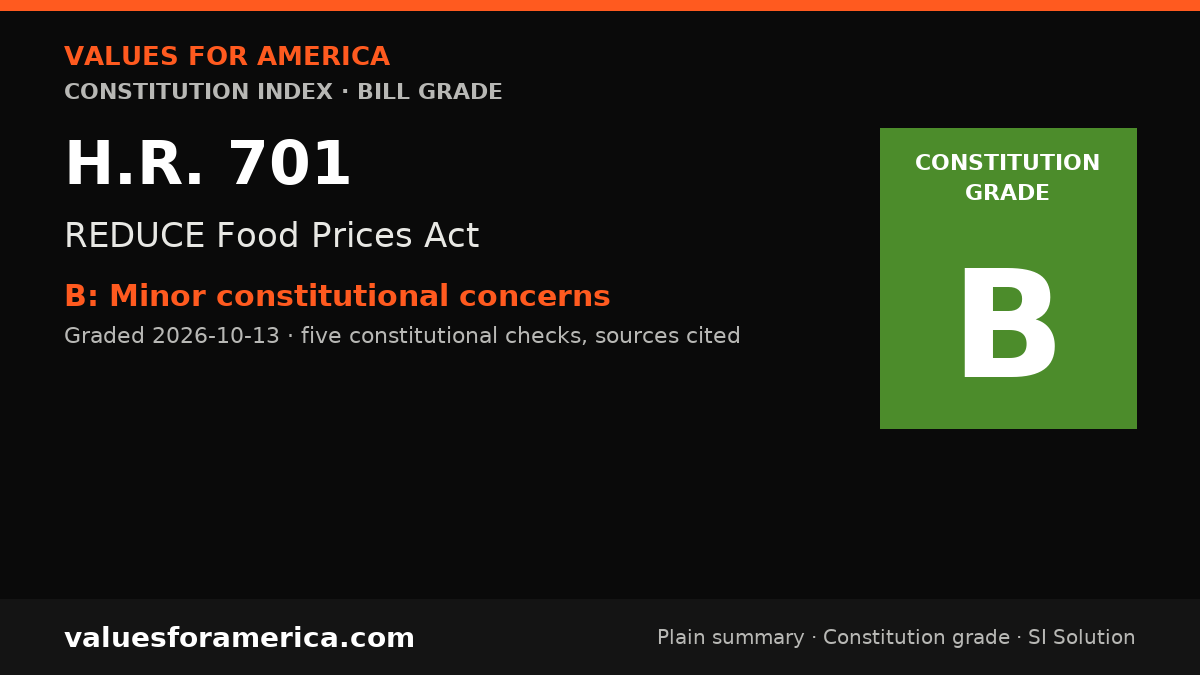
REDUCE Food Prices Act
Cosponsors: 2 (2 D, 0 R) · per Congress.gov, 2026-10-12
Introduced: 2025-01-23
Latest action (2025-01-23): Referred to the House Committee on Ways and Means.
What H.R. 701 does, in plain terms
Restoring Establishment Deductions and Uplifting Competition to Ease Food Prices Act or the REDUCE Food Prices Act This bill establishes a new tax credit for certain food retail businesses. The bill also increases bonus depreciation, the qualified business income (QBI) tax deduction, the rehabilitation tax credit (also known as the historic preservation tax credit), and the work opportunity tax credit (WOTC) for the businesses. The bill establishes a new tax credit (as part of the general business tax credit) in the amount of 15% of certain capital investments by a qualified small food retail business in the first three years of operation. The bill defines a qualified small food retail business as a private or closely-held company, a partnership, or a sole proprietorship (1) with annual average gross receipts of $200 million or less for the three tax years preceding the current tax year, (2) with at least 70% of its annual average gross receipts attributable to the retail sale of food or produce, and (3) located in a low-competition area. The bill also increases bonus depreciation percentages for certain property placed into service by a qualified small food retail business, the QBI tax deduction for qualified small food retail business, the rehabilitation tax credit for qualified rehabilitation expenses incurred by a qualified small food retail business, and the WOTC for wages paid by a qualified small food retail business to eligible workers.
Official summary by the Congressional Research Service, via Congress.gov.
Constitution Index
“VFA Constitution grade”
Minor constitutional concerns
Graded 2026-10-13
SI-generated grade · five published checks · not individually reviewed by a person · methodology
The bill uses Congress's broad taxing and spending powers to provide targeted tax incentives for small food retail businesses in low-competition areas. While it does not infringe on individual rights or consolidate power improperly, it does create a distinction between businesses based on size and location, which raises minor equal protection concerns. The bill is otherwise within federal authority and does not violate the Bill of Rights or due process.
-
✓ Passes · Enumerated powers
Congress has the power to lay and collect taxes and to provide for the general welfare under Article I, Section 8, Clause 1. Tax credits and deductions are a valid exercise of this power, as they are a form of tax expenditure. The bill's provisions are within the scope of Congress's taxing authority. -
✓ Passes · Bill of Rights
The bill does not restrict speech, religion, assembly, press, petition, the right to bear arms, or any other right protected by the Bill of Rights. It does not involve searches, seizures, self-incrimination, or cruel and unusual punishment. The tax incentives are voluntary and do not compel any action that would violate constitutional rights. -
✓ Passes · Individual sovereignty
The bill does not restrict individual liberty. It provides tax benefits to certain businesses, but does not mandate any behavior or infringe on personal autonomy. The burden of proof for any restriction is not triggered because there is no restriction. -
✓ Passes · Decentralization
The bill operates at the federal level, but it does not consolidate decision-making upward in a way that prevents states or localities from acting. States and localities can still regulate food retail businesses as they see fit. The federal tax code is a legitimate area for federal action, and the bill does not preempt state law or force states to comply. The questions: (1) Individuals and familie… -
✓ Passes · Due process and takings
The bill does not take property without just compensation. It provides tax benefits, which are not a deprivation of property. There is no procedural due process concern because the bill does not impose penalties or require hearings. The tax credits are available to qualifying businesses, and the criteria are objective and non-arbitrary.
Sources: Congress.gov: HR 701 summary
Report an error in this grade
What should pass
“VFA SI Solution”
No solution yet
A sourced SI draft appears here once it passes automated checks (Constitution citation, source verification, independent SI critic). How publication works.
Related on VFA

For journalists and bloggers
“Embed this grade”
Free to use with the link back. The badge and card update when the grade changes. Embed terms →
