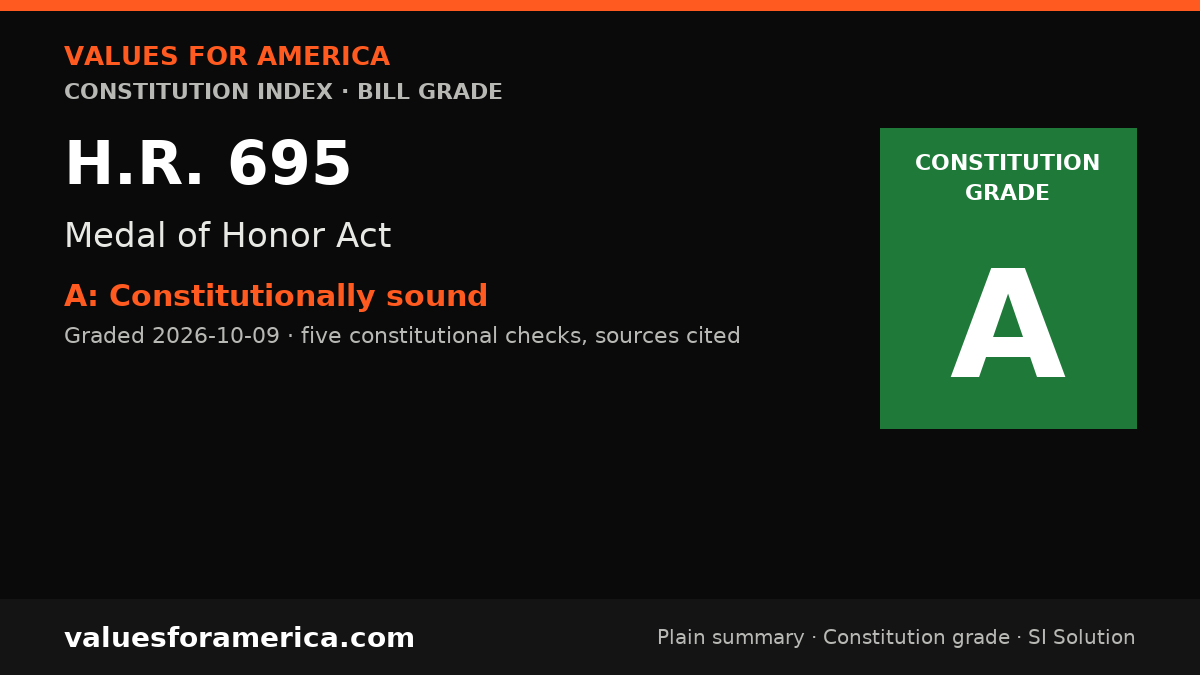
H.R. 695 explained · 119th Congress · Became law
Medal of Honor Act
Cosponsors: 4 (1 D, 3 R) · per Congress.gov, 2026-10-10
Introduced: 2025-01-23
Latest action (2025-12-01): Became Public Law No: 119-43.
What H.R. 695 does, in plain terms
Medal of Honor Act This act increases the monthly special pension for living Medal of Honor recipients. The act also prohibits the Department of Veterans Affairs from increasing the amount of the pension for inflation if the amount was already increased during such year. Additionally, the act extends a limitation on the pension paid to veterans who reside in Medicaid nursing homes and have no spouse or child. Currently, such pensions are limited to $90 per month through November 30, 2031. The act extends this limitation through January 31, 2033.
Official summary by the Congressional Research Service, via Congress.gov.
Constitution Index
“VFA Constitution grade”
Constitutionally sound
Graded 2026-10-09
SI-generated grade · five published checks · not individually reviewed by a person · methodology
The Medal of Honor Act is a straightforward exercise of Congress's enumerated powers under Article I, Section 8 to provide for the general welfare and to regulate military affairs. It adjusts pension benefits for Medal of Honor recipients and extends a limitation on certain nursing home pensions. It does not infringe any constitutional rights, restrict individual sovereignty, violate due process, or improperly centralize power. The law is fully constitutional.
-
✓ Passes · Enumerated powers
Congress has explicit authority under Article I, Section 8, Clause 1 (the Spending Clause) to tax and spend for the general welfare, and under Clause 14 to make rules for the land and naval forces. Veterans' pensions and benefits fall squarely within these powers. The law does not exceed any enumerated limit. -
✓ Passes · Bill of Rights
The law does not restrict speech, religion, press, assembly, petition, arms, quartering, search and seizure, self-incrimination, due process, takings, trial rights, jury rights, cruel and unusual punishment, or any other right protected by the first ten amendments. It merely adjusts benefit amounts and eligibility conditions. -
✓ Passes · Individual sovereignty
The law imposes no restriction on personal liberty, property, speech, labor, or belief. It provides a conditional benefit (pension) to a specific class of individuals. The government has a compelling interest in honoring military service and managing federal benefit programs. No individual sovereignty is infringed. -
✓ Passes · Decentralization
While the law operates at the federal level, veterans' benefits have historically been a federal responsibility due to the national character of military service and the need for uniform standards. An individual or family cannot independently provide a Medal of Honor pension; a local community or state could theoretically create a similar benefit, but the federal government's role is well-establis… -
✓ Passes · Due process and takings
The law does not deprive anyone of life, liberty, or property without due process. It adjusts prospective benefits; no existing property right is taken. The limitation on nursing home pensions applies to future eligibility and does not retroactively deprive anyone. There is no violation of the Fifth Amendment's Due Process or Takings Clauses.
Sources: Congress.gov: HR 695 summary
Report an error in this grade
What should pass
“VFA SI Solution”
No solution yet
A sourced SI draft appears here once it passes automated checks (Constitution citation, source verification, independent SI critic). How publication works.
Related on VFA

For journalists and bloggers
“Embed this grade”
Free to use with the link back. The badge and card update when the grade changes. Embed terms →
