H.R. 692 explained · 119th Congress · Pending in Congress
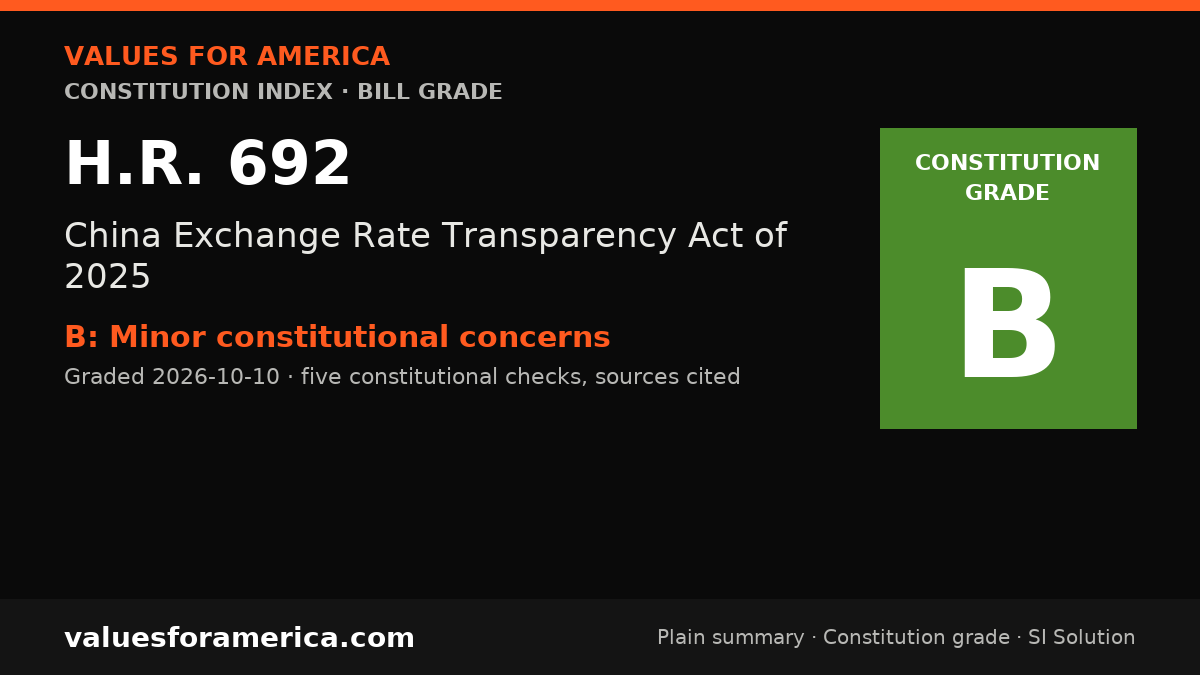
China Exchange Rate Transparency Act of 2025
Cosponsors: 10 (2 D, 8 R) · per Congress.gov, 2026-10-12
Introduced: 2025-01-23
Latest action (2025-02-11): Received in the Senate and Read twice and referred to the Committee on Foreign Relations.
What H.R. 692 does, in plain terms
China Exchange Rate Transparency Act of 2023 This bill requires the U.S. Executive Director at the International Monetary Fund (IMF) to use the voice and vote of the United States to advocate for increased exchange rate transparency from China. Some areas of focus for this advocacy are (1) Chinese exchange rate arrangements, including any indirect foreign exchange market intervention through Chinese financial institutions or state-owned enterprises; (2) enhanced multilateral and bilateral surveillance by the IMF; and (3) stronger consideration of China's performance as a responsible stakeholder in the international monetary system when evaluating quota and voting shares at the IMF. The requirements of the bill expire seven years and 30 days after the date of the bill's enactment or earlier if China meets certain conditions regarding its exchange rate policies.
Official summary by the Congressional Research Service, via Congress.gov.
Constitution Index
“VFA Constitution grade”
Minor constitutional concerns
Graded 2026-10-10
SI-generated grade · five published checks · not individually reviewed by a person · methodology
The bill directs U.S. conduct within an international financial institution, which falls within the federal government's foreign affairs and treaty powers. It does not directly regulate domestic conduct or restrict individual rights. The main constitutional tension is the potential for the bill to pressure China's exchange rate policies, which could be seen as an overreach into matters traditionally left to international negotiation and the executive's foreign affairs discretion, but it does not violate any explicit constitutional provision.
-
✓ Passes · Enumerated powers
The federal government has broad authority over foreign affairs and international monetary policy. Article I, Section 8, Clause 3 grants Congress the power to regulate commerce with foreign nations, and the President's treaty and executive powers (Article II, Section 2) support U.S. participation in international financial institutions. Directing the U.S. Executive Director at the IMF is a valid e… -
✓ Passes · Bill of Rights
The bill does not infringe on any of the first ten amendments. It does not restrict speech, religion, assembly, press, petition, arms, quartering, search and seizure, self-incrimination, due process, takings, fair trial, jury, cruel and unusual punishment, or unenumerated rights. It is a foreign policy directive, not a domestic regulation. -
✓ Passes · Individual sovereignty
The bill does not restrict the actions of individuals. It directs the U.S. Executive Director at the IMF to advocate for certain policies. It does not impose any direct restrictions on personal liberty, property, speech, labor, or belief. The burden of justification is not triggered because there is no restriction on individual sovereignty. -
✗ Concern · Decentralization
This is a federal action in the realm of foreign affairs, which is inherently a national responsibility. The four-question test is not applicable in the same way as for domestic policy, but the action does consolidate decision-making at the federal level. However, foreign exchange rate policy and international monetary affairs cannot be handled by individuals, local communities, or states, and the… -
✓ Passes · Due process and takings
The bill does not deprive any person of life, liberty, or property without due process, nor does it take private property for public use without just compensation. It is a directive to a U.S. official in an international context, with no domestic legal effect on individuals or entities.
Sources: Congress.gov: HR 692 summary
Report an error in this grade
What should pass
“VFA SI Solution”
No solution yet
A sourced SI draft appears here once it passes automated checks (Constitution citation, source verification, independent SI critic). How publication works.
Related on VFA

For journalists and bloggers
“Embed this grade”
Free to use with the link back. The badge and card update when the grade changes. Embed terms →
