H.R. 670 explained · 119th Congress · Pending in Congress
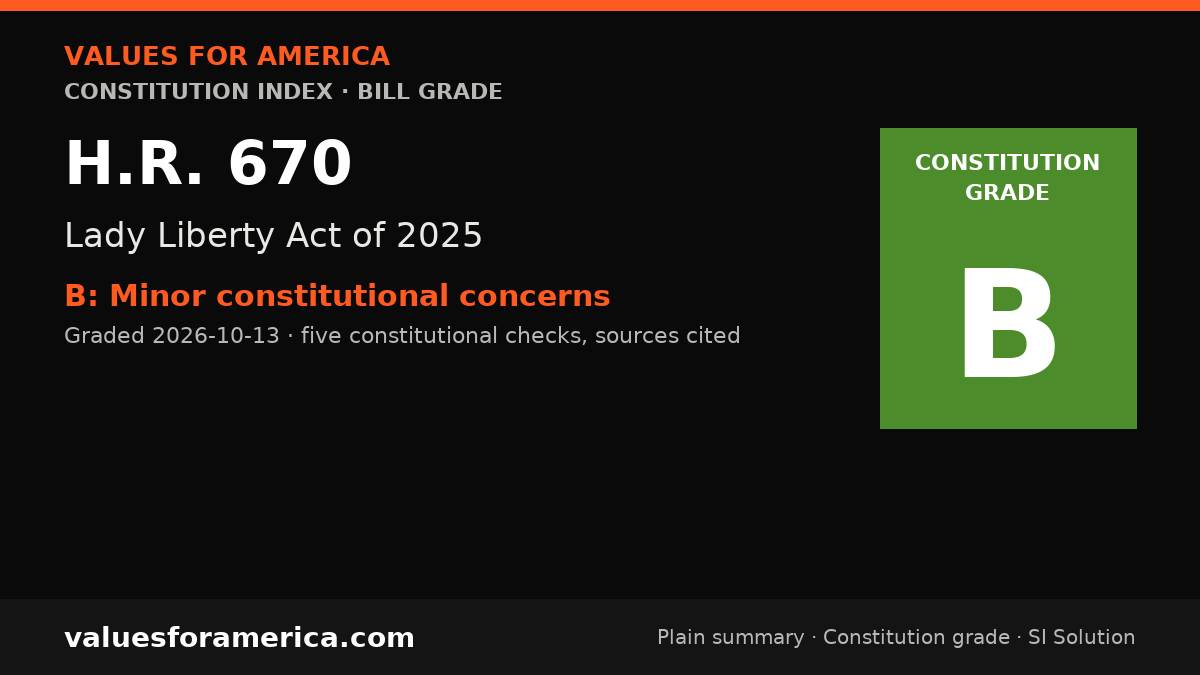
Lady Liberty Act of 2025
Cosponsors: 12 (12 D, 0 R) · per Congress.gov, 2026-10-10
Introduced: 2025-01-23
Latest action (2026-01-08): ASSUMING FIRST SPONSORSHIP - Mr. Walkinshaw asked unanimous consent that he may hereafter be considered as the first sponsor of H.R. 670, a bill originally introduced by Representative Connolly, for the purpose of adding cosponsors and requesting reprintings pursuant to clause 7 of rule XII. Agreed to without objection.
What H.R. 670 does, in plain terms
Lady Liberty Act of 2025 This bill sets a floor of 125,000 for the maximum number of refugees who may be admitted into the United States each fiscal year beginning in FY2027. Under current law, the President sets the annual cap on refugee admissions at the beginning of each fiscal year.
Official summary by the Congressional Research Service, via Congress.gov.
Constitution Index
“VFA Constitution grade”
Minor constitutional concerns
Graded 2026-10-13
SI-generated grade · five published checks · not individually reviewed by a person · methodology
The bill is a federal statutory change to refugee admissions, which falls within Congress's enumerated power over immigration and naturalization. It does not infringe on individual rights, and it does not consolidate power upward beyond what is necessary for a uniform national immigration policy. The primary constitutional tension is that it restricts the President's discretionary authority over refugee admissions, which may raise separation of powers concerns, but it does not clearly violate the Constitution.
-
✓ Passes · Enumerated powers
Congress has explicit authority over immigration and naturalization under Article I, Section 8, Clause 4. Setting a statutory floor for refugee admissions is a direct exercise of this power. The bill does not exceed this authority. -
✓ Passes · Bill of Rights
The bill does not implicate any of the first ten amendments. It does not restrict speech, religion, assembly, press, petition, arms, quartering, search and seizure, self-incrimination, due process, takings, fair trial, jury, cruel and unusual punishment, unenumerated rights, or reserved powers. It concerns the admission of refugees, which is a matter of immigration policy, not a rights issue. -
✓ Passes · Individual sovereignty
The bill does not restrict the rights of individuals already in the United States. It sets a minimum number of refugees who may be admitted, which does not restrict anyone's person, property, speech, labor, or belief. The government has a compelling interest in controlling immigration, and this bill does not infringe on individual sovereignty. -
✓ Passes · Decentralization
Immigration and refugee admissions are inherently national matters requiring uniform federal policy. An individual, local community, or state cannot effectively handle refugee admissions without federal involvement. The bill does not consolidate decision-making upward beyond the minimum necessary; it sets a statutory floor, which is a federal function. The Tenth Amendment is not violated because t… -
✓ Passes · Due process and takings
The bill does not bypass due process or take property. It does not affect the rights of any person in a way that would require procedural or substantive due process. It does not involve any taking of property. The only potential issue is that it limits the President's discretion, but this is a statutory change, not a due process violation.
Sources: Congress.gov: HR 670 summary
Report an error in this grade
What should pass
“VFA SI Solution”
No solution yet
A sourced SI draft appears here once it passes automated checks (Constitution citation, source verification, independent SI critic). How publication works.
Related on VFA

For journalists and bloggers
“Embed this grade”
Free to use with the link back. The badge and card update when the grade changes. Embed terms →
