H.R. 6500 explained · 119th Congress · Became law
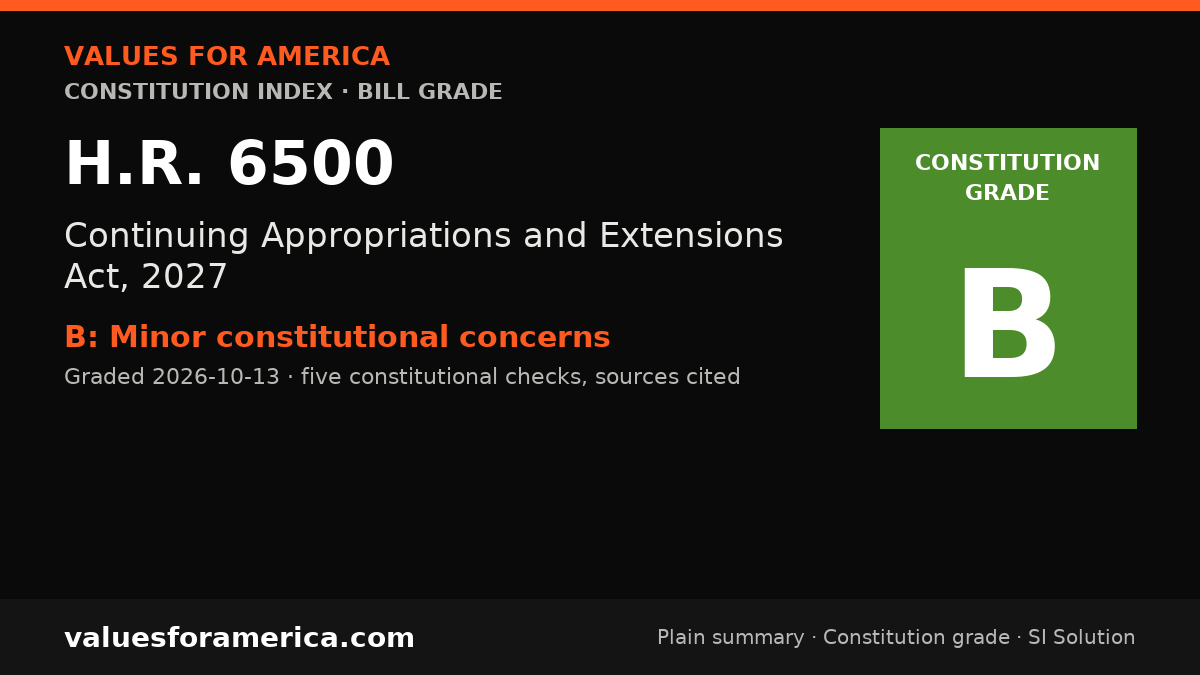
Continuing Appropriations and Extensions Act, 2027
Cosponsors: 1 (0 D, 1 R) · per Congress.gov, 2026-10-14
Introduced: 2025-12-09
Latest action (2026-09-02): Became Public Law No: 119-103.
What H.R. 6500 does, in plain terms
Continuing Appropriations and Extensions Act, 2027 This act provides continuing FY2027 appropriations for federal agencies through December 11, 2026, and extends various expiring programs and authorities. DIVISION A--CONTINUING APPROPRIATIONS ACT, 2027 Continuing Appropriations Act, 2027 This division provides continuing FY2027 appropriations to federal agencies through the earlier of December 11, 2026, or the enactment of the applicable appropriations act. It is known as a continuing resolution (CR) and prevents a government shutdown that would otherwise occur if the FY2027 appropriations bills have not been enacted when FY2027 begins on October 1, 2026. The CR funds most programs and activities at the FY2026 levels with several exceptions that provide funding flexibility or additional appropriations for various programs. For example, the CR includes exceptions for the Special Supplemental Nutrition Program for Women, Infants, and Children (WIC); Small Business Administration loans; the Disaster Relief Fund; the Indian Health Service; the Department of Justice; and wildfire suppression activities. For more information on this division, see CRS Report R49353, Overview of Continuing Appropriations for FY2027 (Division A of P.L. 119-103). DIVISION B--AUTHORIZING EXTENSIONS This division extends various expiring programs and authorities, including certain programs related to agriculture and foreign trade. (Sec. 2001) This section reauthorizes the United States Grain Standards Act, which authorizes the Department of Agriculture to establish official marketing standards for grains. Specifically, this section extends the authority of the Federal Grain Inspection Service (FGIS) through December 11, 2026, to (1) collect fees for required federal supervision of official inspections and weighing services provided by designated official agencies and state agencies, and (2) maintain the Grain Inspection Advisory Committee. The section also extends through FY2027 (1) the cap on FGIS's administrative and supervisory costs, and (2) authorization for FGIS grain standards development and maintenance activities. (Sec. 2002) This section extends the authority for the Forest Service to use the Agriculture Conservation Experienced Services (ACES) program through December 11, 2026. The program allows the Forest Service to acquire skilled personnel (age 55 and older) from nonprofit partners to provide temporary technical and administrative services for conservation-related programs that are executed on or directly impacting National Forest System land. (Sec. 2003) This section extends through December 11, 2026, the authority for entering into agreements to finance sales or provide other assistance through the Food for Peace program. (Sec. 2004) This section extends certain authorities under the Defense Production Act of 1950 through December 11, 2026. (Sec. 2005) This section extends through December 11, 2026, the authority of the Environmental Protection Agency to collect user fees under the Toxic Substances Control Act. (Sec. 2006) This section increases Medicaid funding for FY2026 for the Northern Mariana Islands. (Sec. 2007) This section reduces funding for the Medicare Improvement Fund beginning in FY2027. (Sec. 2008) This section extends through December 31, 2028, trade preferences that provide duty-free access to the U.S. market for most exports from eligible countries in sub-Saharan Africa (SSA). Specifically, the section extends through 2028 the duty-free treatment of the products of beneficiary SSA countries under the Trade Act of 1974 (specifically, the Generalized System of Preferences) and the African Growth and Opportunity Act (AGOA). (Currently, there are 32 countries eligible for AGOA.) Additionally, the extended period applies to the following provisions of AGOA: (1) the duty-free treatment of certain apparel articles from beneficiary SSA countries; and (2) the third-country fabric provision, which allows limited amounts of apparel articles from lesser developed beneficiary SSA countries to qualify for duty-free treatment, even if the yarns and fabrics used in their production are imported from non-AGOA countries (e.g., apparel assembled in Kenya with Chinese fabrics). (Sec. 2009) This section extends through December 31, 2028, the special duty-free rules for various apparel products imported from Haiti. (Sec. 2010) This section extends various customs user fees through March 31, 2032, including certain rates for merchandise processing fees. (Sec. 2011) This section extends the authorization for the Cybersecurity Information Sharing Act through December 11, 2026. The act authorizes sharing of appropriate cybersecurity information between federal and nonfederal entities, defensive cybersecurity activities, liability protections, and oversight. (Sec. 2012) This section extends the authority for the Department of Homeland Security's (DHS’s) National Cybersecurity Protection System and related reporting requirements through December 11, 2026. The system authorizes multiple activities by DHS to help defend federal agencies from cyberthreats. (Sec. 2013) This section extends the authority for DHS's Joint Task Forces through December 11, 2026. (Sec. 2014) This section extends through December 11, 2026, the Technology Modernization Fund and the fund's board. The fund is administered by the General Services Administration to improve information technology and enhance cybersecurity across the federal government. (Sec. 2015) This section extends the authority of the U.S. Patent and Trademark Office to set fees through December 11, 2026. (Sec. 2016) This section extends the U.S. Commission on International Religious Freedom through December 11, 2026. The commission is an independent federal commission tasked with monitoring international religious freedom conditions, reviewing U.S. government policy, and making policy recommendations. (Sec. 2017) This section extends through December 11, 2026, the authority of the Department of State to collect passport fees under the Western Hemisphere Travel Initiative. (Sec. 2018) This section exempts the budgetary effects of Divisions B-D of this act from (1) the Statutory Pay-As-You-Go (PAYGO) Act of 2010, (2) the Senate PAYGO rule, and (3) certain budget scorekeeping rules. (Sec. 2019) This section delays the effective date of portions of the new statutory definition of hemp until December 11, 2026. For more information, see CRS In Focus IF13136, Changes to the Statutory Definition of Hemp and Implications for Agricultural Policy. DIVISION C--SURFACE TRANSPORTATION EXTENSION ACT OF 2026 Surface Transportation Extension Act of 2026 This division extends various expiring surface transportation programs and authorities. TITLE I--SURFACE TRANSPORTATION PROGRAMS (Sec. 3101) This section extends federal highway, transit, and road safety programs of the Department of Transportation through December 11, 2026. (Sec. 3102) This section reauthorizes until December 11, 2026, the Appalachian Regional Commission, including the high-speed broadband deployment and energy hub initiatives. (Sec. 3103) This section reauthorizes until December 11, 2026, the Sport Fish Restoration Program. (Sec. 3104) This section extends until September 30, 2027, the deadline to use previously authorized federal highway funds for certain Federal Highway Administration programs, including the Bridge Investment Program; Congestion Relief Program; Charging and Fueling Infrastructure Discretionary Grant Program; Rural Surface Transportation Grant Program; Promoting Resilient Operations for Transformative, Efficient, and Cost-saving Transportation Program (PROTECT) grants; Reduction of Truck Emissions at Port Facilities Program; and Nationally Significant Federal Lands and Tribal Projects program. TITLE II--TRUST FUNDS (Sec. 3201) This section extends expenditure authority through December 11, 2026, for the Highway Trust Fund, Sport Fish Restoration and Boating Trust Fund, and Leaking Underground Storage Tank Trust Fund. DIVISION D--DEPARTMENT OF VETERANS AFFAIRS EXTENDERS This division extends various expiring Department of Veterans Affairs (VA) programs and authorities. TITLE I--HEALTH CARE MATTERS (Sec. 4101) This section extends through December 10, 2026, the authority for the VA to collect copayments from certain veterans for hospital care or nursing home care. (Sec. 4102) This section extends through December 11, 2026, the requirement that the VA provide nursing home care to certain veterans with a service-connected disability. (Sec. 4103) This section extends through December 11, 2026, the authorization for the expansion of the VA’s Rural Access Network for Growth Enhancement (RANGE) program, which serves veterans in rural areas who are experiencing mental illness. (Sec. 4104) This section extends through December 11, 2026, the VA’s authority to provide grants under the Staff Sergeant Parker Gordon Fox Suicide Prevention Grant Program, for purposes of providing community-based suicide prevention services and mental health care. (Sec. 4105) This section extends through December 11, 2026, the VA grant program to provide mental health support for family caregivers of veterans who participate in the VA’s Program of Comprehensive Assistance for Family Caregivers. (Sec. 4106) This section extends through December 11, 2026, the requirement that the VA pay or reimburse certain veterans with a service-connected disability for ambulance transport from a rural area. (Sec. 4107) This section extends through December 11, 2026, the joint incentive program between the VA and Department of Defense to share health care resources. TITLE II--BENEFITS (Sec. 4201) This section extends through December 11, 2026, the authority of the VA to maintain a regional office in the Philippines. (Sec. 4202) This section extends through December 11, 2026, the period of relief for those affected by a closure or disapproval of a course of education in regard to the individual’s educational assistance entitlement. Generally, when an individual transfers fewer than 12 credits from a program of education that is closed or disapproved, the individual is deemed to have not received those credits, and no charge from the individual's entitlement to education assistance may be made for that period of enrollment. This section extends the relief through December 11, 2026. TITLE III--HOUSING (Sec. 4301) This section extends through December 11, 2026, a Department of Labor grant program for programs and facilities that provide dedicated services for homeless women veterans and homeless veterans with children. (Sec. 4302) This section extends through December 11, 2026, the VA's Health Care for Homeless Veterans program, which provides outreach, treatment, rehabilitation, and therapeutic transitional housing assistance for seriously mentally ill and homeless veterans. Additionally, the section extends the authority of the VA to operate a program to expand and improve the provision of benefits and services to homeless veterans. (Sec. 4303) This section extends through December 11, 2026, the VA’s authority to provide housing assistance to homeless veterans and their families. (Sec. 4304) This section extends through December 11, 2026, the Supportive Services for Veterans Families program, which provides financial assistance for supportive services for very low-income veteran families in permanent housing or transitioning from homelessness. (Sec. 4305) This section extends through December 11, 2026, the VA program to provide grants to encourage the development of programs for homeless veterans with special needs. (Sec. 4306) This section extends through December 11, 2026, the authority and activities of the VA’s Advisory Committee on Homeless Veterans. (Sec. 4307) This section extends through December 11, 2026, the VA’s authority to provide assistance for hous
Official summary by the Congressional Research Service, via Congress.gov.
Constitution Index
“VFA Constitution grade”
Minor constitutional concerns
Graded 2026-10-13
SI-generated grade · five published checks · not individually reviewed by a person · methodology
This continuing resolution is mostly constitutional. It funds existing federal programs at prior levels, which falls within Congress's enumerated power to appropriate funds (Article I, Section 9, Clause 7). It does not infringe on any Bill of Rights protections, restrict individual sovereignty, or violate due process. However, it receives a B rather than an A because it extends several federal programs and authorities that may exceed the minimum necessary level of decentralization, particularly in areas like agriculture, housing, and cybersecurity where state or local action could suffice. The consolidation of decision-making at the federal level for these extensions is a minor constitutional tension.
-
✓ Passes · Enumerated powers
Congress has explicit constitutional authority to appropriate funds under Article I, Section 9, Clause 7 ('No Money shall be drawn from the Treasury, but in Consequence of Appropriations made by Law'). This bill is a continuing resolution that funds existing federal agencies and programs at prior levels, which is a core legislative function. The extensions of expiring authorities also fall within … -
✓ Passes · Bill of Rights
The bill does not restrict speech, religion, assembly, press, petition, arms, quartering, search and seizure, self-incrimination, due process, takings, fair trial, jury, cruel and unusual punishment, or any other right protected by the first ten amendments. It is a funding and extension measure that affects government operations, not individual rights. No infringement of the Bill of Rights is pres… -
✓ Passes · Individual sovereignty
The bill does not restrict what individuals can do with their own person, property, speech, labor, or belief. It funds government programs and extends existing authorities, but imposes no new mandates, prohibitions, or restrictions on individual conduct. The burden on the government to justify any restriction is not triggered because no restriction exists. Individual sovereignty remains fully inta… -
✗ Concern · Decentralization
While the core funding function of a CR is necessary to prevent a government shutdown and is properly federal, the bill extends numerous federal programs and authorities in areas such as agriculture, housing, cybersecurity, and surface transportation. These extensions consolidate decision-making at the federal level when, in many cases, states or localities could handle these matters. For example,… -
✓ Passes · Due process and takings
The bill does not bypass due process, presume guilt, or take property without just compensation. It provides continuing appropriations and extends programs, which involves no adjudicative or enforcement actions against individuals. The freeze on cost-of-living adjustments for Members of Congress and limits on pay increases for certain officials are legislative decisions that do not implicate due p…
Sources: Congress.gov: HR 6500 summary
Report an error in this grade
The Framers
“Founders’ Verdict”
Confidence 0.85
Archived SI output (machine-generated)No editorial review recorded. This historical SI verdict was machine-generated by software and predates the review desk; check it against the official bill text.
Synthesis
The bill is constitutional as a proper exercise of Congress's power to regulate foreign commerce and to lay and collect duties, provided that the refund provision is applied uniformly and without creating factional preferences, as Madison cautioned.
This bill stands firmly within the constitutional authority of Congress to regulate commerce with foreign nations and to lay and collect duties on imports. The extension of preferential trade treatment for sub-Saharan African nations is a proper exercise of the power to regulate foreign commerce, as it directly serves the national interest in securing beneficial commercial relationships and expanding markets for American enterprise. The accompanying customs user fees are a legitimate exercise of the taxing power, and the refund provision is a procedural matter entirely within Congress's discre…
The Constitution vests in Congress the power to regulate commerce with foreign nations, and this bill is a proper exercise of that delegated authority. The extension of trade preferences to sub-Saharan African countries, including duty-free treatment and customs fee adjustments, falls squarely within the realm of foreign commerce. The retroactive refund provision, while unusual, is a matter of fiscal discretion that Congress may exercise under its powers to lay and collect taxes and to regulate commerce. I find no encroachment upon the rights reserved to the states or to the people, as the Ten…
The extension of trade preferences and customs fees falls within the Congress's power under the Commerce Clause (Article I, Section 8, Clause 3) to regulate foreign commerce. However, the retroactive refund of duties raises concerns under the uniformity requirement for duties and the prohibition on bills of attainder or ex post facto laws. The refund provision must be carefully tailored to avoid arbitrary or discriminatory treatment, as it could create a factional advantage for certain importers, contrary to the principles of Federalist No. 10. Additionally, the extension of customs user fees …
This bill falls squarely within the power of Congress to regulate commerce with foreign nations, as vested by Article I, Section 8, Clause 3. The extension of duty-free treatment to imports from sub-Saharan African nations is a regulation of foreign commerce, precisely the kind of measure that the Constitution entrusts to the legislative branch. Moreover, the provision for refunds of duties is an exercise of the taxing power, which likewise reposes in Congress. As this Court held in Gibbons v. Ogden, the power over commerce is plenary and may be exercised to its utmost extent, acknowledging no…
Report an error in this Founders' Verdict
What should pass
“VFA SI Solution”
Archived SI output (machine-generated) · No editorial review recorded
This historical draft has no editorial review time on record. Check its claims against the original bill and current law.
Sub-Saharan Africa Trade Preference Extension and User Fee Stability Act of 2027
Generated by VFA SI Solutions
Extend duty-free trade preferences for eligible sub-Saharan African countries under AGOA and the Generalized System of Preferences through 2028, extend customs user fees through 2031, and provide retroactive duty refunds for qualifying imports that entered after the previous expiration.
Bipartisan rationale: Honors Democratic priorities: supports economic development in sub-Saharan Africa, preserves labor and human rights eligibility conditions, and adds GAO oversight to ensure program effectiveness and accountability. Honors Republican priorities: no new spending (refunds paid from existing fee collections), sunset provisions to prevent permanent programs, and user fee extension to maintain customs operations without general fund reliance.
Article I, Section 8, Clause 3 Article I, Section 8, Clause 1 Article I, Section 8, Clause 18 Amendment X
Report an error in this Solution
Citizen Consensus
“Do you support this VFA SI Solution?”
One vote per verified account; you can change it any time. Only verified accounts count, results publish once 30 verified people have voted, and state and district results count only people who attested a home ZIP code. How this works.
Email verification is not switched on yet, so no vote counts toward results yet. Votes cast now are saved and count once the voter verifies their email address.
Sign in or create a free account to vote.
Add a short reason (optional)
/280 · no links or contact details · reasons are reviewed before anyone sees them, and many never are shown.
Your vote is saved but held out of published results by an automated integrity check (for example, several accounts voting from one browser).
Your vote is saved. It will count once you verify your email address. Verify on your account page.
Your vote counts nationally. Add your home ZIP code to count in your state and district too.
Your vote counts nationally and in .
Reason saved privately; it is shown only if it passes review.
Verified participants nationwide · n =
Self-selected participants, not a random sample; ± is the 95% sampling margin.
Not enough verified votes yet. Results publish at verified votes.
A sudden surge of votes on this item was flagged and is under review; votes from new accounts in that surge are held out until it is resolved.
Related on VFA

For journalists and bloggers
“Embed this grade”
Free to use with the link back. The badge and card update when the grade changes. Embed terms →
