H.R. 6494 explained · 119th Congress · Pending in Congress
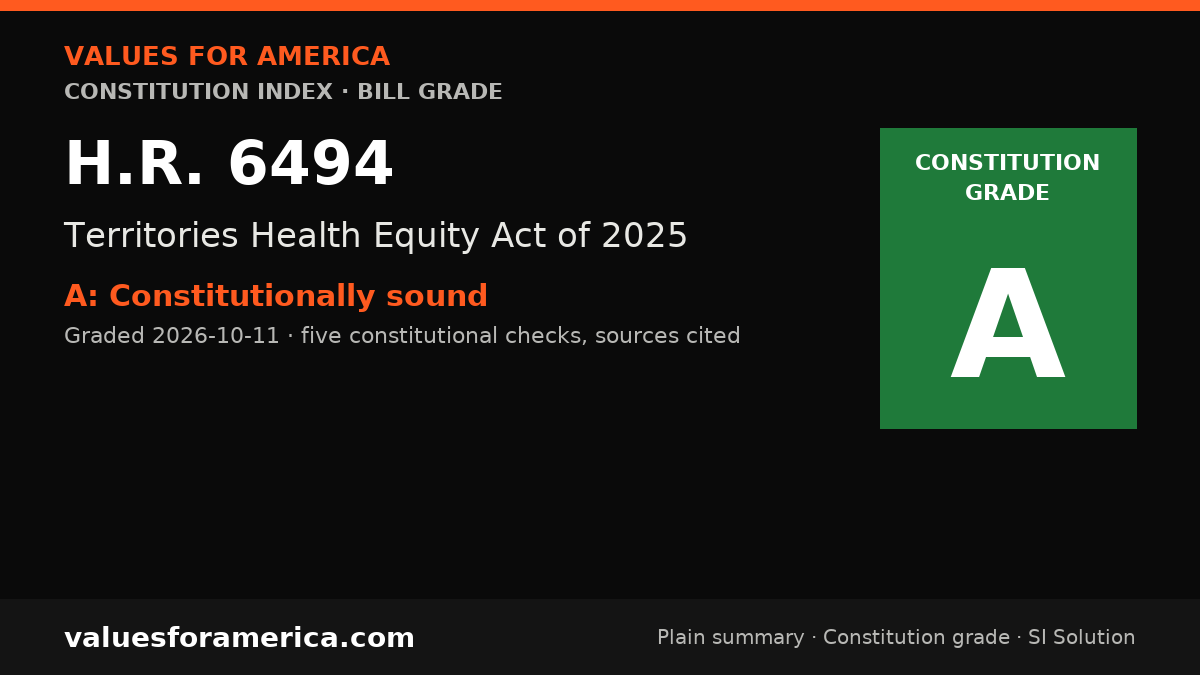
Territories Health Equity Act of 2025
Cosponsors: 4 (1 D, 3 R) · per Congress.gov, 2026-10-10
Introduced: 2025-12-05
Latest action (2025-12-05): Referred to the Committee on Energy and Commerce, and in addition to the Committee on Ways and Means, for a period to be subsequently determined by the Speaker, in each case for consideration of such provisions as fall within the jurisdiction of the committee concerned.
What H.R. 6494 does, in plain terms
Territories Health Equity Act of 2025 This bill alters provisions relating to the treatment of U.S. territories under Medicaid, Medicare, and Medicare Advantage. For example, the bill eliminates Medicaid funding limitations for U.S. territories beginning in FY2026, exempts an individual from late-enrollment penalties for Medicare medical services if the individual resided in Puerto Rico as of the date of eligibility and the individual enrolls within five years of such date, and establishes minimum criteria for certain elements used in Medicare Advantage payment calculations for areas within U.S. territories. The bill also allows residents of U.S. territories who are unable to obtain health insurance through their employer or a health insurance exchange to instead obtain coverage that is at least as broad as the coverage available to Members of Congress and their staff through the District of Columbia exchange.
Official summary by the Congressional Research Service, via Congress.gov.
Constitution Index
“VFA Constitution grade”
Constitutionally sound
Graded 2026-10-11
SI-generated grade · five published checks · not individually reviewed by a person · methodology
The Territories Health Equity Act of 2025 is a federal statute that operates within Congress's enumerated spending powers under Article I, Section 8, Clause 1 (the General Welfare Clause) and the territorial clause of Article IV, Section 3, Clause 2. It does not infringe upon any enumerated rights, does not restrict individual sovereignty, appropriately decentralizes by leaving program administration to states and territories, and does not implicate due process or takings concerns. The bill is fully constitutional.
-
✓ Passes · Enumerated powers
Congress has broad authority to spend for the general welfare and to make rules for U.S. territories. Article I, Section 8, Clause 1 grants Congress the power to lay and collect taxes to provide for the general welfare, which includes funding health programs like Medicaid and Medicare. Article IV, Section 3, Clause 2 gives Congress plenary power over U.S. territories, including Puerto Rico. The bi… -
✓ Passes · Bill of Rights
The bill does not implicate any of the first ten amendments. It expands access to health coverage and does not restrict speech, religion, assembly, press, petition, the right to bear arms, quartering of soldiers, search and seizure, self-incrimination, due process, trial rights, jury rights, or cruel and unusual punishment. It does not infringe upon any enumerated right. -
✓ Passes · Individual sovereignty
The bill does not restrict individual liberty. Instead, it expands individual choice by providing additional health insurance options for residents of U.S. territories. It removes barriers to enrollment and funding, thereby enhancing individuals' ability to obtain health care. There is no restriction on personal autonomy, property, speech, labor, or belief. -
✓ Passes · Decentralization
The bill does not consolidate decision-making at a higher level than necessary. It operates within the existing federal-state-territorial framework for health programs. It removes federal funding caps, allowing territories to have more resources, but does not centralize administration. It also provides an alternative for individuals who cannot obtain coverage through employer or exchange, which is… -
✓ Passes · Due process and takings
The bill does not deprive any person of life, liberty, or property without due process. It does not take private property for public use without just compensation. It does not impose penalties or burdens without notice or hearing. The provisions regarding late-enrollment penalties are actually lenient, exempting certain individuals from penalties, which is not a deprivation but a benefit.
Sources: Congress.gov: HR 6494 summary
Report an error in this grade
What should pass
“VFA SI Solution”
No solution yet
A sourced SI draft appears here once it passes automated checks (Constitution citation, source verification, independent SI critic). How publication works.
Related on VFA

For journalists and bloggers
“Embed this grade”
Free to use with the link back. The badge and card update when the grade changes. Embed terms →
